On Piazza Torquato Tasso, Sorrento's central square where the town converges each evening, Fauno Bar occupies one of the Amalfi Coast hinterland's most observed terraces. The setting positions it at the intersection of aperitivo tradition and tourist-route spectacle, making it a useful reference point for understanding how Southern Italy's bar culture translates when placed in one of the region's most trafficked locations.
 Discover on Pearl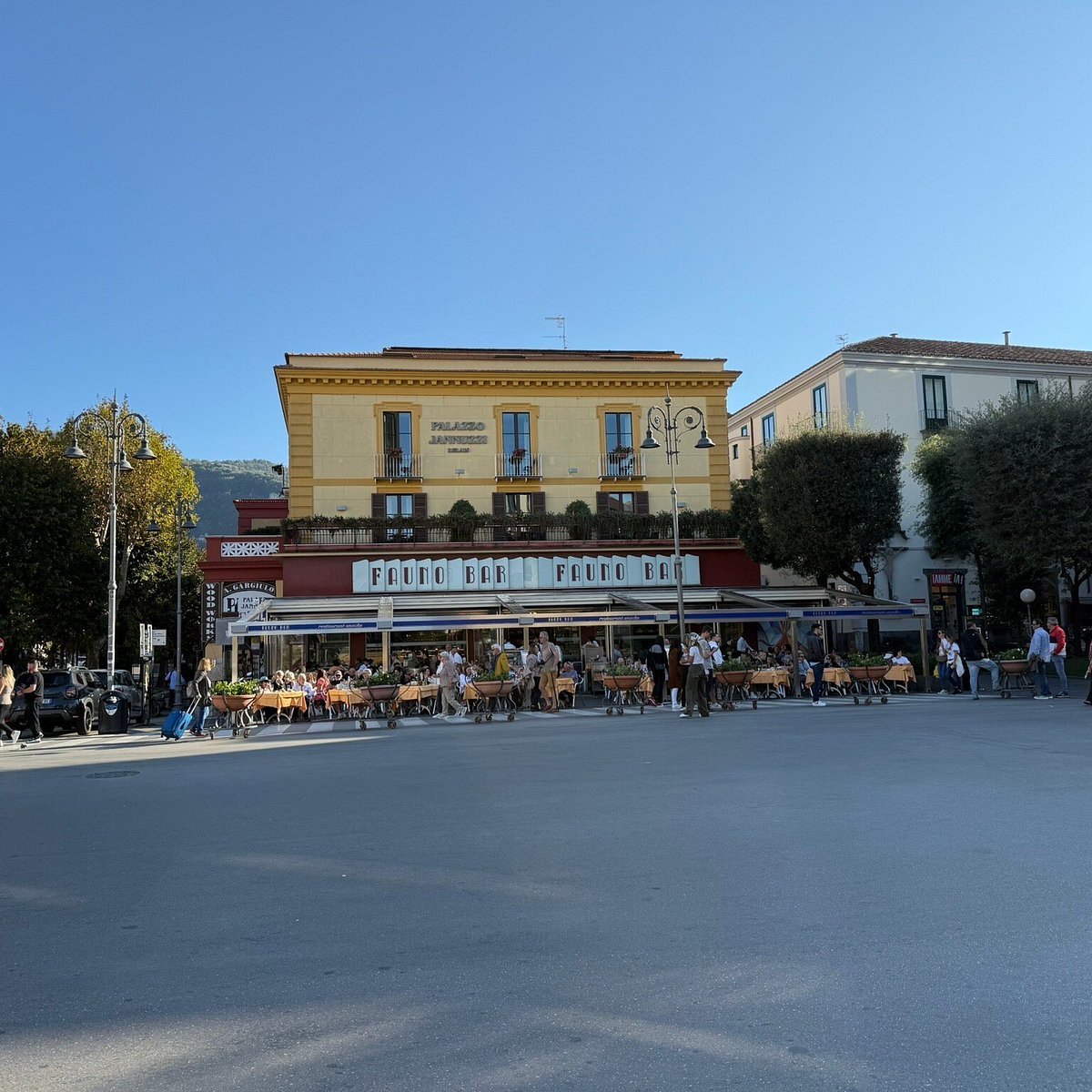
The Square and What It Demands
Piazza Torquato Tasso is not a quiet discovery. Named after the 16th-century poet born in Sorrento, it functions as the town's primary gathering node: the terminus of the pedestrian corso, the departure point for buses to the Amalfi Coast, and the place where residents and visitors alike negotiate the same few square metres of early-evening pavement. Any bar that occupies a position here is, by definition, in dialogue with that foot traffic, that noise, that particular Southern Italian version of public life that plays out under baroque church facades and the low angle of a Campanian sunset. Fauno Bar sits at number 13 on that piazza, which means it inherits the full weight of that scene.
Italian bar culture at this scale tends to bifurcate. On one side are the working-class caffè operations — espresso at the counter, cornetto in the morning, rapid transactions — and on the other are the terrace-facing establishments where the aperitivo hour stretches, the drinks are designed to be held rather than downed, and the social performance of sitting in a beautiful place is part of what you are paying for. Fauno Bar belongs to the latter register. Its position on one of the Amalfi hinterland's most observed public squares puts it in a category where atmosphere and address do much of the heavy lifting.
The shortlist, unlocked.
Hard-to-book tables, cellar releases, and concierge-planned trips.
Get Exclusive Access →Aperitivo in the South: The Campanian Context
To understand what a bar like this is doing, it helps to understand how Southern Italy's drinking culture differs from the more internationally discussed northern models. Milan's aperitivo ecosystem , which produced technically exacting programmes at places like 1930 in Milan , is built around Campari and Aperol bitterness, spritz construction, and a pace tied to office hours. In Rome, bars such as Drink Kong have pushed the format into something more overtly cocktail-bar-coded, with Japanese-influenced precision and reserved-seat formats that would feel foreign on a Sorrento piazza.
The South operates differently. Campania's bar tradition leans into the limoncello family of citrus-forward spirits , a natural development given that the Sorrentine Peninsula produces some of the most prized sfusato and femminello lemons in Italy, the same variety used in the leading limoncello production. A terrace bar in this setting is expected to anchor its drinks offer to that local raw material, even if the broader menu extends to international spirits and classic aperitivo formats. At L'Antiquario in Naples, the approach is more curatorial and heritage-facing, with a bespoke vintage interior that makes the drinks programme feel almost archival. Fauno's register is more public-facing, more pitched toward the passeggiata crowd.
What the Cocktail Programme Signals
Bars positioned on major tourist squares in Southern Italy face a structural tension: the clientele is international, rotating, and broadly unfamiliar with local production, yet the most interesting material to work with is hyperlocal. How a programme resolves that tension tells you a great deal about the bar's editorial identity. The bars that lean too far toward crowd-pleasing produce generic Aperol spritzes and limoncello shots for Instagram. Those that ignore the international context produce lists that confuse or exclude the majority of their guests.
The more considered approach , and the one that marks a drinks programme worth attention , integrates local Campanian ingredients into accessible formats. Sorrento's citrus profile, the region's volcanic mineral character, local amaro producers from the Naples hinterland: these are the building blocks of a genuinely place-specific cocktail offer. That kind of programme sits closer to what Gucci Giardino in Florence achieves with Tuscan botanicals, or what Lost & Found in Nicosia does with Cypriot citrus and indigenous spirits , drinks that teach you something about where you are rather than simply refreshing you.
For a bar on Piazza Torquato Tasso, the terrace and the square do the atmospheric work. The programme, whatever form it takes, is the part that determines whether Fauno operates as a serious address or simply as a well-located café with a long drinks menu.
The Terrace as Format
Outdoor seating in Southern Italy is not a summer amenity , it is the primary format. The Sorrentine climate, with its extended warm season running well into October and its mild springs, means that a piazza-facing terrace functions for the majority of the calendar year. This distinguishes the bar geography of Campania from the more seasonal terrace culture of northern Italian cities, where outdoor seating is genuinely transitional and the interior programme carries the winter. Here, the terrace is the interior, in every sense that matters.
That format has implications for how the cocktail programme should be built. Drinks need to perform outdoors, in sunlight or the warm glow of piazza lighting, often alongside food or light bites, across an extended social hour rather than a focused thirty-minute window. The comparison point is less the controlled-environment bars of the north and more the terrace culture of other Mediterranean port towns , Al Covino in Venice operates in a similarly public, place-specific register, though with a wine emphasis that reflects Veneto's different production identity.
Getting There and Practical Notes
Piazza Torquato Tasso is accessible by foot from Sorrento's main train station in under ten minutes, and it connects directly to the ferry port that serves Capri, Positano, and Naples. The ferry connection makes it a natural first or last stop for day-trippers doing the coast by sea. That logistical reality shapes the crowd at almost every hour: early morning locals at the counter, midday tourists recovering from the ferry crossing, early evening aperitivo drinkers either starting their Sorrento night or ending their coastal day. Visiting in the shoulder season , late September or early October , reduces the density considerably and shifts the clientele toward longer-stay visitors rather than cruise-ship day-trippers. For those using Sorrento as a base for exploring the broader region, the piazza's transport connections make Fauno a practical anchor point regardless of the day's itinerary. See our full Sorrento restaurants guide for additional context on the town's food and drink scene.
Italy's broader bar circuit includes technically focused programmes worth comparing for those building a longer itinerary: Enoteca Historical Faccioli in Bologna, Bistrot Torrefazione Samambaia in Turin, Cascate del Mulino in Manciano, and Bar Avio in Trepuzzi each reflect distinct Italian regional drinking cultures. For international comparison, Bar Leather Apron in Honolulu shows how a similar piazza-facing, place-specific ethos plays out in a Pacific context.
Frequently Asked Questions
- What kind of setting is Fauno Bar?
- Fauno Bar occupies a terrace position on Piazza Torquato Tasso, the central square of Sorrento. It is a public-facing, outdoor-primary venue rather than an intimate cocktail bar in the vein of more interior-focused Italian programmes. The setting suits extended aperitivo sessions rather than reserved tasting formats.
- What should I try at Fauno Bar?
- Sorrento's most compelling local raw material is its sfusato lemon, the basis of the region's limoncello production. Any bar in this location with a considered programme will anchor something to that citrus identity. Campanian citrus-forward aperitifs and local amaro expressions reflect what the region actually produces, and are a more grounded choice than generic imported spirits formats.
- Is Fauno Bar a good option for a first or last drink when taking the ferry to Capri or the Amalfi Coast?
- Piazza Torquato Tasso is the logistical hub connecting Sorrento's pedestrian centre to the ferry port, making Fauno Bar a practical stop before or after a coastal crossing. The piazza is walkable from both the Circumvesuviana train station and the harbour, and the bar's terrace allows you to track the square's activity while you wait. The ferry routes to Capri, Positano, and Naples all depart from the nearby Marina Piccola, roughly a five-minute walk downhill from the piazza.
Comparable Spots, Quickly
These are the closest comparables we have in our database for quick context.
| Venue | Cuisine | Price | Awards | Notes |
|---|---|---|---|---|
| Fauno Bar | This venue | |||
| Drink Kong | World's 50 Best | |||
| Freni e Frizioni | World's 50 Best | |||
| L'Antiquario | World's 50 Best | |||
| Nottingham Forest | World's 50 Best | |||
| 1930 | World's 50 Best |
Need a Table?
Our members enjoy priority alerts and concierge-led booking support for the world's most difficult bars and lounges.
Get Exclusive AccessThe shortlist, unlocked.
Hard-to-book tables, cellar releases, and concierge-planned trips.
Get Exclusive Access →