Dokebi Bar and Grill
Dokebi Bar and Grill on Grand Street in Williamsburg sits at the intersection of Korean-American drinking culture and Brooklyn's bar-and-grill tradition. The address places it firmly in a neighbourhood that has moved from industrial fringe to a densely layered food and drink corridor, where Korean flavour profiles now compete alongside established cocktail programs. For visitors cross-referencing Brooklyn with Manhattan options, Dokebi occupies a specific local niche worth understanding before you book.
Pearl is the En Primeur Club membership app — saves, bookings, and concierge access live there. Same editors, same standards.
- Address
- 199 Grand St, Brooklyn, NY 11211
- Phone
- +1 718 782 1424
- Website
- dokebibrooklyn.com
- Directions
- Get directions
 Saves & bookings on Pearl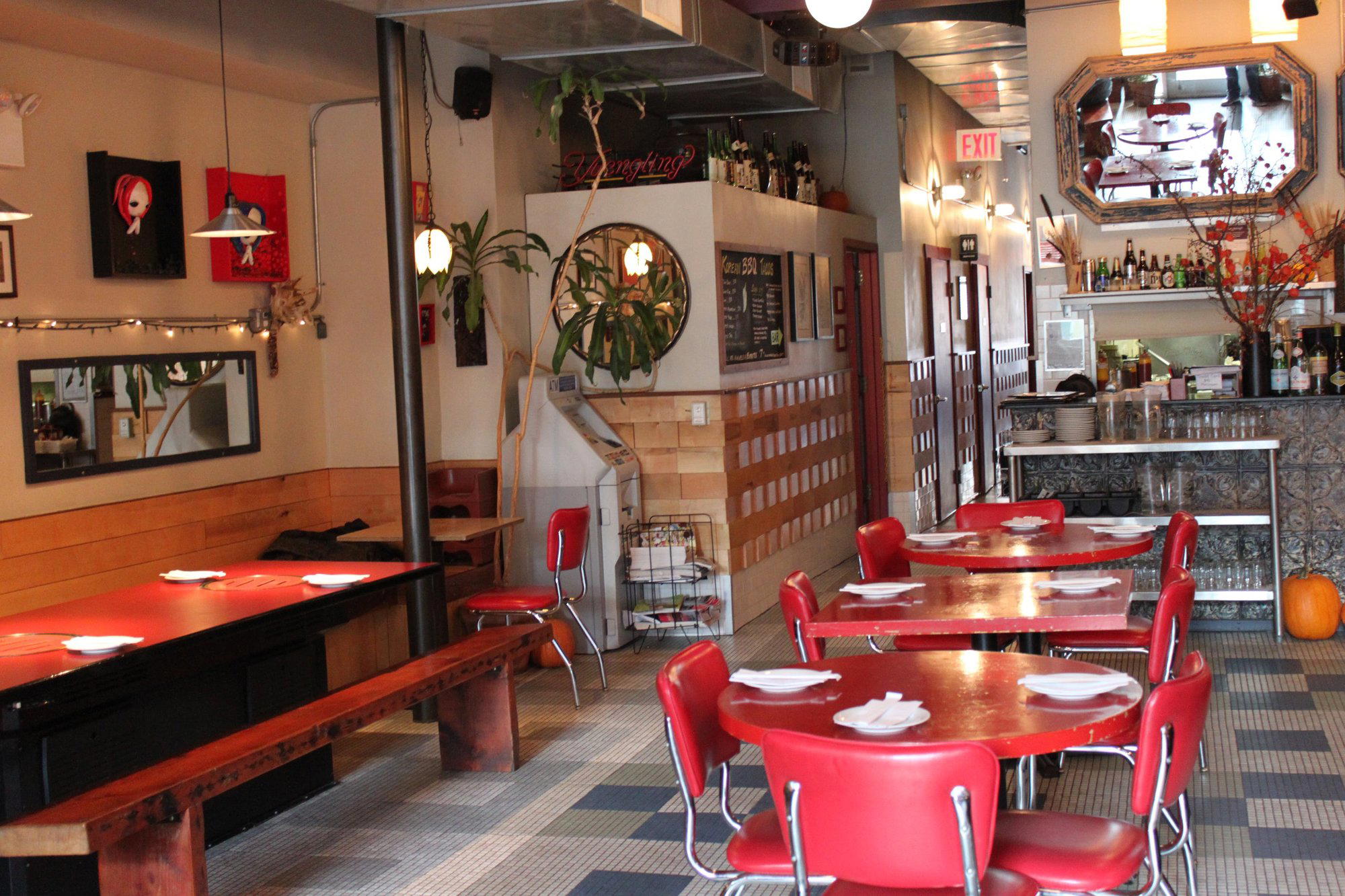
Where Williamsburg Drinking Culture Meets Korean Bar Food
Grand Street in Williamsburg runs a particular kind of energy after dark: the block between Bedford and Driggs draws a crowd that has moved past the borough's earlier dive-bar phase without fully committing to the polished cocktail rooms of lower Manhattan. Dokebi Bar and Grill, at 199 Grand St, occupies that middle register. The signage is low-key, the interior reads as a working bar rather than a concept space, and the draw is the combination of Korean bar food and a drinks programme calibrated to sit alongside it rather than above it.
That pairing logic matters more than it might first appear. Across New York's bar scene, the food programme at most cocktail-forward venues remains an afterthought: a few plates assembled to extend the check average. Venues where the kitchen and the bar operate at equal weight are rarer, and in Brooklyn, the Korean-inflected version of that format is rarer still. Dokebi sits in that smaller tier, alongside a handful of spots nationally, from Kumiko in Chicago to Bar Leather Apron in Honolulu, where the drinks and the food are conceived as a single programme rather than two separate departments sharing a space.
The Food and Drink Framework
Korean bar food, known broadly as anju, is built around the proposition that drinking improves food and food improves drinking. The tradition is less a formal cuisine than a functional one: fermented, spiced, and fatty preparations that hold up against alcohol rather than being overwhelmed by it. Kimchi, fried chicken, spicy rice cakes, and grilled meat skewers are the standard palette, and each element is calibrated for persistence of flavour rather than delicacy.
That makes the drinks pairing question genuinely interesting. The fermented heat in Korean bar food reads differently against a lager than against a spirit-forward cocktail, and differently again against something acidic and low-ABV. Bars working in this format tend to resolve the tension one of two ways: either they lean into the beer-and-soju model that dominates the Korean original, or they construct a cocktail list that uses acid, citrus, and lower-proof spirits to cut through rather than compete with the food's intensity. At Dokebi, the bar operates in Williamsburg, which has enough cocktail literacy in its customer base to support the latter approach.
For context on how New York's broader bar scene handles food pairing, it is worth looking at the range. Amor y Amargo resolves the question by eliminating food almost entirely, letting the bitters-forward drinks programme occupy the full attention. Attaboy NYC takes a similar approach, with the menu built around the spirit and the guest's stated preferences rather than any kitchen collaboration. Dokebi's model is structurally different: the kitchen is part of the proposition from the beginning.
Williamsburg as the Right Address for This Format
The neighbourhood context reinforces the concept. Williamsburg in the early 2010s was largely a beer-and-cocktail scene with minimal food ambition. By the mid-2010s, Korean restaurants and bars had established a visible presence in the blocks around Grand and Metropolitan, building a local audience that already understood the anju model. That shift preceded the wider national interest in Korean food that has since moved from trend status to something closer to structural fixture across American restaurant culture.
Dokebi arrived into that environment rather than inventing it, which is a meaningful distinction. The bars that try to introduce unfamiliar formats to a neighbourhood often struggle; the ones that reflect and formalise something the neighbourhood already does informally tend to build faster loyalty. On Grand Street, the Korean bar format already had cultural traction before Dokebi opened its doors at 199.
The broader Brooklyn cocktail context places Dokebi in a competitive set that includes neighbourhood bars across Williamsburg and Bushwick with varying levels of drinks ambition. Within that set, the Korean food angle is a genuine differentiator. It also positions Dokebi differently from Manhattan peers working the same food-and-drink pairing territory. Superbueno operates a comparable integrated model with a Latin kitchen; Angel's Share in the East Village runs in a quieter, more Japanese-influenced register. Neither does what Dokebi does on the food side.
How This Compares to the National Bar Food Picture
Across the United States, the bar-kitchen integration model has gained ground over the past decade, with venues from Jewel of the South in New Orleans to Julep in Houston to ABV in San Francisco building food programmes with the same rigour applied to the drinks. In each case, the food functions as both a practical pairing tool and a signal of the bar's overall seriousness. Allegory in Washington, D.C. and The Parlour in Frankfurt on the Main extend that model internationally, with kitchen programmes that operate as equals to the cocktail lists.
What the Korean anju format contributes to this category is a set of flavour intensities that push the pairing logic harder than most Western bar food does. The drinks programme at a venue like Dokebi has to handle fermented heat, strong umami, and high-fat preparations simultaneously. That is a more demanding brief than the standard charcuterie-and-cocktail model, and it tends to produce more interesting results when it works.
Planning a Visit
Dokebi Bar and Grill is at 199 Grand St, Brooklyn, NY 11211, in Williamsburg, accessible from the L train at Bedford Avenue or the J/M/Z at Marcy Avenue. As a bar and grill rather than a reservation-driven restaurant, the format lends itself to walk-in traffic, though weekend evenings on Grand Street run busy across the block. Visiting earlier in the evening on a weekday gives a more relaxed experience without sacrificing the atmosphere.
The Essentials
Comparable venues nearby, for context on price, style, and recognition.
| Venue | Cuisine | Price | Notes |
|---|---|---|---|
| Dokebi Bar and GrillThis venue — the venue you are viewing | Not listed | $$ | Not listed |
| Bar 7 | Greenwich Village, lounge | $$ | Not listed |
| The Test Brewery | Not listed | $$ | Williamsburg, beer_bar |
| Abigail's Kitchen | Chinatown-Two Bridges, lounge | $$ | Not listed |
| The Ten Bells | Not listed | $$ | Lower East Side, wine_bar |
| Turntable Chicken Jazz | Not listed | $$ | Midtown South-Flatiron-Union Square, lounge |
Continue exploring
More in New York City
Bars in New York City
Browse all →
Restaurants in New York City
Browse all →
Hotels in New York City
Browse all →







At a Glance
- Lively
- Cozy
- Group Outing
- Casual Hangout
- Standalone
- Seated Bar
- Booth Seating
- Craft Cocktails
Current opening hours
- Monday
- 12–11 PM
- Tuesday
- 12–11 PM
- Wednesday
- 12–11 PM
- Thursday
- 12–11 PM
- Friday
- 12 PM–12 AM
- Saturday
- 12 PM–12 AM
- Sunday
- 12–11 PM
Hours can change for holidays and private events. Last verified .
Casual and warm with a friendly, lively atmosphere and comfortable seating.