Altius
Altius occupies a commanding position on Grandview Avenue, where the view across the Monongahela to downtown Pittsburgh is as much a part of the experience as what arrives at the table. The restaurant sits within a dining tier that Pittsburgh visitors rarely associate with the city's industrial-heritage identity, making it a useful reference point for understanding how the local fine-dining scene has shifted over the past decade.
 Discover on Pearl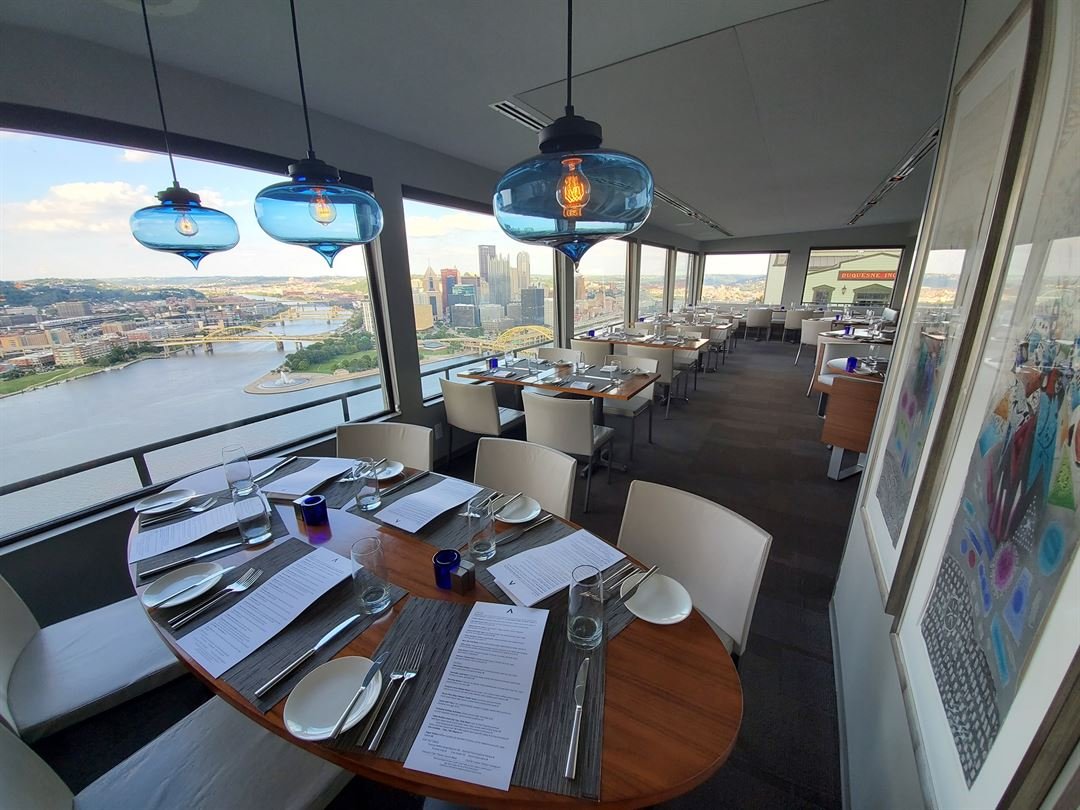
The View From Mount Washington
Grandview Avenue runs along the crest of Mount Washington on Pittsburgh's South Side, and the city below behaves like a working diagram of American geography: three rivers converging, bridges layered at different heights, and the downtown grid lit against a skyline that punches above the city's population size. Restaurants on this ridge have always traded on that panorama, but the more interesting question is which ones have built a kitchen program capable of holding attention once the view becomes familiar. Altius, at 1230 Grandview Ave, occupies that upper position on the ridge and positions itself in the tier of Pittsburgh dining where the room and the plate are expected to carry equal weight.
Mount Washington's dining corridor has historically attracted a tourist-facing, occasion-dining clientele — anniversary dinners, proposals, visiting family. The challenge for any serious kitchen operating in that environment is distinguishing itself from properties that treat the panorama as the entire value proposition. The Pittsburgh dining scene has matured considerably over the past decade, with neighborhoods like Lawrenceville, East Liberty, and Squirrel Hill generating the kind of ingredient-focused, chef-driven programming that tends to set the critical conversation. That shift has raised the baseline expectation across the city, including for restaurants on the Grandview ridge.
Where the Food Comes From
In American fine dining broadly, the sourcing conversation has moved from novelty to baseline expectation. Menus that once earned points simply for naming a farm or a region now compete against programs where provenance is the structural logic of the kitchen, not a marketing add-on. Pittsburgh has particular geographic advantages in this regard: the city sits within reach of some of the most productive agricultural land in the northeastern United States, with Pennsylvania's rural counties supplying dairy, heritage pork, pastured poultry, and seasonal produce to kitchens across Allegheny County. Restaurants operating at the fine-dining tier in Pittsburgh increasingly use that access as a point of differentiation, particularly against peer cities where local sourcing requires more logistical effort.
For a restaurant at Altius's address and positioning, the sourcing framework matters because it determines how the kitchen reads against the broader Pittsburgh fine-dining tier rather than simply against other Grandview venues. The restaurants in Pittsburgh that have built the most durable critical reputations — across neighborhoods from Bloomfield to the Strip District , have done so by treating regional supply chains as kitchen infrastructure rather than as a seasonal talking point. That standard shapes what a serious diner arriving from elsewhere in the country should expect from the top tier of Pittsburgh's restaurant offering.
It is worth noting that Pittsburgh's restaurant community has developed meaningful connections to Appalachian and mid-Atlantic foraging traditions, with mushrooms, ramps, pawpaws, and other foraged ingredients appearing on menus in a way that reflects genuine regional identity rather than borrowed trend. A kitchen on Grandview with access to these networks occupies a different culinary position than one sourcing generically from national distributors. The distinction is not always visible on the menu surface but tends to register in the texture and seasonality of what arrives at the table.
Pittsburgh Fine Dining in Context
Pittsburgh's fine-dining tier is smaller and less internationally legible than its peer cities of comparable size, but that has changed meaningfully in recent years. The city does not carry Michelin Guide coverage, which affects how its leading restaurants are ranked internationally, but the absence of guide coverage has also allowed a more locally grounded dining culture to develop without the distortions that come with chasing star criteria. Venues like Alla Famiglia have built reputations across decades through consistency and neighborhood loyalty rather than through awards cycles. That model, community-anchored and repetition-built, runs through Pittsburgh's hospitality identity in a way that distinguishes it from more trend-sensitive markets.
For context on what the fine-dining tier looks like across American cities of different scales, it is useful to compare programmatic ambition. In Chicago, venues like Kumiko have built international recognition around format discipline and beverage seriousness. In New Orleans, Jewel of the South operates within a culinary tradition dense enough to generate its own critical grammar. In Houston, Julep has demonstrated how a regional identity can anchor a program against generic national competition. Pittsburgh's equivalent is a dining scene where local loyalty and geographic specificity carry more weight than platform visibility.
The broader American bar and restaurant tier also provides useful framing. Programs at Bar Leather Apron in Honolulu, Superbueno in New York City, ABV in San Francisco, and The Parlour in Frankfurt each show how a clear point of view, whether built around cocktail technique, regional cuisine, or beverage depth, separates venues that hold critical attention over time from those that rely on setting alone. That distinction is directly relevant to how Altius reads within its competitive set on Mount Washington.
Planning a Visit
Grandview Avenue is accessible by the Duquesne Incline or Monongahela Incline from Station Square, both of which operate on regular schedules and add a transit layer to the arrival experience that is specific to this part of Pittsburgh. Visitors arriving by car should account for limited street parking along the ridge. The Mount Washington dining corridor draws reservation demand on weekend evenings, and Grandview venues at the fine-dining tier typically book ahead for Friday and Saturday service. Pittsburgh's dining scene repays exploration beyond this ridge: the Allegheny Wine Mixer and Allegheny Elks Lodge #339 across the river represent a different register of the city's hospitality character, while Aiello's Pizza in Squirrel Hill anchors the kind of neighborhood institution that has defined Pittsburgh's eating culture for generations. A full itinerary that includes both the fine-dining tier and the neighborhood institutions gives a more accurate read of the city than either category alone. See our full Pittsburgh restaurants guide for a broader map of what the city offers across price tiers and neighborhoods.
Frequently Asked Questions
- What do regulars order at Altius?
- Altius sits within Pittsburgh's fine-dining tier, where the kitchen programs that hold repeat-visitor loyalty tend to rotate around seasonal sourcing and regionally anchored proteins. In this category across the city, dishes built around Pennsylvania-raised proteins and market-driven vegetables tend to define what regulars return for, rather than fixed signature items. The cuisine positioning and any current menu specifics are leading confirmed directly with the restaurant before visiting.
- What is Altius known for?
- Altius is known primarily for its position on Grandview Avenue and the panoramic view of Pittsburgh's downtown skyline and river confluence that the room commands. Within the city's dining conversation, it occupies a tier associated with occasion dining and refined expectations for both service and kitchen output. Pittsburgh does not carry Michelin Guide coverage, so the local fine-dining tier is assessed through a combination of longevity, local press recognition, and peer positioning rather than international awards.
- Is Altius a good choice for visitors who want to understand Pittsburgh's food identity, or is it more of a view-driven destination?
- The honest answer is that both things can be true simultaneously, and the distinction matters less than it once did as Pittsburgh's fine-dining tier has raised its kitchen standards across the board. Grandview Avenue restaurants have historically skewed toward occasion dining driven by the panorama, but the broader city dining scene has pushed expectations upward in a way that affects even view-destination properties. Visitors who want the full range of Pittsburgh's food identity should pair a Grandview dinner with neighborhood-level eating in areas like Lawrenceville or Squirrel Hill, where the city's sourcing culture and culinary character are most legible at street level.
Comparison Snapshot
A quick comparison pulled from similar venues we track in the same category.
| Venue | Cuisine | Price | Awards | Notes |
|---|---|---|---|---|
| Altius | This venue | |||
| diners 2+1 | ||||
| Mola | ||||
| Tony's Pub | ||||
| APTEKA | ||||
| Alla Famiglia |
Need a Table?
Our members enjoy priority alerts and concierge-led booking support for the world's most difficult bars and lounges.
Get Exclusive Access