
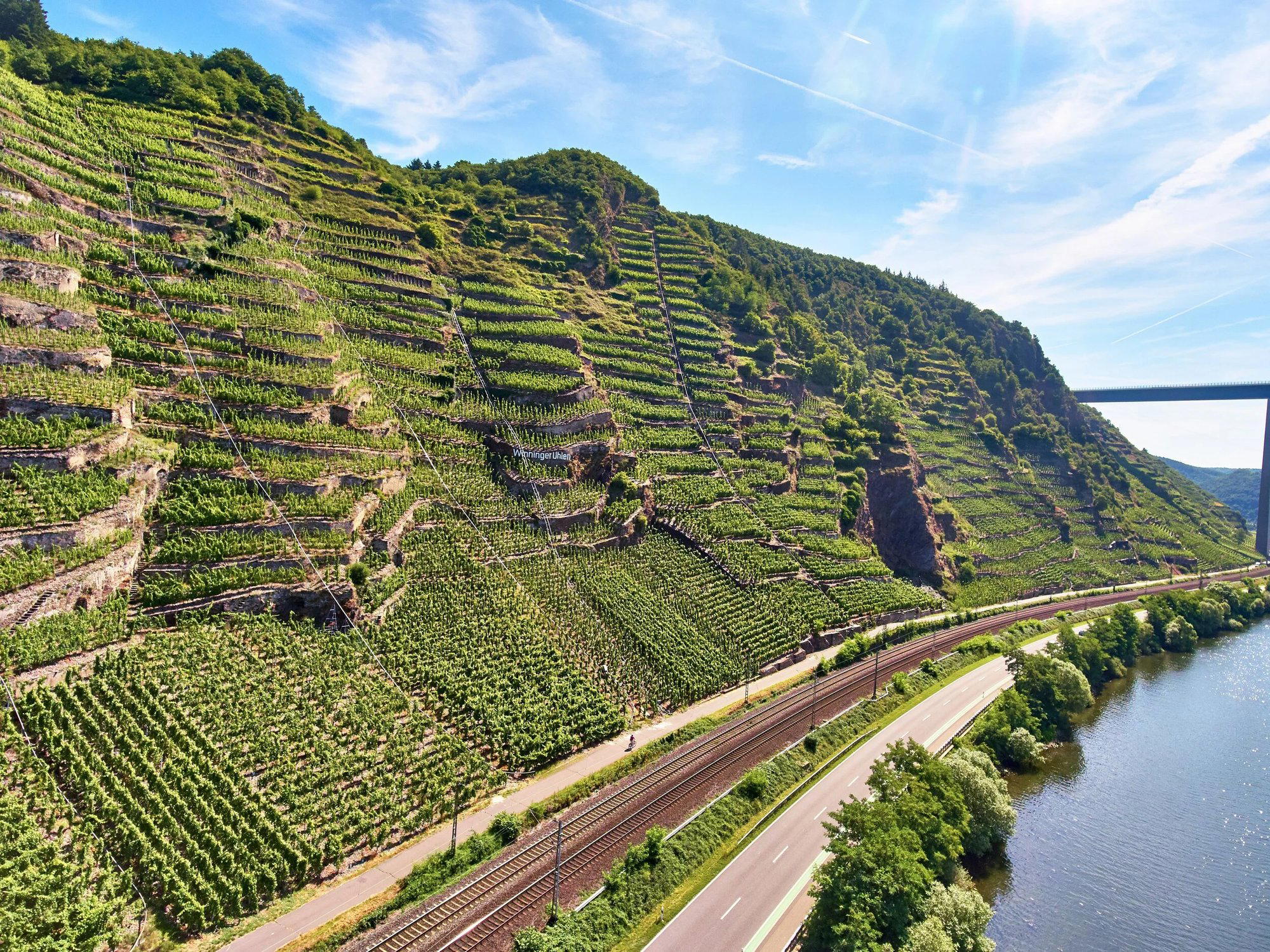
Weingut Richard Richter reads as a Terrassenmosel study in slope, slate, and family continuity. The fifth-generation Winningen estate dates to 1838, works almost seven hectares across sites including Röttgen and Uhlen, and keeps Riesling at the center while allowing a small range of Pinot Noir, Pinot Blanc, and Chardonnay.
Pearl is the En Primeur Club membership app — saves, bookings, and concierge access live there. Same editors, same standards.
- Address
- Winningen, Mittelrhein, Rhineland-Palatinate, Deutschland
 Saves & bookings on Pearl
Winningen’s wine country is defined by steep terraced vineyards, quiet lanes, and the sense that vineyard work is inseparable from landscape. Within that setting, Weingut Richard Richter is best understood as a traditional, family-run Mosel winery with a strong heritage feel. The profile points less toward spectacle and more toward place: cellar work, terraced slopes, rustic character, and a philosophy that treats work in the vineyard as an art form.
The available facts support a classic, scenic, quiet, and somewhat hidden-gem impression in Winningen. They do not confirm a particular tasting format, grape list, production scale, founding date, tour length, address, or named vineyard roster. For planning, that means the winery should be approached as a heritage Mosel stop whose appeal rests on setting and tradition, not on unsupported claims about a menu, service model, or award history.
Terrassenmosel character without overclaiming the details
The identity of Weingut Richard Richter centers on steep terraced vineyards and cellar work. That matters in Winningen, where the Mosel landscape can feel dramatic without needing embellishment. Terraces, slopes, and the visual rhythm of vineyard walls create the frame for the estate’s appeal. The guideable fact is not a named bottle, a score, or a specific grape breakdown; it is the winery’s connection to a traditional Mosel way of working, where vineyard labor is treated as craft.
That also affects expectations. This is not best presented as a high-design destination or a venue built around a flashy hospitality concept. The grounded description is quieter: rustic, classic, scenic, and rooted in a family-run winery atmosphere. Visitors comparing options in Winningen should think of Weingut Richard Richter as a place for heritage, landscape, and cellar-centered wine culture rather than as a source of dining, lunch, take-out, delivery, or formal restaurant-style service.
Price is listed as $$, which places the venue in a moderate bracket for planning purposes. If those details matter for a visit, they should be checked directly before making plans.
A family-run winery with a heritage feel
One reliable editorial angle is the estate’s family-run, traditional character. “Family-run” is not just a decorative phrase here; it is part of the profile and helps explain the tone of the place. The winery is presented as a Mosel winery with a strong heritage feel, centered on the relationship between vineyard work and cellar work. That is a narrower claim than saying exactly who runs it, how long the family has owned it, or which technical qualifications are involved, none of which are confirmed in the provided facts.
The atmosphere is correspondingly restrained. Expect the appeal to come from Winningen’s scenic vineyard context and the winery’s rustic, quiet identity. The estate is better framed for travelers who value a sense of place than for those looking for a fully documented visitor program in advance. The available profile does not verify seating capacity, languages, children’s facilities, outdoor seating, accessibility details, or a fixed tour structure, so those should remain open questions rather than promises.
What can be said with confidence is that the winery’s philosophy is tied to the vineyard. The description emphasizes vineyard work as an art form, which gives the estate a clear thematic identity: careful work on steep terraced land, supported by cellar practice, within a classic Mosel setting. That is enough to make the venue relevant for travelers interested in the cultural range of Winningen, even without attaching awards, rankings, or producer comparisons.
How to place it in a Winningen wine itinerary
The winery fits most naturally into a Winningen itinerary focused on wine, scenery, and local heritage. The village context is important: this is a place where the surrounding slopes help define the experience. A visit, if arranged, should be planned with the expectation of a quiet winery atmosphere rather than a restaurant, bar, or event venue with confirmed food service.
For a broader day in Winningen, pair the winery with other local dining or hospitality options generically, while keeping the focus on the landscape that gives the town its character. Its case is simpler and more durable: a traditional family-run Mosel winery in Winningen, with a scenic, rustic, hidden-gem feel and a profile centered on terraced vineyards and cellar work.
The main reason to keep it on a shortlist is educational and atmospheric. The winery represents a kind of Mosel wine culture where the terrain is not background decoration but the organizing principle. For travelers who want polished certainty on every service detail, more direct checking will be necessary. For travelers drawn to quiet heritage, steep vineyards, and the craft of cellar-and-vineyard work, the grounded profile is compelling on its own terms.
Recognition history
Dated appearances from independent guides and award organizations, with the underlying list record or original source where available.
Falstaff Winery - Listed
Falstaff
Continue exploring
More in Winningen
At a Glance
- Classic
- Scenic
- Quiet
- Rustic
- Wine Education
- Group Outing
- Special Occasion
- Vineyard Tour
- Historic Building
- Terrace
- Vineyard
- Terrassenmosel
- Riesling
- Pinot Noir
- Pinot Blanc
- Chardonnay
- Still White
- Still Red
- Sparkling
- Dessert
- Wine Tasting
- Cellar Tour
- Company Tour
Traditional family-run Mosel winery with a strong heritage feel, centered on steep terraced vineyards, cellar work, and a philosophy that treats vineyard work as an art form.