Winningen, Germany
Weingut Heymann-Löwenstein
Visiting or tasting here requires an appointment and some willingness to seek out a village most wine tourists pass through without stopping.
Restaurants, hotels, bars and wineries in Winningen from the En Primeur Club guide.
Accolades in Winningen
These are the estates that anchor Winningen’s cellar culture, with Riesling, steep slate slopes and site-specific Mosel wines.
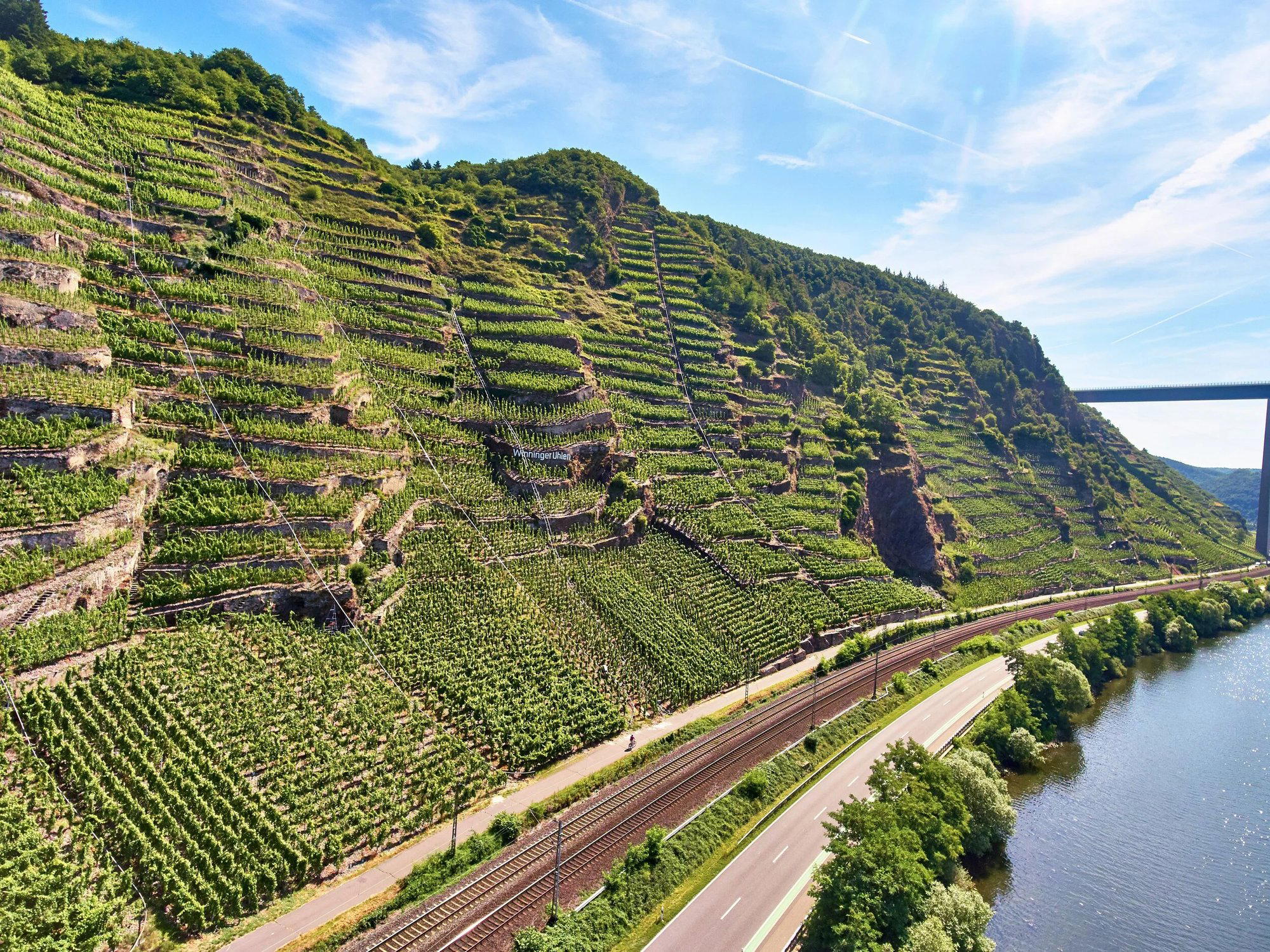
Weingut Heymann-Löwenstein in Winningen makes natural dry Rieslings using grapes grown on steep terraces of slate. Its wines undergo spontaneous fermentation with no additives. The estate holds a Falstaff Winery 5 Stars award for 2026.
A centuries-old family winery in Winningen built around Riesling from some of Germany’s steepest terraced slate vineyards. The estate works from Uhlen, Brückstück, Röttgen and Domgarten, and its hands-on model keeps the focus on site-specific Mosel wine and family continuity.
Weingut Richard Richter is a fifth-generation Mosel estate in Winningen, founded in 1838. It works steep terraced vineyards, with Riesling from Röttgen and from Uhlen. It also grows Pinot Noir, Pinot Blanc and Chardonnay. It has a Falstaff Winery Listed award for 2026.
These producers work with low-intervention methods or make Sekt, adding another side to Winningen’s Riesling-led scene.
Weingut Materne & Schmitt is a small all-Riesling winery in Winningen. The estate grows dry Riesling on steep terraced slate vineyards, with all vineyard work done by hand. It uses spontaneous fermentation and restrained sulphur use. It has a Falstaff Winery Listed award for 2026.
A natural winery in Winningen with a Terrassenmosel focus, working old Riesling and Müller-Thurgau vines on steep dry-farmed terraces. The wines use wild fermentations and minimal cellar intervention, with the focus on slope, slate heat, airflow and hand labour across the lower Mosel terrain.
A sparkling-wine specialist built around Riesling and traditional bottle fermentation. It works with 2.4 hectares of vines, a 95% Riesling base and a tasting format that can also include alcohol-free Sparkling Tea made from regional ingredients.
There are no Michelin-starred restaurants in our guide to Winningen. The guide lists 16 wineries citywide, including Weingut Heymann-Löwenstein and the all-Riesling estate Weingut Materne & Schmitt in Winningen. Weingut Heymann-Löwenstein makes natural dry Rieslings from steep slate terraces using spontaneous fermentation without additives.
Winningen itself has 15 of the 16 wineries in our guide, and Terrassenmosel has one. The village is where the cellar-led estates sit, including Riesling specialists and the sparkling-wine producer.
Riesling is the main grape across most estates in our guide to Winningen. Weingut Materne & Schmitt in Winningen grows only Riesling, with dry wines from steep terraced slate vineyards. Weingut Heymann-Löwenstein in Winningen makes natural dry Rieslings using spontaneous fermentation without additives.
Winninger Sektmanufaktur C•Kloss / von Canal is the sparkling-wine specialist in our guide. It uses traditional bottle fermentation, a 95% Riesling base and a tasting format that can also include alcohol-free Sparkling Tea made from regional ingredients.
By Emmett Haley · Updated October 8, 2026 · Editorial standards
Winningen
Selected entries from the current guide for Winningen.
No venues found.
Winningen
Selected entries from the current guide for Winningen.
No venues found.
Winningen
Selected entries from the current guide for Winningen.
No venues found.
Winningen
Selected entries from the current guide for Winningen.
Winningen, Germany
Visiting or tasting here requires an appointment and some willingness to seek out a village most wine tourists pass through without stopping.

Winningen, Germany
Madame Flöck Wines works the Terrassenmosel from Winningen with a natural-wine lens: steep slate terraces, old Riesling and Müller-Thurgau vines, dry farming, wild fermentations, and minimal cellar intervention. The appeal is not polish or scale, but a close reading of Lower Mosel terrain through wines shaped by slope, airflow, slate heat, and hand labor.
Winningen, Germany
Rüdiger Kröber is a small family-owned winery in Winningen, shaped by the steep terraces of the Terrassenmosel and a Riesling-led cellar culture. The experience is quiet and traditional: cellar and vineyard tours, German or English tastings, and a rustic room where Pinot Blanc, Pinot Noir and sparkling styles sit beside the white-wine focus.
Winningen, Germany
Sünner Weinbau sits in Winningen’s small-producer wine culture: family-run, quiet in scale, and tied to the Mosel village rhythm rather than large estate theater. Its 1.5 hectares, Riesling focus, and playful label voice make it a useful stop for travelers interested in local bottle identity and the vinothek side of Winningen wine life.
Winningen, Germany
Weinbau Julien Renard belongs to the small-scale, natural-leaning side of the Mosel, where steep terraces and cellar restraint matter more than visitor infrastructure. The estate works about 1 hectare around Winningen, with hand cultivation, spontaneous fermentation, low sulfur, no filtration, and a focus on still white wines including Riesling, Müller-Thurgau, and Weissburgunder.
Winningen, Germany
Weinbau Maximilian Knebel is a small Winningen winery tied to the Terrassenmosel’s steep-slope Riesling culture, with Uhlen Riesling at the center of its public identity. The appeal is terroir rather than spectacle: slate, river-valley exposure, a quiet traditional atmosphere, and a family-run format dating to 1642, with Matthias Knebel named as winemaker.
Winningen, Germany
Weingut Daniel und Reiner Fries is a small Winningen estate rooted in Mosel wine culture, with Riesling, Spätburgunder and Weissburgunder framing the house identity. The experience reads as village-scale rather than theatrical: quiet, casual, appointment-led, and built around cellar tasting, outdoor seating and direct wine sales from a family-run address.
Winningen, Germany
A small Terrassenmosel estate in Winningen, Weingut Freiherr von Heddesdorff is built around Riesling, steep slate terraces, and family continuity dating to 1454. The draw is not scale or ceremony, but site-specific Mosel wine from Uhlen, Brückstück, Röttgen, and Domgarten, shaped by Andreas von Canal’s hands-on estate model.
Winningen, Germany
Weingut Hess-Hautt is a small, third-generation family winery in Winningen, framed by the Mosel’s terraced slate-vineyard culture rather than by luxury-winery theatre. The draw is its compact four-hectare scale, quiet traditional setting, and direct local feel: a sensible stop for travelers who want the village-level texture of Mosel wine country in a low-key $$ format.
Winningen, Germany
Weingut Knebel is a Terrassenmosel estate in Winningen where Riesling is read through slate, slope, and river-valley exposure rather than through cellar theatrics. The family line reaches back to 1642, the modern estate dates to 1990, and the scale remains small at about 7 hectares and roughly 45,000 bottles a year.
Winningen, Germany
Weingut Löwensteinhof is a Winningen winery and Straußwirtschaft shaped by the Terrassenmosel: steep vineyard setting, estate wines, and small regional dishes rather than a polished tasting-room script. Riesling anchors the picture, with Winninger Domgarten Riesling Feinherb giving a clear signal of site-led Mosel identity and a quietly traditional hospitality format.
Winningen, Germany
A small Winningen winery built around dry Riesling from steep terraced slate vineyards, Weingut Materne & Schmitt belongs to the labor-intensive side of Mosel wine culture. Founded in 2012 by Rebecca Materne and Janina Schmitt, it favors hand-worked vines, spontaneous fermentation, restrained sulfur use, and a quiet cellar-door rhythm over hospitality spectacle.
Winningen, Germany
Weingut Richard Richter reads as a Terrassenmosel study in slope, slate, and family continuity. The fifth-generation Winningen estate dates to 1838, works almost seven hectares across sites including Röttgen and Uhlen, and keeps Riesling at the center while allowing a small range of Pinot Noir, Pinot Blanc, and Chardonnay.
Winningen, Germany
Weingut Röttgerding is a small family-run Mosel estate in Winningen, focused on Riesling from steep terraced vineyards with White Burgundy and Blue Pinot Noir planted where the sites suit them. The appeal is the old-school cellar-door logic of tasting and buying at source, with terroir rather than ceremony doing the heavy lifting.
Winningen, Germany
Weingut Weyh is a family-run Mosel winery in Winningen, founded in 1919 and now led by fourth-generation winemaker Peter Weyh. The draw is Riesling from Winningen vineyards including Uhlen and Röttgen, tasted in a relaxed vinotheque and Rosenhof setting beside the Mosel cycle path, with English-language hospitality and a walk-in-friendly format.
Winningen, Germany
A small Mosel sparkling-wine specialist in Winningen, Winninger Sektmanufaktur C•Kloss / von Canal is built around Riesling, compact vineyard holdings, and a cellar geared to Sekt rather than broad still-wine range. The appeal is technical and local: 2.4 hectares of vines, a 95% Riesling base, traditional bottle fermentation, and a tasting format that can include sparkling wine and alcohol-free Sparkling Tea.
Continue exploring