
Tullamore D.E.W. sits at the geographic and historical centre of Irish whiskey's midlands tradition, operating from Bury Quay in County Offaly where the original distillery shaped the town's identity across two centuries. The visitor experience holds a Pearl 3 Star Prestige rating for 2025, positioning it among Ireland's most formally recognised whiskey destinations. For anyone tracing the country's distilling heritage beyond Dublin, this is the logical first stop.
Midlands Grain, Midlands Character
County Offaly sits at the quiet heart of Ireland, far from the coastal drama of Dingle or the urban bustle of Dublin's Liberties. The Grand Canal runs through Tullamore, and it was precisely this inland waterway infrastructure that made the town a viable distilling centre in the early nineteenth century — grain in, barrels out, markets reached without dependence on roads. That logistical fact shaped a whiskey tradition distinct from the southern distilleries of Midleton or the island producers of the west. The terrain here is low, flat, and agricultural: bogland and pasture rather than mountain or coast. If terroir matters in whiskey — and the most compelling argument in Irish distilling right now is that it does , then the Offaly midlands produces a different kind of character than its peers, one shaped by soft water, malted and unmalted barley, and the particular grain-forward profile that defined Tullamore D.E.W. across its long commercial history.
The visitor experience at Bury Quay, the address where Tullamore D.E.W. now operates its distillery and heritage centre, sits at the intersection of that agrarian history and a more contemporary approach to whiskey tourism. The 2025 Pearl 3 Star Prestige award confirms its position inside the upper tier of Irish distillery experiences , a peer set that includes Kilbeggan Distillery in Kilbeggan and Jameson (Bow St.) in Dublin, both of which draw significant visitor numbers but operate from quite different commercial and spatial contexts. Kilbeggan offers intimate heritage; Jameson offers scale and accessibility. Tullamore occupies its own position: a working distillery returned to its historic town, with the canal and quayside as its physical setting.
Reading the Place Before You Taste the Spirit
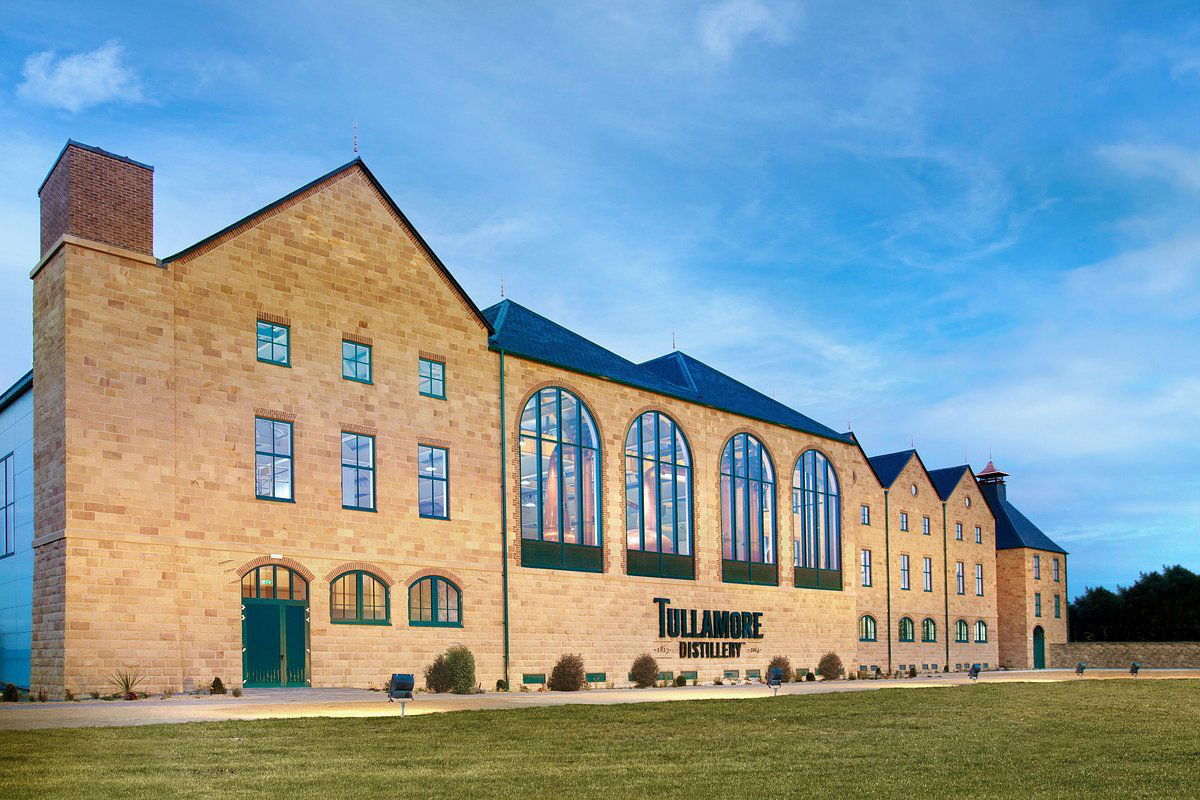
Approaching along Bury Quay, the building communicates its purpose clearly. The architecture retains enough of the original distillery fabric to register as genuinely old without performing heritage as theme-park decoration. The canal sits alongside, still enough on most mornings to reflect the stonework. This is not an abstract brand experience built inside a converted warehouse , it is a specific place, with specific geography, and the whiskey it produces is meant to be understood in that context.
Irish whiskey's triple distillation tradition, which Tullamore D.E.W. exemplifies in its pot still expressions, produces a smoother, lighter spirit than Scotch single malt but one that carries its own complexity through the interplay of malted barley, unmalted barley, and grain. The unmalted component is what distinguishes Irish pot still whiskey from its Scottish counterpart, and it introduces a spiced, oily quality that straight grain or pure malt whiskeys do not possess. Understanding that distinction is part of what a visit to a heritage distillery like this one can deliver in a way that a retail tasting cannot: the physical context of copper pot stills, the smell of a working warehouse, and the visible scale of production all act as explanatory material for what ends up in the glass.
For visitors tracing the broader arc of Irish distilling, the comparison set is worth mapping. Dingle Distillery in Dingle represents the new-wave, small-batch end of the revival; Redbreast in Midleton anchors the premium single pot still category from a large, industrialised operation; Waterford Distillery in Waterford has built its entire identity around terroir-specific barley sourcing. Tullamore D.E.W. sits between heritage brand and active distillery: large enough to have shaped the category, small enough in its current incarnation to connect visitors directly to the physical processes that produce the spirit.
The Whiskey Itself: Grain, Wood, and Time
Tullamore D.E.W.'s core range spans blended Irish whiskey, single malt, and single pot still expressions. The blended whiskey , the most widely distributed product , combines grain whiskey with pot still and malt components in proportions that have historically prioritised approachability and consistency. That commercial logic explains both the brand's global reach and its place in the wider Irish whiskey narrative: it helped define what international consumers understood Irish whiskey to be through much of the twentieth century.
The more instructive tasting territory lies in the pot still expressions, where the character of the midlands grain and the specific wood management decisions made at the distillery become legible. Cask selection for Irish whiskey has historically favoured ex-bourbon barrels, with sherry wood used for finishing or as a proportion of the maturation stock. The flatland warehouse conditions in the midlands , moderate temperatures, high humidity from the surrounding bogland , produce a particular extraction rate from oak that differs from coastal warehouses exposed to Atlantic air movement. Whether that registers as a distinct flavour variable or simply as a background condition is a question worth exploring through comparison across the range.
For context on how Irish distilleries outside the country's borders approach similar questions of terroir and maturation, Aberlour in Aberlour and Abadía Retuerta in Sardón de Duero offer instructive parallels in how place-specific conditions shape spirit and wine character respectively.
Planning Your Visit
Tullamore is roughly ninety minutes by road from Dublin, and the town is reachable by train on the Dublin-Galway line. The distillery sits directly on Bury Quay, walkable from the town centre and the train station. Given the Pearl 3 Star Prestige recognition for 2025, demand for guided experiences is likely to be steady through the spring and summer months, and booking ahead rather than arriving without a reservation is the sensible approach for peak periods. Tullamore itself is a working midlands town rather than a tourist destination in the conventional sense, which means accommodation options are more modest than in Dingle or Killarney , factoring in a day trip from Dublin or combining with the wider midlands is a practical approach for most international visitors.
For anyone building an itinerary around Irish distillery experiences, pairing Tullamore with Kilbeggan (roughly twenty kilometres to the north) covers the full span of midlands whiskey heritage in a single day. Slane Irish Whiskey in Slane, The Shed Distillery in Drumshanbo, and Powerscourt Distillery in Enniskerry each represent different dimensions of the contemporary Irish spirits revival and can extend a multi-day itinerary across Leinster and Connacht.
For broader Tullamore context beyond the distillery, our full Tullamore restaurants guide, our full Tullamore hotels guide, our full Tullamore bars guide, our full Tullamore wineries guide, and our full Tullamore experiences guide cover the town's full hospitality picture.
Frequently Asked Questions
- What should I expect atmosphere-wise at Tullamore D.E.W.?
- The Bury Quay site combines working distillery infrastructure with heritage architecture alongside the Grand Canal. The atmosphere is grounded rather than theatrical , this is a functioning production facility in a midlands market town, not a purpose-built visitor attraction. The Pearl 3 Star Prestige award for 2025 signals a guided experience with demonstrable quality, and the canal-side setting gives the approach a physical character absent from city-centre distillery experiences like Jameson on Bow Street.
- What should I taste at Tullamore D.E.W.?
- The single pot still expressions give the clearest read on what differentiates Tullamore from blended Irish whiskey at large. The unmalted barley component in pot still whiskey introduces a spiced, oily texture that blended grain-forward products do not carry. The 2025 Pearl 3 Star Prestige recognition suggests the tasting programme is structured to communicate these distinctions rather than simply presenting the commercial range.
- What is Tullamore D.E.W. leading at?
- Tullamore D.E.W. is most credible as an entry point into Irish whiskey heritage and the pot still tradition specifically. The combination of a genuine historic connection to the town of Tullamore, an active distillery operation, and a Pearl 3 Star Prestige rating for 2025 places it ahead of purely heritage-museum formats and behind industrial-scale operations as an educational and sensory experience.
- Do I need a reservation for Tullamore D.E.W.?
- Given the Pearl 3 Star Prestige status and Tullamore's role as a primary Irish whiskey destination outside Dublin, advance booking is advisable rather than optional, particularly between April and September. The venue's website should be the first point of contact for tour availability and pricing, as walk-in capacity varies by season and day.
- How does Tullamore D.E.W. fit into a broader Irish whiskey distillery itinerary?
- Tullamore D.E.W. represents the midlands strand of the Irish whiskey tradition , grain-forward, pot still-rooted, and historically linked to the Grand Canal trade routes. Pairing it with Kilbeggan Distillery covers the midlands heritage arc in a single day, while adding Waterford Distillery or Dingle Distillery to a longer trip maps the contrast between heritage scale and the contemporary terroir-focused revival. The Pearl 3 Star Prestige award for 2025 confirms Tullamore D.E.W. as a formal anchor point within that itinerary structure.
Quick Comparison
These are the closest comparables we have in our database for quick context.
| Venue | Classification | Awards | First Vintage | Notes |
|---|---|---|---|---|
| Tullamore D.E.W. | 1 awards | This venue | ||
| Redbreast | 2 awards | |||
| Dingle Distillery | 1 awards | |||
| Jameson (Bow St.) | 1 awards | |||
| Kilbeggan Distillery | 1 awards | |||
| Slane Irish Whiskey | 1 awards |
Access the Cellar?
Our members enjoy exclusive access to private tastings and priority allocations from the world's most sought-after producers.
Access the Concierge