
One of Ireland's oldest distilling sites, Kilbeggan Distillery on Lower Main Street in County Westmeath holds a Pearl 3 Star Prestige rating (2025) and operates as both a working distillery and a living record of Irish whiskey's industrial past. The stone-walled mill and pot still setup place it in a different register from Ireland's newer visitor-centre distilleries, offering depth that goes beyond the tasting room.
Where Irish Whiskey Was Made Before It Was Fashionable Again
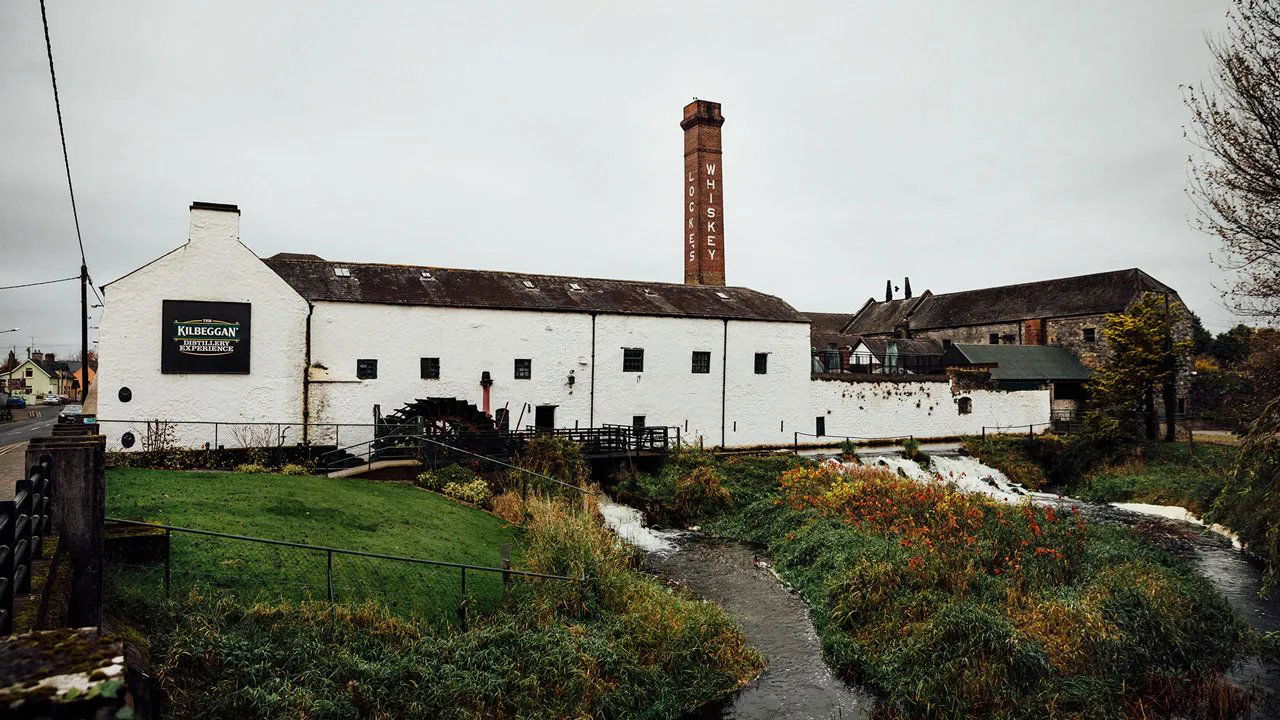
The Midlands town of Kilbeggan sits at the kind of crossroads that shaped pre-industrial Ireland: accessible by road from Dublin (roughly 90 kilometres west), positioned on the River Brosna, and close enough to the barley-growing heartland of Westmeath to have made grain supply a direct logistical matter. The distillery on Lower Main Street didn't emerge from a branding exercise or a craft-spirits boom. It was built when whiskey production in this part of Ireland was an unremarkable economic fact, the same way a mill or a tannery would have been. That context is what gives the site its specific character among Irish distilleries open to visitors today.
In a category that has seen rapid expansion — Dingle Distillery on the west coast, Powerscourt Distillery in Wicklow, The Shed Distillery in Drumshanbo — Kilbeggan occupies a distinct position. The newer entrants have architecture, design language, and visitor experiences built for the current premium-spirits market. Kilbeggan's physical plant predates that market by generations. Walking through the distillery means encountering original equipment, low ceilings, stone walls absorbing decades of spirit vapour, and the particular stillness that old industrial buildings develop when they've outlasted their original purpose and found a second one.
The Site as Evidence
The Pearl 3 Star Prestige rating awarded to Kilbeggan Distillery in 2025 places it in a recognised tier of Irish distillery experiences. That recognition matters partly because it confirms what the site offers is assessed, not assumed. Among Irish whiskey distilleries accessible to visitors , which now includes Jameson on Bow Street in Dublin, Redbreast in Midleton, and Tullamore D.E.W. less than 20 kilometres to the south , the range of experiences varies considerably by scale, production authenticity, and depth of historical context on offer. Kilbeggan's placement in the prestige tier signals it holds its own in that field on quality criteria, not just on heritage novelty.
The distinction matters for visitors making choices across the Irish Midlands. Tullamore D.E.W.'s visitor centre has the commercial infrastructure of a large international brand. Kilbeggan's operation is smaller, more contained, and oriented toward the mechanics and history of distilling rather than brand storytelling. Both are legitimate reasons to visit a distillery; they are simply different reasons, and knowing which you're after saves time.
Terroir in a Grain-Spirit Context
Editorial angle of terroir applies more readily to wine than to whiskey in most conversations, but the Irish Midlands makes a reasonable case for the concept. The barley varieties grown across Westmeath and the wider midland counties, the limestone-filtered water from local sources, and the ambient humidity of a river-adjacent mill environment all contribute to conditions that affect fermentation and maturation, even if those effects are harder to isolate than a specific vineyard's soil profile. Kilbeggan's location on the Brosna, in a part of Ireland where the land is flat, the climate is cool and damp, and the growing season produces grain at a pace dictated by Atlantic weather patterns, is not incidental to what gets made there.
This is a useful counterpoint to the more polished visitor experiences at distilleries positioned in scenic coastal or mountain settings. Dingle Distillery benefits from the marketing weight of the peninsula's landscape. Kilbeggan's setting is quieter, more agrarian, and more directly connected to the arable land that Irish whiskey has always depended on. Visitors who arrive via the Midlands route from Dublin pass through that countryside before they reach the distillery, which gives the location a contextual logic that more scenically dramatic settings sometimes lack.
Inside the Distillery
The physical experience of Kilbeggan is shaped by the building's age and the working nature of the facility. This is not a museum replica or a hospitality fit-out built around a viewing gallery; the equipment inside has production history behind it, and the distillery operates within its Irish whiskey context as an active participant in the category's recent revival. The pot stills, the wooden fermentation vessels, and the waterwheel driven by the Brosna all communicate a production logic that predates modern distillery design conventions.
For visitors accustomed to the visitor-centre format of larger operations like Jameson Bow St. , where the experience is calibrated for high throughput and brand immersion , Kilbeggan's smaller scale and closer proximity to actual equipment offers a different register. The practical details of visiting are worth checking directly with the distillery ahead of travel, as touring formats and availability can vary by season and group size. Kilbeggan is a working day trip from Dublin or a logical stop on an overland route through the Midlands toward the west.
Placing Kilbeggan in the Irish Distillery Map
Irish whiskey distilleries now span a wide range of formats, from the Midleton mega-complex in Cork, home to Redbreast and a dozen other expressions, to single-site craft operations like Slane Irish Whiskey in County Meath, which pairs its distillery with a Castle setting built around a different visitor demographic. Further afield, Waterford Distillery has made terroir traceability , single farm origin, documented barley provenance , its explicit commercial proposition in a way that has drawn attention from the wine world's vocabulary into whiskey criticism.
Kilbeggan operates differently from all of these. It is not a heritage brand scaled for global distribution, not a craft startup building an identity, and not a terroir-documentation project. It is the physical site of a distilling tradition that almost disappeared entirely in the twentieth century and was revived. That specific history gives it a character that none of the newer entrants can replicate, regardless of their design budgets or distribution reach. For context on comparable visitor distillery formats internationally, Aberlour in Scotland's Speyside offers a useful comparison point: an old-established distillery in a landscape defined by its production history rather than its tourism infrastructure.
Planning a Visit
Kilbeggan sits in County Westmeath, roughly midway between Dublin and Athlone on the N6 corridor, making it a natural stop for travellers crossing the Midlands by car. The town itself is small, and the distillery on Lower Main Street is the principal draw for most visitors passing through. For accommodation, dining, and further activity options in the area, our Kilbeggan hotels guide and our Kilbeggan restaurants guide cover the practical ground. Those planning a broader Midlands itinerary that includes whiskey experiences should also consult our Kilbeggan experiences guide and our Kilbeggan bars guide for context on what else the town and its surrounds offer.
Given the limited data publicly available on touring hours and booking requirements, contacting the distillery directly before arrival is advisable, particularly for group visits or off-peak travel periods. The Pearl 3 Star Prestige rating (2025) from EP Club establishes that the experience merits the detour; the practicalities of timing are worth confirming in advance. For visitors building a broader Irish whiskey itinerary, our full Kilbeggan wineries guide provides additional context on how the site fits into the regional picture.
FAQs: Kilbeggan Distillery
- What's the atmosphere like at Kilbeggan Distillery?
- The atmosphere is defined by the building itself: a stone-walled, river-adjacent mill with working equipment and a production environment that reads as industrial history rather than curated hospitality. It is quieter and more contained than the large visitor-centre distilleries. Given its 2025 Pearl 3 Star Prestige rating from EP Club and its location in a small Midlands town, visitors arriving expecting the scale of a Dublin operation like Jameson Bow St. will find something meaningfully different in tone and format.
- What's the must-try whiskey at Kilbeggan Distillery?
- Because the distillery is located in the Irish Midlands rather than a wine region, and operates without a named winemaker, the EP Club Pearl 3 Star Prestige award (2025) is the clearest signal of quality on offer. Specific expression recommendations are leading sourced directly from the distillery's current tasting programme, as the range available changes. For comparable award-recognised Irish distillery experiences, Redbreast in Midleton provides a useful peer reference on expression quality.
- What is Kilbeggan Distillery leading at?
- Kilbeggan's particular strength is historical depth: the site gives visitors access to the physical infrastructure of Irish whiskey production as it existed before the category's modern revival, in a setting that is working rather than reconstructed. The 2025 Pearl 3 Star Prestige rating from EP Club confirms that the experience delivers at a recognised quality level. For visitors in County Westmeath, it sits in a different register from newer, design-led distillery visitor centres elsewhere in Ireland.
- Is Kilbeggan Distillery reservation-only?
- Specific booking requirements are not confirmed in EP Club's current venue data. Given the distillery's small-town location in Kilbeggan and its Pearl 3 Star Prestige (2025) recognition, demand from visitors making dedicated detours is likely to affect availability, particularly in peak travel season. Contacting the distillery directly before arrival is the prudent approach, especially for groups or visits outside the main summer window.
- How does Kilbeggan Distillery compare to other historic Irish whiskey sites?
- Kilbeggan holds a 2025 Pearl 3 Star Prestige rating from EP Club, placing it in a recognised quality tier among Irish distillery experiences. What separates it from revived or newly built heritage-style operations is the continuity of the physical site: original equipment, original mill architecture, and a production location on the River Brosna that reflects the practical geography of pre-industrial Irish distilling. For visitors comparing it to Tullamore D.E.W., less than 20 kilometres south, the key difference is scale and brand infrastructure; Kilbeggan's experience is more contained and more directly centred on the mechanics of production history.
Recognition, Side-by-Side
A quick peer list to put this venue’s basics in context.
| Venue | Classification | Awards | First Vintage | Notes |
|---|---|---|---|---|
| Kilbeggan Distillery | 1 awards | This venue | ||
| Redbreast | 2 awards | |||
| Dingle Distillery | 1 awards | |||
| Jameson (Bow St.) | 1 awards | |||
| Slane Irish Whiskey | 1 awards | |||
| Teeling | 1 awards |
Access the Cellar?
Our members enjoy exclusive access to private tastings and priority allocations from the world's most sought-after producers.
Access the Concierge