
SantoWines, the cooperative winery in Pyrgos Kallistis, represents a collective model that shaped Santorini's modern wine identity. Holding a Pearl 2 Star Prestige rating for 2025, it sits among the island's most recognised producers, with a programme built around the volcanic terroir and Assyrtiko-led portfolio that defines the appellation. A visit here reads as much as wine education as it does a tasting.
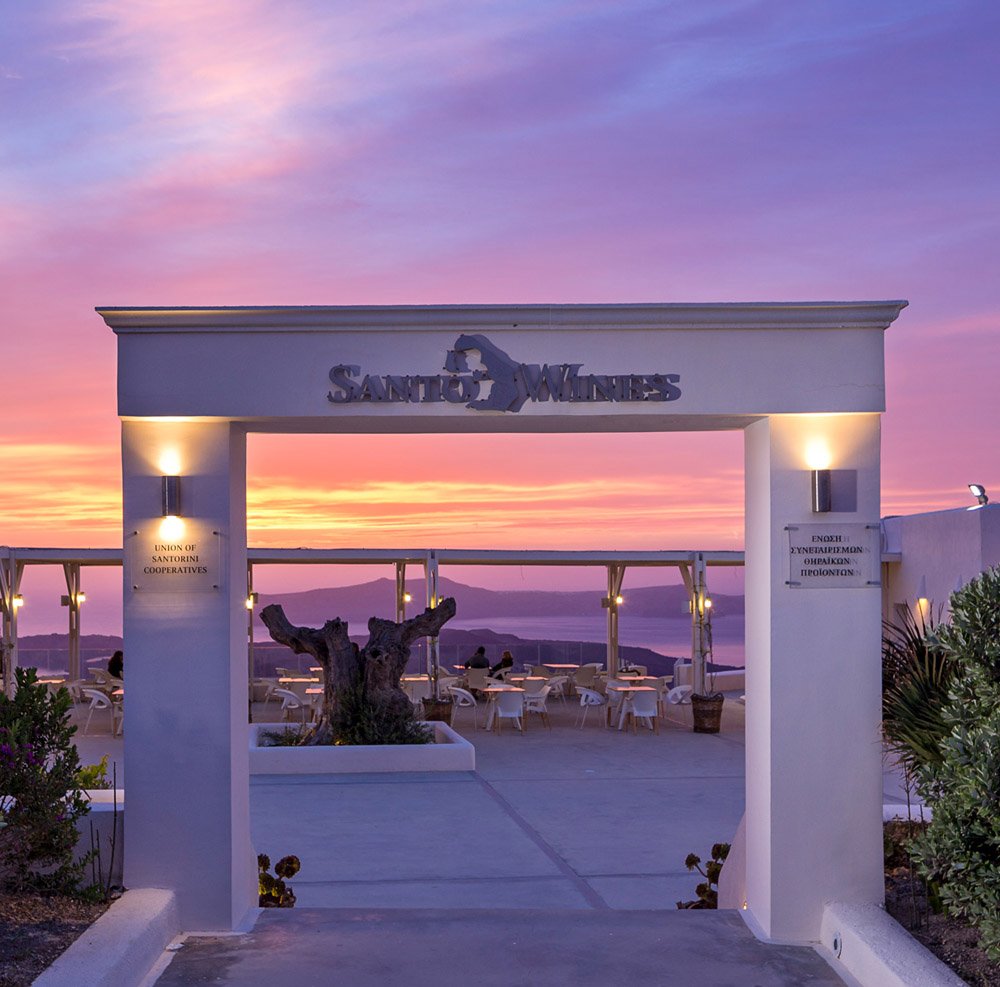
Where the Caldera Meets the Cooperative
Santorini's wine identity has always been communal before it was commercial. The island's cooperative tradition stretches back decades, born from the practical reality that small-parcel farming on volcanic ash soil made individual winemaking economically tenuous for most growers. SantoWines, operating from Pyrgos Kallistis, is the most direct expression of that cooperative logic — a producer formed by the collective weight of growers across the island rather than the vision of a single estate. That origin shapes everything about what happens in the cellar, and it sets SantoWines apart from the estate-led producers that now attract much of the international press attention.
The physical approach to the winery in Pyrgos, one of the island's inland villages and historically its highest, offers a different register from the cliff-edge tasting rooms of Oia or Imerovigli. The cooperative draws its grapes from vineyards spread across multiple micro-zones of the island, which means the blending decisions made here are inherently more complex than those of a single-terroir estate. It also means the programme carries an implicit responsibility: what SantoWines does with its barrels and aging decisions is partly a statement about how the island's collective viticultural output should be interpreted.
The Cooperative Model and What It Means in the Cellar
Cooperative wineries in Greece occupy a position that single estates rarely acknowledge publicly: they often hold the largest aggregate volumes of old-vine fruit in any given appellation. On Santorini, where basket-trained kouloura vines can reach 70 to 100 years of age and yields are among the lowest in Europe, the cooperative's access to grower parcels gives SantoWines a breadth of raw material that few individual producers can match in sheer variety of plot and vine age.
That breadth creates a particular challenge and opportunity in the aging programme. Where a small estate might vinify a single parcel and follow one barrel-aging path, a cooperative must make layered decisions: which parcels merit extended lees contact, which fractions are destined for stainless steel to preserve the reductive, mineral signature that defines entry-level Santorini Assyrtiko, and which selections might support wood. The latter question is contentious on Santorini. The island's winemaking community has long debated whether oak and Assyrtiko are compatible — the grape's naturally high acidity and saline edge can read as austere when barrel fermentation isn't managed with precision. At SantoWines, the scale of production means those decisions are made across a larger volume than peers like Estate Argyros or Artemis Karamolegos Winery typically encounter , a factor that either amplifies the consequences of good decisions or magnifies the cost of inconsistency.
Nykteri, Santorini's traditional oxidative white, is the category where aging decisions carry the most historical weight. Historically pressed late at night to avoid daytime heat and fermented in old barrel, Nykteri sits at the intersection of tradition and modern cellar technique. The question for any producer making it today is how much oxidative character to allow and how to balance that against freshness. SantoWines' cooperative structure, with access to multiple harvest batches and parcel profiles, gives it more blending latitude here than most.
Vin Santo and the Long Game
If Nykteri represents the overnight oxidative tradition, Vinsanto (the island's own spelling, distinct from Tuscany's Vin Santo) represents Santorini's most patient winemaking. Made from sun-dried Assyrtiko and Aidani grapes, aged in small barrels for a minimum of two years under Greek appellation law , and often considerably longer at serious producers , Vinsanto is the wine that most clearly tests a winery's commitment to its aging programme over commercial timelines.
For a cooperative, this is a meaningful investment. Extended barrel aging ties up capital and space, and the volumes required to make Vinsanto commercially relevant are large enough that growers must be willing to dedicate sun-drying capacity rather than sending all fruit to fresh vinification. SantoWines' position in Pyrgos, with infrastructure built for cooperative-scale production, gives it the physical capacity to age Vinsanto across multiple vintages simultaneously , a depth of inventory that smaller producers like Koutsoyannopoulos Winery or Boutari Winery (Santorini) manage at more limited scale.
The 2025 Pearl 2 Star Prestige award signals that the output across the range has reached a level of recognition that places SantoWines clearly in the island's upper tier , a competitive set that includes estate producers who have spent the last decade building international reputations on single-vineyard bottlings. Holding that position through a cooperative model, rather than the estate-winery narrative that dominates premium Greek wine marketing, is itself a meaningful signal.
Pyrgos and the Island's Inland Winery Circuit
Santorini's tasting room geography has a familiar pattern: the dramatic caldera-view venues attract the highest visitor numbers and command premium tasting fees, while inland producers in villages like Pyrgos and Megalochori operate in a quieter register that rewards the visitor willing to move beyond Oia. Pyrgos is the island's highest village, its Venetian castle ruins visible from most of the southern caldera rim, and the approach to SantoWines from the main island road gives a different orientation to the landscape than the cliff-leading experience.
For those building a Santorini winery itinerary, the inland circuit makes sense as a half-day structure. Canava Santorini Distillery (1974) and the producers concentrated in the central and southern plateau offer a counterweight to the more theatrical settings of the north. Planning visits to coincide with morning or early afternoon avoids the late-day tour-group volumes that accumulate at caldera-view tastings; SantoWines, as a cooperative with significant domestic and export production, operates at a scale where visitor infrastructure is developed rather than improvised.
Those building a broader picture of Greek winemaking beyond the Aegean islands can connect the Santorini cooperative model to producers elsewhere in the country. Achaia Clauss in Patras represents a different tradition of large-scale Greek wine production, while Acra Winery in Nemea shows how Agiorgitiko-led production in the Peloponnese intersects with the cooperative and estate models. International comparisons, such as Abraam's Vineyards in Komninades or Abadía Retuerta in Sardón de Duero, illustrate how estate-scale aging programmes operate in very different climatic and soil contexts.
Planning Your Visit
Visitors arriving on Santorini between late April and October will find SantoWines operating within the island's main tourist season; the months of May, June, and September offer the most workable combination of pleasant temperatures and manageable visitor volumes before and after the July-August peak. The winery is located in Pyrgos Kallistis, accessible by car from Fira in under fifteen minutes via the island's central road. Tasting format and reservation requirements should be confirmed directly before arrival, as cooperative-scale producers often have more flexible walk-in capacity than smaller estate cellars, though the summer months warrant advance planning regardless.
For those using SantoWines as a starting point for broader island exploration, EP Club's full Santorini wineries guide maps the complete producer landscape across all price points and styles. Adjacent guides covering Santorini restaurants, Santorini bars, Santorini hotels, and Santorini experiences provide the fuller picture for trip planning beyond the cellar door.
Frequently Asked Questions
- What should I taste at SantoWines (Santorini Coop)?
- The most instructive path through the range starts with the dry Assyrtiko, which gives the clearest expression of Santorini's volcanic-soil signature , high acidity, saline minerality, and citrus concentration that comes from low-yield, old-vine fruit. From there, Nykteri shows the oxidative tradition of the island, and Vinsanto demonstrates the aging programme at its most extended. As a cooperative with access to multiple grower parcels, the range covers more of the appellation's spectrum than most single-estate pours can. The 2025 Pearl 2 Star Prestige rating affirms that the quality across these categories meets a premium benchmark.
- What is SantoWines (Santorini Coop) known for?
- SantoWines is the island's primary cooperative producer, which means it occupies a distinct structural position relative to the estate wineries that dominate premium Santorini wine coverage. It is known for an Assyrtiko-anchored portfolio that runs from dry whites through to Nykteri and Vinsanto, a caldera-adjacent visitor operation in Pyrgos Kallistis, and a 2025 Pearl 2 Star Prestige recognition that places it in the island's recognised upper tier. The cooperative model gives it access to old-vine fruit from grower parcels across the island, which differentiates its blending base from single-estate producers.
- Do I need a reservation for SantoWines (Santorini Coop)?
- Cooperative-scale producers generally have more visitor capacity than small estate cellars, but Santorini's summer peak , roughly July through mid-August , places heavy demand on all island wineries. Arriving without a booking in high season carries real risk of long waits or limited tasting availability. Checking directly with the winery before arrival is advisable for any visit between June and September. The 2025 Pearl 2 Star Prestige status means SantoWines draws informed wine visitors in addition to general tourists, so demand runs beyond the casual caldera-view crowd.
- How does SantoWines differ from Santorini's private estate wineries?
- As a producer cooperative rather than a family or privately owned estate, SantoWines aggregates grapes from numerous member growers across the island's different zones, giving the cellar team a wider and more varied raw material base than most individual estates hold. This structure historically made cooperatives less fashionable in premium wine narratives, but it also means the blending programme here has more variables to work with , a genuine technical distinction. The 2025 Pearl 2 Star Prestige rating signals that the cooperative model, in the right appellation with the right vine material, produces output that sits comfortably alongside Santorini estate wines in recognised quality tiers.
Comparable Spots
A quick peer snapshot; use it as orientation, not a full ranking.
| Venue | Classification | Awards | First Vintage | Notes |
|---|---|---|---|---|
| SantoWines (Santorini Coop) | 1 awards | This venue | ||
| Estate Argyros | World's 50 Best | |||
| Artemis Karamolegos Winery | 1 awards | |||
| Boutari Winery (Santorini) | 1 awards | |||
| Canava Santorini Distillery (1974) | 1 awards | |||
| Kazianis Distillery | 1 awards |
Access the Cellar?
Our members enjoy exclusive access to private tastings and priority allocations from the world's most sought-after producers.
Access the Concierge