
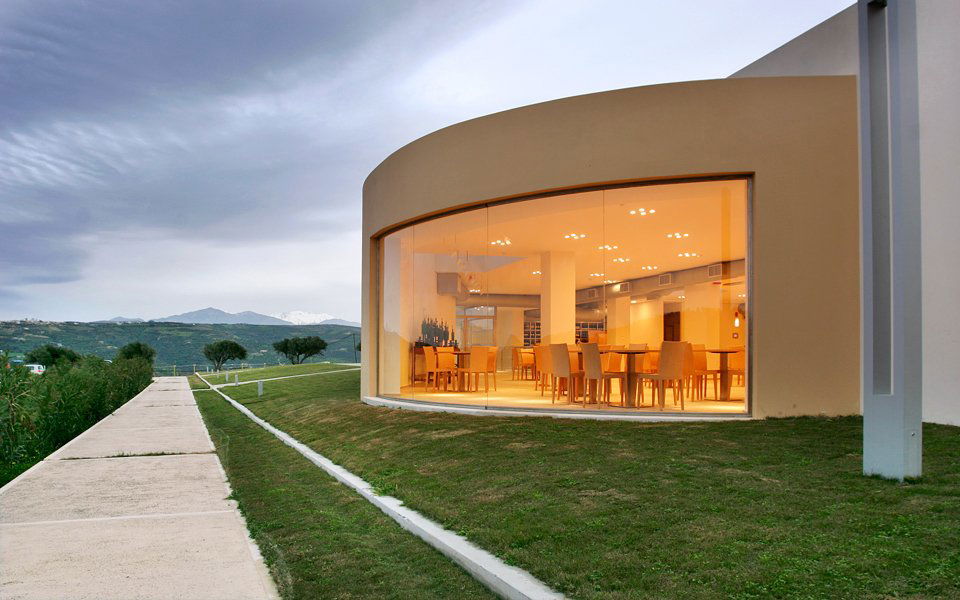
Boutari Winery sits in Megalochori, placing it among Santorini's established names in indigenous varietal production on the island's volcanic caldera soils. Recognised with a Pearl 2 Star Prestige award in 2025, the property represents one strand of a broader Greek wine story that began long before Assyrtiko became internationally traded. Visitors arrive for both the wines and the context they carry.
Volcanic Ground, Established Name
Santorini's wine identity is built on conditions that would defeat most viticulture elsewhere. Pumice and ash soils retain almost no water. Winds across the caldera reach speeds that would strip conventional trellising apart. The island's solution, developed over centuries, is the kouloura: low-trained vines coiled into basket shapes close to the ground, shielding fruit from the Meltemi while drawing moisture from the volcanic substrate below. It is this tradition, not any single producer's marketing strategy, that defines what Santorini wine is. Boutari Winery, located in Megalochori in the island's interior, operates within that tradition and carries the weight of a Boutari name that has been present in Greek wine commerce for generations.
The broader Boutari group stands as one of the longest-established wine operations in Greece, with origins in Northern Greece and eventual expansion to several appellations including Santorini. That institutional history places the winery in a different competitive register from the newer, smaller estate producers that have grown up around it. Where properties like Artemis Karamolegos Winery or Estate Argyros are defined by tighter family-scale production, Boutari brings a national-brand infrastructure to island appellation work. The distinction matters when reading what a bottle from each represents.
Megalochori and the Southern Interior
Most visitors arriving at Santorini gravitate immediately toward Fira or Oia, where caldera views dominate the experience. Megalochori sits further south, a quieter village whose character has not been remade entirely by tourism infrastructure. Winery visits in this part of the island tend to attract people who have already cycled through the obvious itinerary and are looking for something with more texture. The agricultural landscape here, with its low vines running across flat or gently sloping ground, reads differently from the dramatic cliff-leading scenery: it is the working island rather than the postcard version.
This positioning is relevant to how Boutari sits within the island's wine circuit. The concentrated cluster of well-known tasting rooms and visitor facilities lies partly to the north, around Pyrgos and Vothonas, where SantoWines (Santorini Coop) operates its large-format visitor centre with its caldera panorama, and where Koutsoyannopoulos Winery has built its underground wine museum. Boutari in Megalochori occupies a somewhat different geography, and that separation shapes the visit.
The Assyrtiko Question
Any serious engagement with Santorini wine begins and ends with Assyrtiko. The grape is the island's defining white variety, producing wines with high natural acidity, low pH, and a mineral profile that carries the character of the volcanic soil with unusual directness. Unoaked expressions tend toward citrus and saline notes with a lean, taut structure. Oak-aged versions, sometimes labelled as Nykteri or simply aged in barrel, develop more textural weight while retaining the variety's backbone. The debate between these two stylistic camps has sharpened as international demand for Santorini Assyrtiko has grown, with sommeliers in London, New York, and Tokyo increasingly treating it as a serious fine-wine proposition rather than a holiday curiosity.
Boutari's approach to Assyrtiko sits within the broader appellation context: the Santorini PDO governs minimum Assyrtiko content, yields, and geographical boundaries. Working within that framework, the winery produces wines that reflect the appellation's general profile while drawing on sourced fruit from island vineyards. The 2025 Pearl 2 Star Prestige recognition acknowledges the standard achieved within that structure. For reference, the Pearl award tier within EP Club's framework signals sustained quality at a prestige level, placing Boutari among the credentialled names in the island's peer set rather than at its experimental edges.
For comparison across the island's production styles, Canava Santorini Distillery (1974) occupies a different segment entirely, focused on Vinsanto and distilled products rather than dry white production, while Estate Argyros has built its reputation on biodynamic-adjacent farming and single-vineyard expressions. These are distinct ambitions, and visitors who understand the difference will get more from each stop.
Boutari in the Context of Greek Wine's Export Generation
Greece's fine wine story has been told largely through two lenses over the past two decades: the rise of indigenous varieties as internationally marketable appellations, and the shift from bulk-production heritage toward small-scale estate prestige. Boutari occupies a complicated position in that story. As a multi-regional producer with operations across several Greek PDOs, it predates the boutique-estate movement and carries associations with an earlier era of Greek wine commerce. That history is neither a disadvantage nor a distinction in itself; what it means in practice is that the winery's Santorini work is one part of a larger portfolio rather than a singular focus.
That differs from the model at properties like Abraam's Vineyards in Komninades or Acra Winery in Nemea, where the entire operation is organised around a single terroir. It also differs substantially from the approach at old-world producer-estates like Abadía Retuerta in Sardón de Duero, where centuries of a single site define the offering. Boutari's strength lies in the depth of its appellation knowledge across Greece and the institutional resources that come with a long-established commercial infrastructure.
For context on how major Greek producers have historically shaped the country's wine export identity, the comparison with Achaia Clauss in Patras is instructive. Both represent an era when Greek wine identity was built around established houses rather than individual estates, and both have had to define their positioning as the market has shifted toward boutique production. The fact that Boutari maintains a recognised presence in Santorini through to a 2025 award reflects that the transition has been managed rather than ignored.
Planning a Visit
Santorini's high season runs from late May through September, when visitor numbers across the island compress available time at tasting facilities. Arriving at wineries before midday in summer, or choosing to visit in May or October when crowds are lighter and temperatures more manageable, will generally improve the quality of time spent. Boutari's Megalochori address is accessible by car or scooter from the main island road; public transport to smaller villages on the island is limited, and most visitors arriving without a hire vehicle will need to account for taxi availability.
Booking arrangements and current hours are leading confirmed directly before travel, as seasonal operation patterns on Santorini can vary significantly. The full range of what the island's wine scene offers across different production styles is mapped in our full Santorini wineries guide, which covers the island's peer set in detail. For the broader island itinerary, our full Santorini restaurants guide, our full Santorini hotels guide, our full Santorini bars guide, and our full Santorini experiences guide provide the surrounding editorial context for building a visit around wine without reducing it to a single stop.
Frequently Asked Questions
- What is the leading wine to try at Boutari Winery (Santorini)?
- Assyrtiko is the starting point for any visit to a Santorini winery, and Boutari produces within the island's PDO framework, meaning its white wines carry the variety's characteristic high acidity and mineral register. The appellation mandates minimum Assyrtiko content and sets the parameters for both unoaked and aged styles. Boutari's Pearl 2 Star Prestige recognition in 2025 confirms quality at the appellation level. For broader regional comparison, Estate Argyros and Artemis Karamolegos Winery represent the island's other credentialled producers across a range of Assyrtiko styles.
- What is the defining thing about Boutari Winery (Santorini)?
- Boutari's Santorini presence is the island arm of one of Greece's longest-established wine houses, operating within the caldera's volcanic PDO appellation and holding a Pearl 2 Star Prestige award in 2025. Its distinction from smaller estate producers on the island lies in institutional depth and multi-appellation experience rather than single-terroir intensity. The winery is located in Megalochori, away from the heavily visited northern caldera strip.
- How far ahead should I plan for Boutari Winery (Santorini)?
- Santorini's peak season from June through August compresses available slots across the island's most visited wine facilities significantly. Visiting in May, September, or October allows more flexibility and more manageable conditions. Current booking details, opening hours, and visit formats should be confirmed directly with the winery before travel, as seasonal schedules vary and no booking information is publicly listed in this record. Arriving with confirmed arrangements rather than hoping for walk-in availability is advisable during high season.
Style and Standing
A quick look at comparable venues, using the data we have on file.
| Venue | Classification | Awards | First Vintage | Notes |
|---|---|---|---|---|
| Boutari Winery (Santorini) | 1 awards | This venue | ||
| Estate Argyros | World's 50 Best | |||
| Artemis Karamolegos Winery | 1 awards | |||
| Canava Santorini Distillery (1974) | 1 awards | |||
| Kazianis Distillery | 1 awards | |||
| Koutsoyannopoulos Winery | 1 awards |
Access the Cellar?
Our members enjoy exclusive access to private tastings and priority allocations from the world's most sought-after producers.
Access the Concierge