
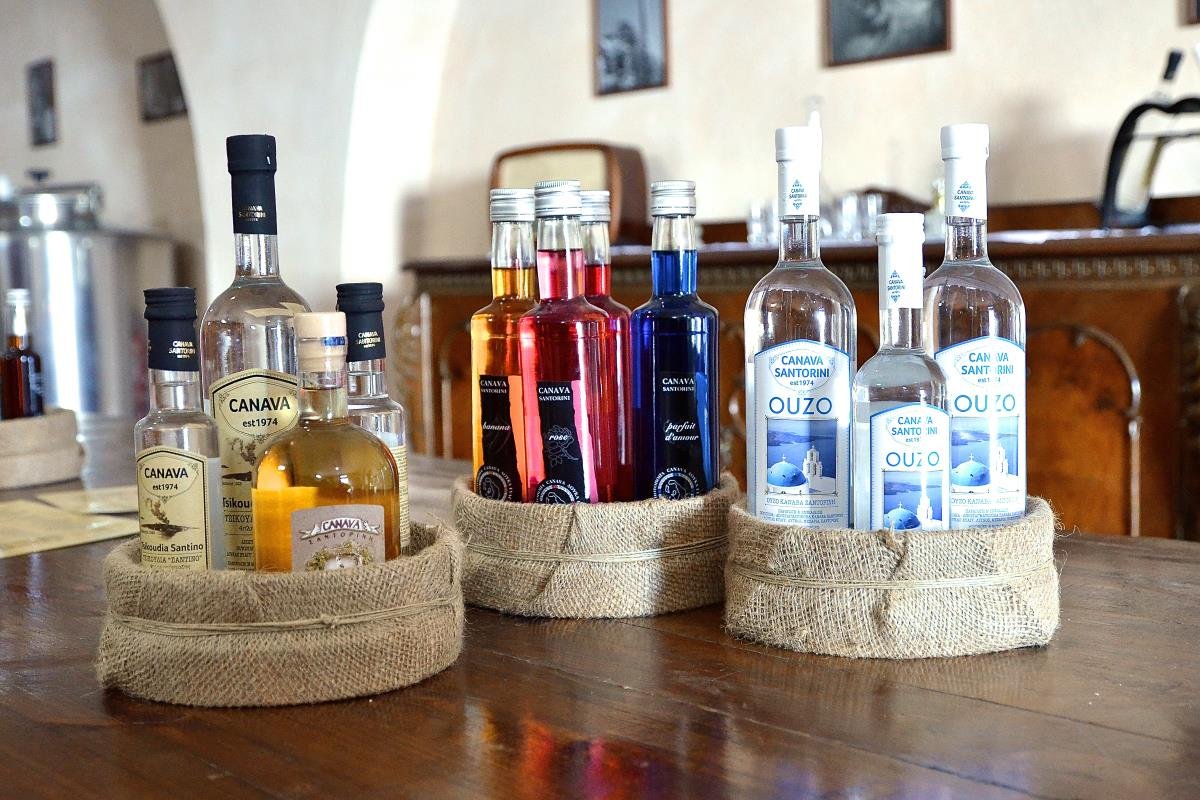
Canava Santorini Distillery (1974), located in Mesaria, sits inside the island's lesser-visited interior wine trail and holds a Pearl 2 Star Prestige rating for 2025. The property operates within a Santorini winery tradition shaped by volcanic soil, basket-trained vines, and Assyrtiko's briny mineral character. For visitors looking beyond the caldera-view tasting rooms, it represents a more grounded encounter with what the island actually produces.
Inside the Volcanic Interior: Santorini's Tasting Room Tradition
The caldera edge gets the photographs, but Santorini's wine story is told from the interior villages. Mesaria, one of the island's oldest agricultural settlements, sits at the centre of a vine-dense corridor where the soil is composed almost entirely of volcanic ash, pumice, and lava fragments deposited over centuries of eruption. This geology is not incidental to what ends up in the glass — it is the reason Santorini Assyrtiko tastes the way it does: high acidity, pronounced salinity, and a mineral tension that resists easy categorisation against Aegean whites from elsewhere in Greece.
Canava Santorini Distillery (1974) is positioned in that interior corridor, in Mesaria, away from the tourist infrastructure that clusters around Oia and Fira. The approach to this part of the island feels different from the cliffside circuit: narrower roads, lower stone walls, and a landscape shaped by agricultural use rather than hospitality design. The tasting experience here is filtered through that context — less theatrical than the caldera-view operations, more embedded in the physical reality of where these wines are grown.
The Tasting Format and What to Expect
Across Santorini's winery circuit, tasting room formats have diverged significantly over the past decade. Operations such as SantoWines (Santorini Coop) and Boutari Winery (Santorini) have built infrastructure around high-volume visitors, with panoramic terraces and structured guided tours. At the other end, properties like Estate Argyros and Artemis Karamolegos Winery have moved toward smaller-format, appointment-led visits that prioritise depth over throughput. Canava Santorini Distillery (1974) operates with a 2025 Pearl 2 Star Prestige rating, which positions it within a recognised tier of the island's wine offer, distinct from both entry-level cooperative tastings and the allocation-heavy collector-facing producers.
What defines a visit to wineries in this part of Mesaria is proximity to the production environment itself. The absence of elaborate terrace architecture and caldera sightlines focuses attention differently , on the cellar, the process, and the wines rather than the view. For visitors who have already done the scenic tasting room circuit, this contrast is part of the point.
The distillery designation in the name is also worth noting. Santorini has a tradition of producing Vinsanto, the island's oxidative dessert wine made from sun-dried Assyrtiko and Aidani grapes, alongside its dry whites. Some producers also work with grape spirits. The 1974 date in the property's name signals an establishment that predates the modern premium wine tourism wave that reshaped the island's winery sector from the 1990s onward , a period when international recognition for Santorini PDO wines began attracting serious investment and redesign.
Santorini's Wine Context and Where This Fits
Santorini's protected designation of origin covers a narrow but intensely characterful wine zone. The island's vines are trained in a low-to-the-ground basket form called kouloura, a technique developed to protect grapes from the fierce Aegean winds and to trap the morning dew that supplements scarce rainfall. These vines, some exceeding a century in age, have never been grafted onto phylloxera-resistant rootstock , the volcanic ash soil is hostile to the pest , which makes Santorini one of the few places in Europe where pre-phylloxera vine genetics remain intact in commercial production.
Assyrtiko dominates the PDO, accounting for the vast majority of dry white production. Its character varies by winemaker intervention and aging vessel: stainless steel preserves the citrus and iodine freshness; oak aging, used selectively by producers such as Koutsoyannopoulos Winery, adds texture and complexity. Vinsanto, requiring a minimum of two years aging in oak, occupies a different category entirely , amber, oxidative, and concentrated in a way that requires patience from both producer and drinker.
For anyone building a serious itinerary around Santorini's wine production, our full Santorini wineries guide maps the island's producers across style, format, and visitor orientation. Canava Santorini Distillery (1974) represents one point on that map: a Mesaria-based operation with a prestige-tier rating, a founding date that places it in an older generation of island producers, and a physical address that keeps it connected to the agricultural interior rather than the tourist periphery.
Placing It in the Greek Wine Picture
Greek wine has undergone sustained critical reassessment since roughly 2010, with indigenous varieties attracting serious attention from international critics and sommeliers. Assyrtiko is the most widely traded of these, appearing on high-end restaurant lists in London, New York, and Tokyo. Santorini production competes within that refined segment , not on price alone, but on provenance specificity. The volcanic-soil, wind-trained, century-old-vine narrative is verifiable and distinct in a way that few other wine regions can replicate.
Comparison with other historic Greek wine operations is instructive. Achaia Clauss in Patras represents a very different Greek wine tradition: large-scale, historically export-oriented, rooted in the Peloponnese rather than the Cyclades. Abraam's Vineyards in Komninades and Acra Winery in Nemea anchor in the Nemean red wine tradition, dominated by Agiorgitiko, which sits in an entirely separate stylistic register from Santorini whites. Even international parallels , the volcanic terroir wines of the Canary Islands or the island-grown whites of Sicily , fall short of matching Santorini's specific combination of ancient vine age, isolation, and PDO framework.
For a wider sense of how premium wine tourism operates across very different geography and tradition, the contrast with Abadía Retuerta in Sardón de Duero is useful: that property represents the other end of the wine estate spectrum , a Castilian monastery-hotel winery built around Tempranillo and Syrah, with luxury accommodation integrated into the estate. The Mesaria approach is more austere, more production-focused, and without the hospitality infrastructure that defines the Iberian luxury wine estate model. Similarly, the distillery tradition at work in Santorini shares almost nothing stylistically with Aberlour in Aberlour, whose Speyside single malt operation works with a completely different raw material, climate, and distillation logic , though both properties are recognised in their respective prestige tiers.
Planning a Visit
Mesaria is accessible from Fira in under ten minutes by car, making it practical to combine a visit here with other interior-village stops before or after hitting the caldera-facing operators. The village sits roughly central to the island, which also makes it a logical base point for covering the southern wine corridor toward Akrotiri or the northern route toward Oia. Given the absence of confirmed booking and hours data for this property, direct contact or in-person inquiry is advisable before building a fixed itinerary around it.
For the broader Santorini trip, our full Santorini restaurants guide covers where to eat across price points and styles, our full Santorini hotels guide maps accommodation from design boutiques to caldera-view classics, and our full Santorini bars guide covers the drinking scene beyond wine. Our full Santorini experiences guide includes non-winery activities for those building a multi-day programme around the island.
Frequently Asked Questions
What wines should I try at Canava Santorini Distillery (1974)?
The answer follows directly from the island's PDO framework rather than any house-specific programme we can confirm. Santorini's two principal categories are dry Assyrtiko whites and Vinsanto, the oxidative dessert wine. The dry Assyrtiko is the place to start on any serious tasting visit: it is the expression most clearly marked by the volcanic soil and ancient vine age that define the island's wine identity. Vinsanto, if available, represents the other pole of Santorini production , concentrated, amber, and built for slow appreciation. For comparative context, the same categories appear across producers like Estate Argyros and Artemis Karamolegos Winery, making a multi-stop tasting day across Mesaria and the surrounding villages a coherent way to understand how winemaker decisions shape these same base varieties differently.
What is Canava Santorini Distillery (1974) leading at?
Its 2025 Pearl 2 Star Prestige rating places it in a recognised prestige tier within Santorini's winery offer. The property's address in Mesaria and its 1974 founding position it as an interior-facing, older-generation producer at a point in the island's wine circuit where visitor numbers thin out and the agricultural context of the vines remains more immediately legible. For travellers who have already covered the high-traffic caldera-view tasting rooms , operations like Boutari Winery (Santorini) or SantoWines (Santorini Coop) , Canava Santorini Distillery (1974) offers a different register: lower theatrical quotient, closer to the production source, and carrying formal recognition that substantiates the visit.
A Lean Comparison
A quick snapshot of similar venues for side-by-side context.
| Venue | Classification | Awards | First Vintage | Notes |
|---|---|---|---|---|
| Canava Santorini Distillery (1974) | 1 awards | This venue | ||
| Estate Argyros | World's 50 Best | |||
| Artemis Karamolegos Winery | 1 awards | |||
| Boutari Winery (Santorini) | 1 awards | |||
| Kazianis Distillery | 1 awards | |||
| Koutsoyannopoulos Winery | 1 awards |
Access the Cellar?
Our members enjoy exclusive access to private tastings and priority allocations from the world's most sought-after producers.
Access the Concierge