

Among Santorini's most respected estates, Argyros operates at the intersection of volcanic terroir and living vine history, with some individual plants surpassing two centuries in age. The winery holds a Pearl 2 Star Prestige rating for 2025 and anchors the island's organic wine identity. Its address at Episkopi Gonias places it in the quieter, agricultural interior rather than the tourist circuit of the caldera edge.
Vines Older Than the Modern Greek State
Santorini's wine culture is built on a paradox: the island receives almost no rainfall, sits on volcanic pumice and ash, and is battered by the Aegean's summer meltemi winds, yet it has sustained continuous viticulture for thousands of years. The mechanism is the kouloura, the basket-shaped vine training system that Santorini growers developed to protect fruit from the wind and gather moisture from overnight condensation. What makes Estate Argyros distinct within this tradition is the age of the plant material working within that system. Some vines on the property exceed two centuries in age, placing them among the oldest productive vinifera in the world, predating Greek independence and the phylloxera epidemic that erased most of Europe's pre-modern vine stock in the late nineteenth century. Those plants are not a heritage attraction. They are the operational centre of the estate's viticulture.
Approaching Episkopi Gonias
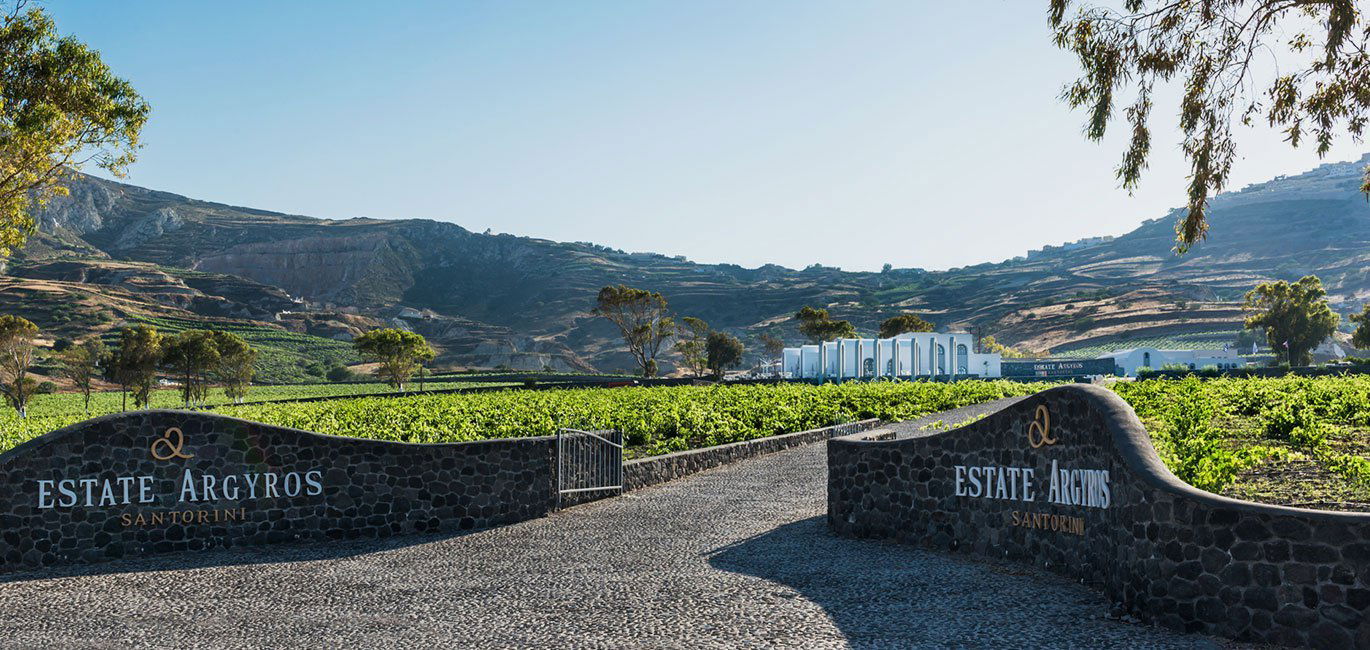
The caldera villages of Oia and Fira draw the majority of visitors to Santorini's wine circuit, but the island's serious viticulture has always sat further inland. The road to Episkopi Gonias moves through the island's agricultural interior, where the terrain flattens into the volcanic plateau and the view opens toward the sea on multiple sides without the drama of cliff-edge architecture. The estate sits in this quieter register of the island, surrounded by the low-slung, trained vines that define the Santorini vineyard aesthetic: no trellises, no vertical canopy, just the gnarled basket shapes pressed close to the volcanic soil. Arriving at Argyros in this context, the physical environment communicates scale and continuity before any wine has been poured. The vines crowd the ground with a density that suggests deep root systems rather than recent planting, and the absence of irrigation infrastructure is conspicuous. These plants are entirely dry-farmed, drawing moisture from the volcanic subsoil, which is why their age is credible rather than decorative. For context on how other producers in the same appellation handle their terroir, Artemis Karamolegos Winery and Boutari Winery (Santorini) represent different scales of operation within the same volcanic framework.
The Organic Certification in Context
Organic certification in a European wine context has become common enough to function as a baseline expectation at the premium end of the market rather than a differentiating claim. On Santorini, however, it carries specific meaning. The island's extreme aridity suppresses the fungal pressure that makes organic farming difficult in wetter European wine regions, and the volcanic soil's mineral composition means that intervention farming was always less necessary than in, say, Burgundy or Bordeaux. Estate Argyros operates as a certified organic estate, which in this environment means the certification reflects a philosophical alignment with natural viticulture rather than a logistical achievement. The distinction matters when evaluating the wines against peer producers: SantoWines (Santorini Coop) and Koutsoyannopoulos Winery occupy different positions in the island's quality and volume spectrum, and organic certification at Argyros's scale is part of the signal that separates estate-focused production from co-operative blending. Greece's broader wine geography offers other reference points for organics and estate focus: Abraam's Vineyards in Komninades and Acra Winery in Nemea each demonstrate how diverse the country's approach to estate viticulture has become across different appellations.
Assyrtiko and the Volcanic Expression
Santorini's primary white grape, Assyrtiko, has become one of the more discussed varieties in serious wine circles over the past decade, partly because it expresses volcanic minerality with unusual clarity and partly because it ages with a structural integrity that few white varieties from warm climates can match. The grape's high natural acidity is a direct product of the island's stress-farming conditions: low yields, intense UV exposure, and very low water availability concentrate the grape's acid and mineral profile rather than its fruit weight. Wines from old-vine Assyrtiko sources, such as the Argyros estate, typically show a more saline, linear character than younger plantings, and the difference in vine age between a twenty-year-old plot and a two-hundred-year-old one is detectable in the wine's texture and length. This is not a marginal distinction. Old-vine material produces lower yields from deeper, more complex root systems, and the resulting wine has a concentration and structure that newer plantings in the same volcanic soil cannot replicate on the same timeline. For a sense of how the island's Assyrtiko expression differs from producer to producer, the Canava Santorini Distillery (1974) offers a different lens on what the island's raw material can become when processed beyond table wine.
The 2025 Pearl 2 Star Prestige Rating
Estate Argyros holds a Pearl 2 Star Prestige rating from EP Club for 2025, placing it within the estate's peer group at the upper tier of Santorini's quality hierarchy. The Pearl rating system is EP Club's framework for positioning producers against their regional and stylistic peers, and two stars at the Prestige level indicates a producer operating with consistent quality signals: certified organic viticulture, demonstrably old vine material, and estate-specific production at a scale that supports meaningful quality control. Against the broader Greek wine map, this positions Argyros alongside the serious estate producers that have driven international recognition of Greek wine over the past two decades. Greece's wine culture has produced prestige-level properties across multiple regions, from large historic operations like Achaia Clauss in Patras to internationally distributed estates, and Argyros sits within a smaller, more terroir-specific cohort focused on a single appellation. For international comparison of what old-vine estate production looks like in other European frameworks, Abadía Retuerta in Sardón de Duero offers a useful contrast in terms of scale and continental European estate philosophy.
Planning a Visit
The estate is located at Episkopi Gonias 847 00 in the island's interior. Visitors to Santorini who orient their itinerary around the caldera villages will find the estate requires a deliberate side trip rather than a casual drop-in, which is part of its character. The island's winery circuit rewards those who build time into their itinerary specifically for the agricultural inland, away from the sunset-viewing infrastructure of the western cliffs. The surrounding area of Episkopi Gonias provides a grounded view of the island's actual physical geography. The contact details on file are limited, so reaching out through the estate's web presence or through local accommodation concierge services is the most reliable approach for booking visits. For a fuller picture of how the winery fits within the island's hospitality scene, the full Santorini wineries guide maps the island's producers across quality tiers and visit formats. Those building a longer Santorini stay around wine, food, and accommodation will find the full Santorini restaurants guide, full Santorini hotels guide, full Santorini bars guide, and full Santorini experiences guide useful for structuring time across the island. For those building a broader study of European estate production, Aberlour in Aberlour represents a distinctly different production tradition that nonetheless shares the emphasis on a specific place and long continuous history.
FAQs
- What is the atmosphere like at Estate Argyros?
- Estate Argyros is located in the agricultural interior of Santorini at Episkopi Gonias, away from the caldera's cliff-edge tourism infrastructure. The setting is defined by the physical presence of the vineyard itself: low, basket-trained vines on volcanic soil, dry-farmed and organic, with some individual plants exceeding two centuries in age. The atmosphere is quiet and agricultural rather than scenic in the dramatic Santorini sense, which makes it a different category of visit from the caldera-facing tasting rooms closer to Fira or Oia. The estate holds a Pearl 2 Star Prestige rating from EP Club for 2025, positioning it at the serious end of the island's wine circuit.
- What wine is Estate Argyros famous for?
- Estate Argyros is most closely associated with Assyrtiko-based wines from old-vine material, with some of the estate's vines documented at over two hundred years of age. Santorini's Assyrtiko is the island's signature variety, known for its high acidity, volcanic minerality, and capacity to age in a way unusual for white wines from warm-climate regions. The estate operates under organic certification, and the combination of ancient vine stock, volcanic terroir, and low-intervention viticulture positions its wines within the island's premium tier. For a full picture of Santorini's wine production, the Santorini wineries guide provides broader context.
Category Peers
A short peer set to help you calibrate price, style, and recognition.
| Venue | Classification | Awards | First Vintage | Notes |
|---|---|---|---|---|
| Estate Argyros | World's 50 Best | This venue | ||
| Artemis Karamolegos Winery | 1 awards | |||
| Boutari Winery (Santorini) | 1 awards | |||
| Canava Santorini Distillery (1974) | 1 awards | |||
| Kazianis Distillery | 1 awards | |||
| Koutsoyannopoulos Winery | 1 awards |
Access the Cellar?
Our members enjoy exclusive access to private tastings and priority allocations from the world's most sought-after producers.
Access the Concierge