
One of Greece's oldest operating wineries, Achaia Clauss sits above Patras on the Peloponnese's northwestern edge, where altitude and Adriatic-influenced winds shape the character of its wines. A 2025 Decanter Silver medal and a Pearl 3 Star Prestige award confirm its continued international standing. The estate is among the few in the region where the history of Greek wine and its present-day quality signals occupy the same ground.
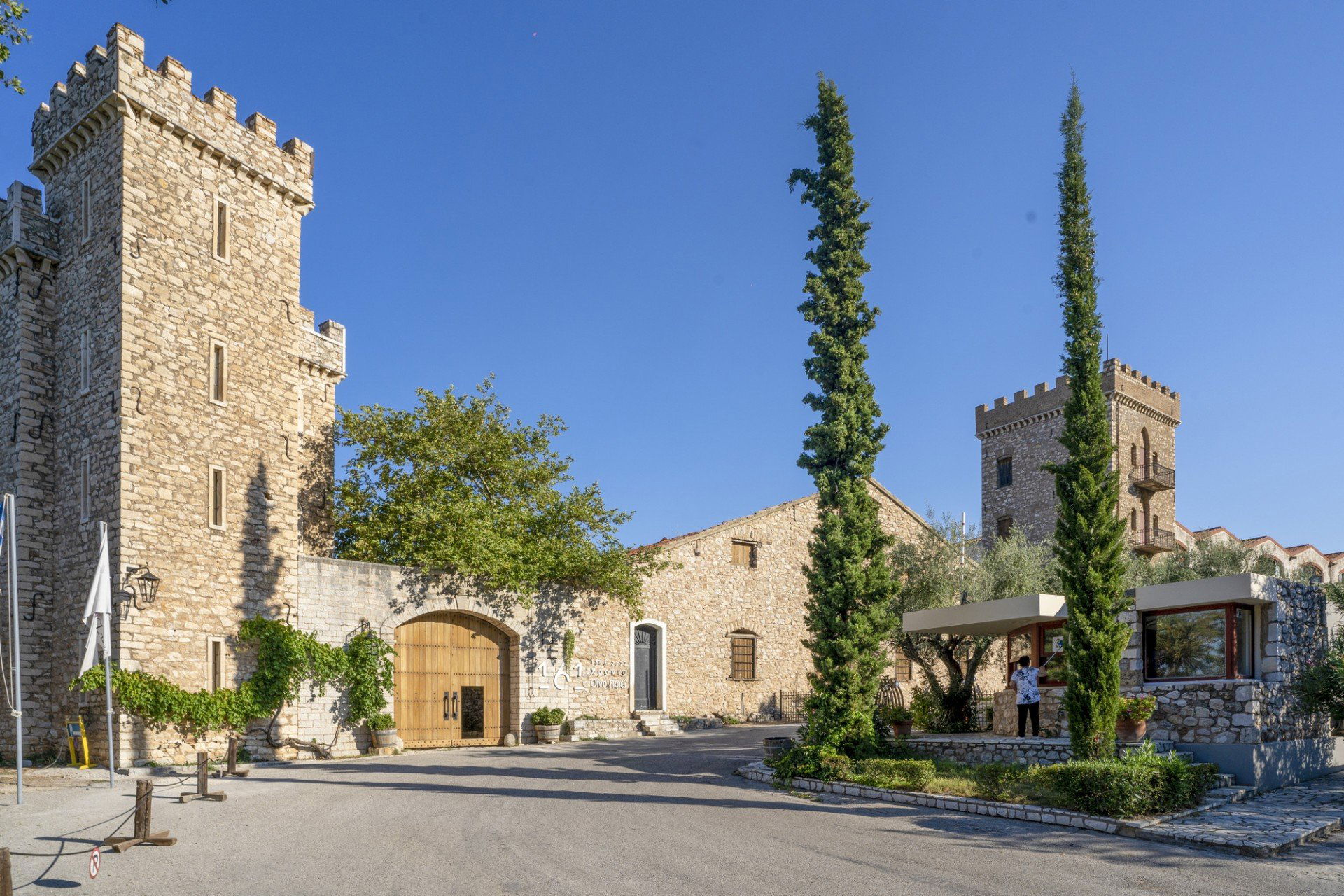
The road up to Achaia Clauss climbs past olive groves and scrub before the estate's stone buildings come into view, set against a hillside that looks out toward the Gulf of Patras. The architecture carries the weight of the nineteenth century without apology: thick walls, vaulted cellars, and the kind of spatial seriousness that accumulates over generations of production rather than being designed in. The setting is not incidental. It is an argument about how place and time shape wine, and it has been making that argument since the winery's founding in the 1860s.
The Peloponnese's Northwest Edge and What It Produces
Patras sits at the northwestern tip of the Peloponnese, where the Gulf of Patras opens toward the Ionian Sea. The city's wine geography is defined by altitude variation, limestone-heavy soils, and a climate that receives cooling maritime influence from the west while retaining the warmth typical of southern Greece. These conditions have historically favoured aromatic whites and the fortified wines that made the region's international reputation in the nineteenth and early twentieth centuries. Mavrodaphne of Patras, a protected designation of origin for a sweet red wine aged oxidatively in barrel, remains the category most directly tied to this terroir, alongside Muscat of Patras, which expresses the aromatic intensity the local conditions amplify.
Within the broader context of Greek wine, the Patras PDO and its sub-appellations represent a category that spent several decades in the shadow of Nemea and Santorini before attracting renewed critical attention. That renewed attention is partly driven by producers here at the northwestern edge demonstrating that the region's historical categories, and its lesser-known dry whites, merit serious evaluation. Achaia Clauss operates inside that longer arc, representing continuity with the period when Patras wines were among the most exported from Greece, alongside contemporaries like Antonopoulos Vineyards and Parparoussis Winery, which approach the same regional palette from different technical directions.
Terroir Expression at the Cellar Level
The estate's elevation above the city is not a minor variable. Cooler nights at altitude extend the growing season marginally and preserve acidity in grapes that would otherwise ripen faster on the valley floor. For the fortified categories, this baseline acidity interacts with the oxidative ageing process in ways that distinguish Patras Mavrodaphne from counterparts produced in hotter, lower-lying zones. The winery's cellars, some of the oldest continuously operating barrel-ageing spaces in Greece, provide the conditions for long oxidative maturation: consistent temperature, humidity, and the concentration of microflora that accumulates only in spaces used for wine for more than a century.
Decanter's 2025 recognition of a Silver medal across the estate's submitted wines, alongside a Pearl 3 Star Prestige award in the same year, places Achaia Clauss in a tier where international judges are confirming what regional context suggests: these are wines whose character reflects specific and identifiable origins, not generic production. The Decanter World Wine Awards applies consistent judging criteria across tens of thousands of entries annually, making a Silver at that scale a substantive credential rather than a courtesy recognition.
Patras in the Greek Wine Geography
Understanding Achaia Clauss requires understanding where Patras fits in the national map. Greek wine's international profile has been dominated in recent decades by the volcanic soils of Santorini and Assyrtiko, and by the Agiorgitiko reds of Nemea. The northwestern Peloponnese operates somewhat apart from that conversation, producing categories that are structurally different: sweeter, more oxidative, and more historically rooted in export markets than in the domestic fine-dining circuit that drove the Greek wine renaissance of the 1990s and 2000s. Producers like Abraam's Vineyards in Komninades and Acra Winery in Nemea illustrate how different parts of the Peloponnese have developed distinct identities within the same regional framing.
The fortified wine category globally has faced declining volume consumption while gaining renewed interest from sommeliers and collectors working with aged examples. Patras's two PDO fortified designations, Mavrodaphne and Muscat, both lend themselves to extended ageing, and the oldest vintages held in estates like Achaia Clauss represent a genuinely rare category of Greek wine: mature, complex, and largely unavailable through standard distribution channels. For comparison, oxidatively aged sweet wines from established European regions, Madeira, Vin Santo, Pedro Ximénez Sherry, command significant premiums at auction; the aged Mavrodaphne category remains comparatively undervalued by those benchmarks.
The Estate as a Point of Reference for the Region
Patras has a diverse production ecosystem. Beyond wine, the city is home to spirits producers including Loukatos Distillery, Notos Distillery, and Papadimitriou Distillery (Tentoura Kastro), the last of which produces Tentoura, a regional spiced liqueur with deep local identity. This layered production culture positions Patras as a city where food and drink heritage is broader than wine alone, though wine remains its most internationally documented category.
Within the winery peer set specifically, Achaia Clauss occupies a distinctive position by virtue of its scale of historical documentation and its cellars' physical continuity. Wineries in northern Greece such as Aidarinis Winery in Goumenissa demonstrate how Greek regions more broadly are producing wines that read internationally; the Patras context is different in that its claim rests partly on tradition and partly on the specific terroir argument for fortified and aromatic styles. For visitors to the region, the contrast between estates here and internationally recognised producers further afield, such as Abadía Retuerta in Sardón de Duero or Aberlour in Aberlour, illustrates how estate heritage functions differently across wine and spirits cultures.
Planning a Visit
Achaia Clauss is located at Petrotou, Patra 262 23, on the hillside above the city centre. The estate is accessible from central Patras by car in under fifteen minutes, and the drive rewards the effort by arriving at a property whose elevation offers a different perspective on the Gulf of Patras below. For visitors organising a wider Patras itinerary, the full Patras wineries guide maps the regional producer landscape, while the Patras restaurants guide, bars guide, hotels guide, and experiences guide cover the broader city offer. Given that specific hours, booking methods, and contact details are not currently published through standard channels, confirming visit arrangements directly with the estate before travel is advisable, particularly outside the main summer season when cellar tour schedules can vary.
Frequently Asked Questions
- What should I taste at Achaia Clauss?
- The wines most directly tied to this estate's terroir and history are from the Patras PDO designations: Mavrodaphne of Patras, an oxidatively aged sweet red with protected origin status, and Muscat of Patras, which reflects the aromatic concentration the region's maritime and altitude conditions produce. The 2025 Decanter Silver medal and Pearl 3 Star Prestige award indicate that the estate's current production is holding to an internationally assessable standard, making these the logical reference points for a tasting visit.
- What's the main draw of Achaia Clauss?
- The combination of continuous production history dating to the 1860s and current-day international recognition sets Achaia Clauss apart from newer producers in Patras and across the Peloponnese. Located above the city with views toward the Gulf of Patras, the estate offers cellar access to one of Greece's oldest wine-ageing environments. The 2025 Decanter Silver and Pearl 3 Star Prestige awards confirm that historical credentials and current production quality are not in conflict here.
- How far ahead should I plan for Achaia Clauss?
- Because specific booking systems and current operational hours are not publicly confirmed through standard channels, planning with flexibility is sensible, particularly if visiting outside peak summer months when estate schedules in the Peloponnese tend to contract. Building the visit into a broader Patras itinerary, which might include other regional producers and the city's spirits distilleries, reduces the cost of any scheduling uncertainty. For the most direct confirmation of availability, contacting the estate via its official channels before finalising travel dates is the reliable approach.
- Is Achaia Clauss one of Greece's oldest continuously operating wineries?
- Founded in the 1860s, Achaia Clauss is among the earliest established wine estates in Greece with documented continuous production, placing it in a small category of European wineries where the physical cellars, the regional designations, and the production methods have coexisted across more than 150 years. That continuity is directly relevant to the character of its aged fortified wines, where the cellar environment itself, accumulated microflora, barrel histories, and consistent temperature, contributes to the wine's profile in ways that cannot be replicated at younger facilities. The Pearl 3 Star Prestige award in 2025 and the Decanter Silver recognition confirm that this historical depth is accompanied by current production merit.
Side-by-Side Snapshot
Comparable venues for orientation, based on our database fields.
| Venue | Classification | Awards | First Vintage | Notes |
|---|---|---|---|---|
| Achaia Clauss | 1 awards | This venue | ||
| Antonopoulos Vineyards | 1 awards | |||
| Loukatos Distillery | 1 awards | |||
| Notos Distillery | 1 awards | |||
| Papadimitriou Distillery (Tentoura Kastro) | 1 awards | |||
| Parparoussis Winery | 1 awards |
Access the Cellar?
Our members enjoy exclusive access to private tastings and priority allocations from the world's most sought-after producers.
Access the Concierge