
Kyrö Distillery Company operates from Isokyrö, a small Finnish town in Ostrobothnia with a grain-farming heritage that feeds directly into the distillery's rye-forward production. Awarded Pearl 3 Star Prestige in 2025, Kyrö has positioned itself as a reference point for Nordic craft spirits, drawing visitors to a region that rewards the detour with serious whisky and gin made from local ingredients.
 Discover on Pearl
Pearl is the En Primeur Club membership app — saves, bookings, and concierge access live there. Same editors, same standards.
- Address
- Oltermannintie 6, 61500 Isokyrö
- Phone
- +358 10 5677971
- Website
- kyrodistillery.com
Grain, Frost, and the Fields of Ostrobothnia
The flat agricultural plains of Ostrobothnia are not where most spirits tourists expect to find a reference-level distillery. Isokyrö sits roughly 50 kilometres east of Vaasa in western Finland, a town whose economy has long tracked the rhythms of rye farming and seasonal labour. That agricultural identity is not incidental to Kyrö Distillery Company, it is the operating logic. Finnish rye, grown in the same short, frost-sharpened growing seasons that define the region's character, forms the backbone of what Kyrö produces, and the distillery's placement in our full Isokyrö guide reflects how seriously the town's craft credentials now register on a European spirits map.
In craft distilling, terroir arguments are still contested: some producers maintain that grain provenance shapes finished spirit in ways analogous to wine; others treat it as marketing shorthand. Kyrö occupies the more committed end of that debate. Ostrobothnian rye brings specific starch characteristics and a phenolic density that distinguishes it from neutral grain bases, and the Finnish climate imposes a slow, cold maturation dynamic that affects barrel interaction differently than warmer Scottish or American conditions. The resulting spirits carry a grain-forward quality that reflects that sourcing.
A Dairy Hall Turned Production Floor
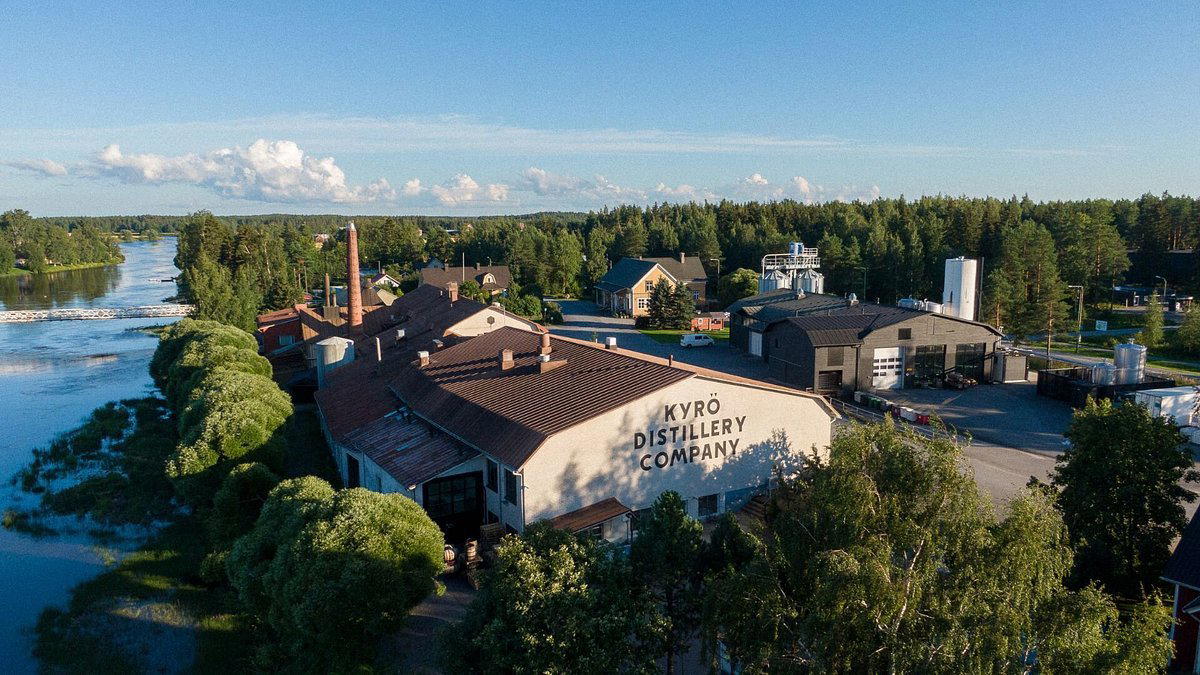
Approaching the distillery, the setting immediately communicates its provenance. The production facility occupies a former dairy, a red-painted rural building that shares its architectural vocabulary with every other functional farm structure on the Ostrobothnian plain. There is no landscaped approach, no boutique hospitality signage angled for social media framing. What registers instead is a working environment: the faint sweetness of fermenting grain on certain mornings, the low mechanical hum of stills in operation, the practical geometry of a building repurposed for precision manufacturing rather than heritage tourism.
While Scottish distilleries have built elaborate visitor centres designed around whisky as romantic narrative, and American bourbon houses have invested in experiential architecture that sells a mythologised South, Finnish producers have tended toward transparency about process. Helsinki Distilling Co. takes a similar approach in an urban format; Kyrö's version plays out in a genuinely rural context where the surroundings substantiate the production claims rather than merely decorating them.
Kyrö Distillery Company earned a Pearl 3 Star Prestige award in 2025. In the European craft spirits market, that kind of recognition carries weight beyond domestic audiences. Finland's whisky scene remains smaller than Scotland's or Ireland's by several orders of magnitude, and the peer group at this quality tier is narrow. For comparison, consider the depth of field in winemaking regions: Aberlour in Speyside operates with decades of category-defining recognition behind it, and Aldo Conterno in Monforte d'Alba holds generational credibility in Barolo. Kyrö's equivalent credibility is being built faster and within a far smaller national tradition, which makes the 2025 rating a more pointed signal than the same award would be in a mature category.
The distillery's standing reflects how regional grain character and production discipline shape its spirits. The structural point, across both cases, is that climate, local grain character, and production discipline can produce spirits that hold against any regional comparable set.
Rye as a Lens on Nordic Agricultural Identity
Rye has a particular cultural weight in Finland that wheat does not carry in most other grain-producing countries. It appears in traditional bread, in older fermentation practices, and in the food calendar in ways that connect it to seasonal and community patterns rather than purely commercial agriculture. A distillery that works from rye in this geography is, whether it frames it in those terms or not, expressing something about the land that grain farmers in the region have understood across generations.
That relationship between place and production is where the terroir argument becomes most coherent for spirits. It is the same logic that makes Albert Boxler's Alsatian Rieslings inseparable from their specific soil profiles, or that explains why Adelsheim Vineyard in Newberg treats Willamette Valley Pinot Noir as fundamentally a Willamette Valley conversation rather than a general Oregon one. In each case, the narrowing of provenance, the insistence on a specific place rather than a broad region, produces spirits or wines that carry information the consumer can read and verify. Kyrö's Ostrobothnian rye sourcing functions in that same register, as evidence rather than decoration.
Isokyrö is a deliberate detour rather than an incidental stop. Vaasa, the nearest city with transport connections including a domestic airport and rail links to Helsinki, provides the practical base. From Vaasa, the distillery is accessible by car in under an hour. The flat terrain and agricultural quiet of the Ostrobothnian winter suit a visit. Visitors can combine the trip with Vaasa's coastal offer or extend into western Finland.
Teerenpeli in Lahti offers a contrast in Finnish whisky expression, operating from a brewery background in a southern Finnish urban setting. Further afield, the comparison points shift to grain-forward producers in other northern European traditions, though the specificity of the Finnish rye argument gives Kyrö a profile that does not translate cleanly to those adjacent categories.
Alexander Valley Vineyards in Geyserville, Adelaida Vineyards in Paso Robles, and All Saints Estate in Rutherglen each carry place-specific identities that hold up under scrutiny of the bottle rather than just the brochure. Kyrö's 2025 Pearl 3 Star Prestige award suggests it is building toward the same kind of legibility, a producer whose Finnish rye origin is a verifiable quality signal rather than a narrative convenience.
Continue exploring
More in Isokyrö
Restaurants in Isokyrö
Browse all →
At a Glance
- Rustic
- Industrial
- Cozy
- Group Outing
- Wine Education
- Historic Building
- Sustainable
Rustic industrial atmosphere in converted dairy buildings with a welcoming, energetic vibe from knowledgeable staff and locally focused restaurant.