Glen Garioch Distillery

One of Scotland's oldest working distilleries, Glen Garioch sits in the Aberdeenshire market town of Oldmeldrum, where the cold northern climate and local barley tradition have shaped its character for centuries. Awarded Pearl 3 Star Prestige in 2025, it occupies a distinct position among Highland single malts. Visitors come for the site itself as much as the whisky: stone buildings, working production, and a regional identity that few distilleries in Scotland can match.
 Discover on Pearl
Pearl is the En Primeur Club membership app — saves, bookings, and concierge access live there. Same editors, same standards.
- Address
- Distillery Rd, Oldmeldrum, Inverurie AB51 0ES, UK
- Phone
- +44 1651 873450
- Website
- glengarioch.com
Where Aberdeenshire's Climate Becomes Character
Scotland's whisky map is usually drawn along familiar axes: Speyside's fruit-driven elegance, Islay's coastal peat, the Highlands' broader and harder-to-pin-down middle ground. Glen Garioch sits in that Highland designation but pulls from a narrower, more specific geography. Oldmeldrum is an Aberdeenshire market town roughly 17 miles north-west of Aberdeen, positioned in the agricultural lowlands of the Garioch, a region historically known for barley production. That proximity to the raw material is not incidental. The barley belt of Aberdeenshire has supplied Scottish distillers for generations, and operating inside it rather than importing grain from elsewhere gives the distillery a supply chain logic that connects directly to place.
The climate reinforces that identity. Aberdeenshire winters are cold and damp without the maritime moderation of the west coast. This continental-edged northern chill slows maturation relative to distilleries further south, producing spirit that develops more gradually inside the cask. The result, as a category tendency in the region, is whisky that leans toward weight and structure rather than early-arriving sweetness. Glen Garioch's position in that environment makes it a useful reference point when considering how Scottish whisky's northern inland expressions differ from the more toured western and island distilleries you'll find at places like Ardnahoe in Port Askaig or Glen Scotia in Campbeltown.
The Physical Setting
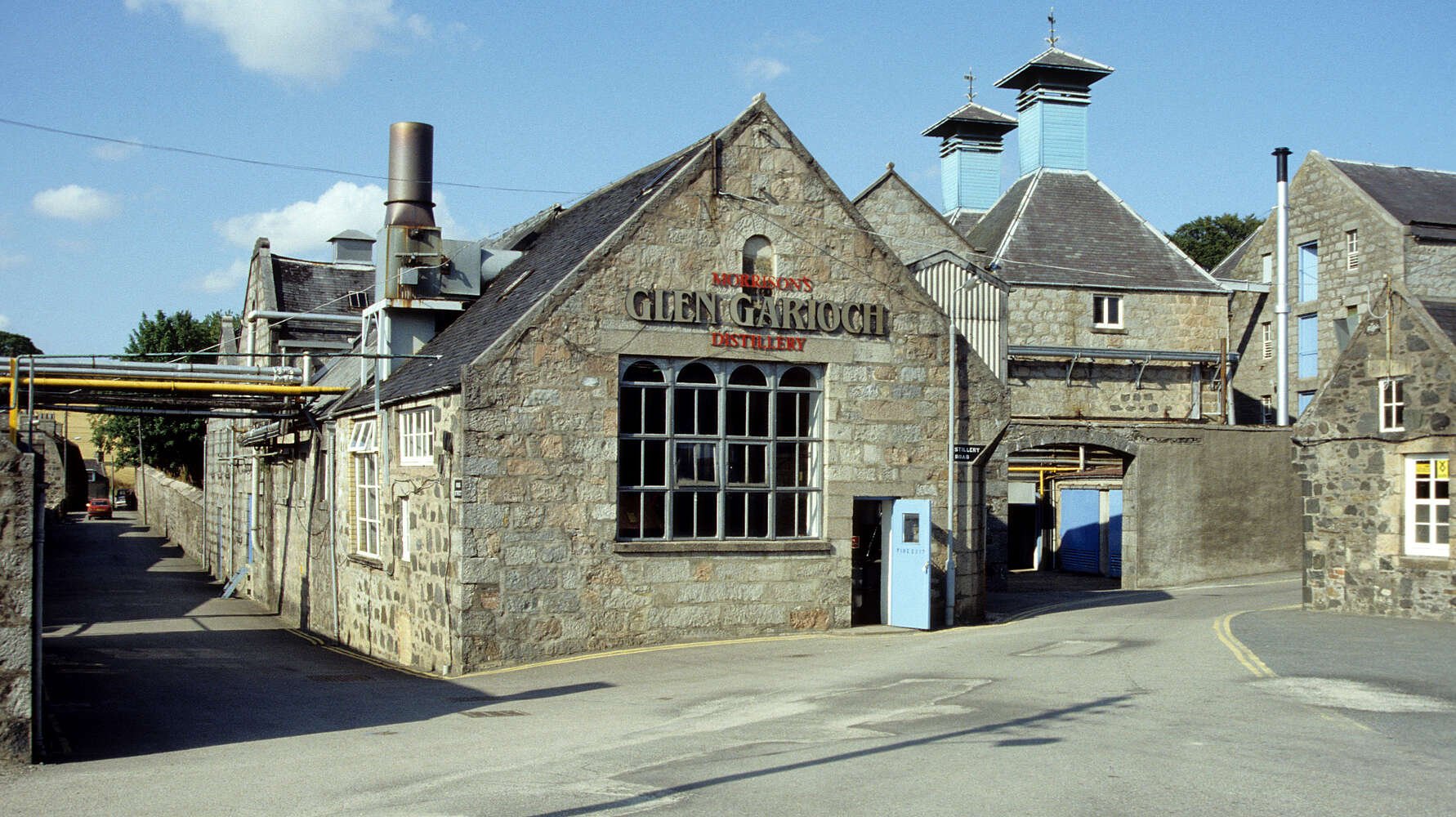
Approaching the distillery from Distillery Road, the stonework is the first thing that registers. The buildings are the colour of the local granite, grey and functional, with the kind of permanence that comes from being built to last rather than to impress. This is one of Scotland's older working distilleries by documented history, and the architecture reflects that: no visitor-centre grandeur imposed from outside, but a working industrial site that has accumulated its built environment over time. The pagoda rooflines and bonded warehouse blocks sit alongside each other in the compressed footprint typical of distilleries established before motorised logistics made space less critical.
Inside, the production environment is compact. The scale is closer to artisanal than industrial, which shapes the visit. Rather than observing distilling as a remote spectacle through glass, the working areas feel proximate. This is not a museum of whisky-making; it is a place where whisky is actually being made, and the sensory environment, warm air from the stills, the low hum of copper and copper fittings, the faint residue of yeast fermentation, reads as evidence of that. For the broader category of Highland distillery visits, that combination of historical depth and unperformed production process is harder to find than the marketing around Scottish whisky sometimes implies.
Regional Context and comparable set
To understand Glen Garioch's position in the current Scottish whisky field, it helps to map where the distillery sits relative to its peers. The Highlands designation covers an enormous geographic range, from distilleries on the northern coast such as Balblair Distillery in Edderton and Clynelish Distillery in Brora to eastern operations closer to the Speyside boundary. Glen Garioch occupies the north-east corner of that range, which gives it access to Speyside grain economics while maintaining a Highland designation that separates its positioning from the heavily trafficked Speyside corridor where distilleries like Aberlour and Cardhu in Knockando operate.
That positioning matters for how collectors and enthusiasts approach the distillery. Single malts from this north-east Highland pocket are less immediately legible to casual buyers than Speyside names with global distribution and brand recognition. That lower profile is a function of geography and scale, not quality. The 2025 Pearl 3 Star Prestige award places Glen Garioch in a tier that rewards this kind of restrained, terroir-grounded operation. Across the Scottish distillery field, Pearl 3 Star Prestige aligns with houses that have documented regional identity and production standards above the entry-level visitor experience, it is a signal of seriousness rather than spectacle.
For comparison, distilleries pursuing a similar combination of historical site integrity and production-led visitor experience in other Scottish regions include Dornoch Distillery, Dunphail Distillery in Dunphail, and InchDairnie Distillery in Glenrothes. Glen Garioch's Aberdeenshire positioning makes it place-specific: there are few other distilleries operating inside the Garioch barley belt with comparable historical continuity.
What to Taste
What the distillery's regional and production context suggests, however, is a house style weighted toward malt-forward structure rather than the lighter, fragrant profiles more common in Speyside. The Aberdeenshire climate and northern Highland tradition point toward whisky that carries some weight in the mid-palate and develops slowly with air. Visitors should approach the tasting programme as a regional comparison rather than a quick orientation to entry-level spirit. Contrasting Glen Garioch's output against Lowland distilleries such as Auchentoshan Distillery in Clydebank or Bladnoch Distillery in Bladnoch would illustrate how much Scottish whisky's character varies by latitude and water source alone, independent of production method differences.
Planning a Visit to Oldmeldrum
Oldmeldrum is a small town with limited independent hospitality infrastructure, which means the distillery visit works well as a planned excursion from Aberdeen rather than part of a longer multi-venue day. Aberdeen Airport is approximately 12 miles south-east, making Glen Garioch accessible for visitors arriving directly into the north-east rather than routing through Edinburgh or Glasgow. The town sits on the A947, a relatively direct route from Aberdeen, and the drive takes under 30 minutes in normal conditions. For visitors combining the distillery with a broader exploration of the region,
The distillery's address, Distillery Rd, Oldmeldrum, Inverurie AB51 0ES, provides a reliable navigation anchor, though the town's grid is small enough that the site is not difficult to locate once in Oldmeldrum.
For context on how Glen Garioch compares internationally as a terroir-specific producer, the production philosophy of regional expression over style uniformity connects it to approaches found in wine-focused producers such as Accendo Cellars in St. Helena and historically rooted operations like Achaia Clauss in Patras and Deanston in Deanston, producers where geography precedes commercial calculation in the production logic.
Fast Comparison
Comparable venues nearby, for context on price, style, and recognition.
| Venue | Cuisine | Price | Notes |
|---|---|---|---|
| Glen Garioch DistilleryThis venue — the venue you are viewing | Highland | $$ | |
| Muse Vineyards | Winery | , | Woodstock |
| Marcassin Winery | Winery | , | Windsor |
| Sonoma Brothers Distilling | Winery | , | Windsor |
| The Balvenie | Speyside | $$ | Dufftown |
| GlenAllachie | Speyside | $$ | Aberlour |
Continue exploring
More in Oldmeldrum
At a Glance
- Historic
- Rustic
- Classic
- Intimate
- Group Outing
- Solo Exploration
- Wine Education
- Historic Building
- Barrel Room
Historic and pristine buildings with a warm, engaging atmosphere created by knowledgeable guides and the rich aromas of whisky production.