

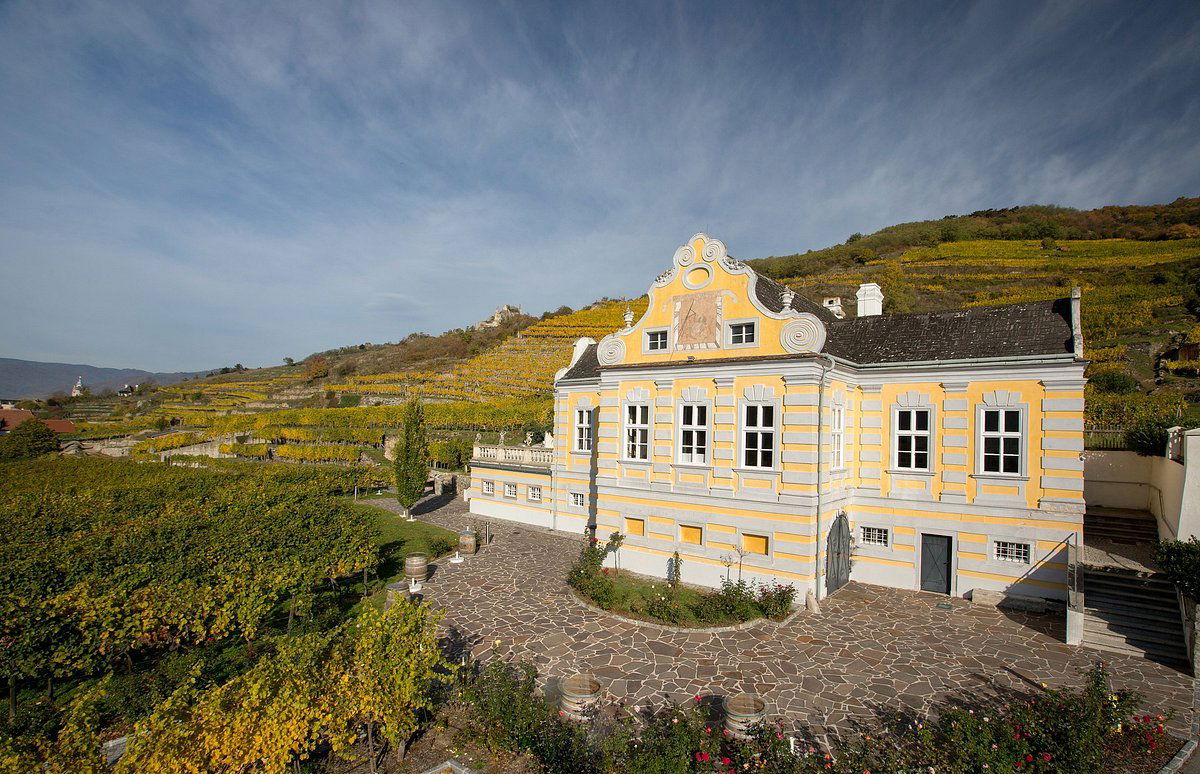
Domäne Wachau sits above the Danube in Dürnstein, operating from a Baroque winery built over cellars that date back three centuries. As a co-operative representing a significant share of the Wachau's vineyard land, it offers tastings that contextualise the region's Grüner Veltliner and Riesling within the protected Vinea Wachau classification system. EP Club awarded it Pearl 4 Star Prestige in 2025.
Where the Danube Bends and the Terroir Begins
Approach Dürnstein from the water and the town reveals itself in layers: the blue-and-white spire of the Augustinian church, the ruined castle on the ridge, the dense terracing of vineyard plots climbing the valley walls on either side. The Wachau is one of the few wine regions in the world where geography does the work of marketing — the Danube's tight meander creates a climatic corridor that is measurably different from the broader Niederösterreich flatlands to the east. Cool nights drop temperatures sharply after warm growing days, preserving acid and aromatic complexity in the grapes with a consistency that flatland viticulture rarely achieves.
Domäne Wachau occupies a Baroque winery building in the centre of Dürnstein, and the 300-year-old cellars beneath it predate most of what we now think of as modern Austrian wine culture by several generations. The building alone is an argument for the visit. But the stronger argument is what those cellars contain: wine made from across the Wachau's most demanding vineyard sites, produced by a co-operative structure that gives it access to a breadth of terroir that single-estate producers — however skilled , cannot replicate by definition.
Co-operative Scale as a Terroir Instrument
The Wachau operates under one of Austria's most disciplined regional wine frameworks. The Vinea Wachau Nobilis Districtus, founded in 1983, sets production rules that go beyond standard Austrian wine law: no enrichment, no must concentration, strict geographic limits, and a three-tier classification , Steinfeder, Federspiel, and Smaragd , tied to alcohol levels and, implicitly, to ripeness and site selection. Any producer working under this system is making a commitment to terroir fidelity that shapes the wines structurally before a single stylistic decision is made.
Domäne Wachau sits inside this framework as a super-cooperative, meaning its sourcing spans a substantial portion of the region's classified vineyard land. Where boutique estates like Weingut Emmerich Knoll or Weingut Alzinger draw from a tightly defined portfolio of their own parcels, Domäne Wachau aggregates fruit from member growers across the valley's contrasting exposures and soil types. The result is a range that functions almost as a regional cross-section: tastings here offer something closer to a comparative study of Wachau terroir than a single-estate expression can provide.
That distinction matters for how a visitor should approach the experience. A tasting at Weingut F. X. Pichler is an argument for a specific vision of what Wachau wine can be. A tasting at Domäne Wachau is something closer to a map of the valley itself.
Grüner Veltliner and Riesling in a Challenging Corridor
The Wachau's two signature varieties , Grüner Veltliner and Riesling , perform here in ways that reflect the region's specific geological inheritance. The primary soils are gneiss and amphibolite, ancient metamorphic rocks that drain well and warm slowly, contributing mineral tension to wines grown on them. On the loess terraces lower in the valley, Grüner Veltliner produces rounder, earlier-drinking expressions; higher on the steep primary rock terraces, the same variety yields wines of markedly different structure and aging potential.
Smaragd-classified Grüner Veltliner from the Wachau's upper slopes carries the region's most recognisable aromatic signature: white pepper, stone fruit, and a mineral salinity that has no precise equivalent in Grüner from the Kamptal or the Kremstal. Riesling, on the same steep sites, produces wines that sit closer to the Mosel's austerity than to Alsace's textural weight , dry, tightly wound, with acidity that can make them seem closed in youth but remarkably long-lived at ten or more years. These characteristics emerge from the land itself, and any serious tasting program in the Wachau is ultimately a set of arguments about how those geological and climatic forces translate into flavour.
For broader comparison within Austrian wine, the Wachau's style of Grüner Veltliner differs substantially from the approaches taken in other regions. Schloss Gobelsburg in Langenlois works the Kamptal's loess-and-crystalline blend with a different register of richness. Further afield, producers like Weingut Kracher in Illmitz operate in the Burgenland's botrytis-influenced sweet wine tradition, which is a different discipline entirely. Placing Domäne Wachau's dry, site-driven program against those alternatives clarifies what the Wachau's particular terroir argument actually is.
Planning the Visit
Dürnstein is most practically reached by train from Vienna along the Wachau rail line, or by boat on the Danube during the months when river cruise and day-trip services operate , typically spring through autumn. The town is small enough that Domäne Wachau's Baroque winery at Dürnstein 107 is direct to locate on foot from either the train station or the river landing. EP Club awarded the property Pearl 4 Star Prestige in 2025, placing it among the Wachau's most credentialed tasting destinations.
The Wachau's high season runs from late spring through the harvest period in October, when the terraced vineyards are at their most visually arresting and the new vintage is being brought in. Visiting outside peak season offers a quieter experience of the cellars and the town, though travelers should confirm tasting availability in advance as winter hours across the valley can be limited. For the full picture of where to eat, sleep, and drink in the area, see our full Dürnstein restaurants guide, our full Dürnstein hotels guide, our full Dürnstein bars guide, and our full Dürnstein experiences guide.
Visitors who want to extend their tasting itinerary through the Austrian wine regions more broadly will find contrasting programs at Weingut Heinrich Hartl in Oberwaltersdorf, Weingut Pittnauer in Gols, and Weingut Scheiblhofer Distillery in Andau. For context on how the cooperative and estate model plays out in other European wine regions with similarly strong geographic identity, Abadía Retuerta in Sardón de Duero offers an instructive comparison, as does the craft production tradition at Aberlour in Aberlour. For the wider context of what the Wachau offers as a wine destination, our full Dürnstein wineries guide maps the valley's key producers and tasting formats.
FAQs
- What wines is Domäne Wachau known for?
- The estate's reputation rests on Grüner Veltliner and Riesling produced under the Vinea Wachau Nobilis Districtus classification, with Smaragd-tier bottlings from the valley's steep primary rock sites carrying the most complexity and aging potential. As a large co-operative drawing from member growers across the region, Domäne Wachau offers a broader cross-section of Wachau vineyard terroir than most single-estate producers. EP Club rated it Pearl 4 Star Prestige in 2025.
- What is Domäne Wachau known for?
- Domäne Wachau is the Wachau's principal co-operative, operating from a Baroque winery in Dürnstein above cellars dating back three centuries. It is recognised for giving visitors access to the full range of the valley's terroir through structured tastings , a scope that reflects its position as a super-cooperative rather than a boutique estate. Its Pearl 4 Star Prestige rating from EP Club (2025) places it among Dürnstein's most credentialed wine experiences.
Pricing, Compared
A quick peer reference to anchor this venue in its category.
| Venue | Classification | Awards | First Vintage | Notes |
|---|---|---|---|---|
| Domäne Wachau | World's 50 Best | This venue | ||
| Weingut Emmerich Knoll | 1 awards | |||
| Weingut Alzinger | 1 awards | |||
| Weingut F. X. Pichler | 1 awards |
Access the Cellar?
Our members enjoy exclusive access to private tastings and priority allocations from the world's most sought-after producers.
Access the Concierge