Castello di Amorosa

A 13th-century Tuscan castle replicated stone by stone in Napa Valley's northern reaches, Castello di Amorosa holds a Pearl 2 Star Prestige rating for 2025 and has produced wine under winemaker Brooks Painter since its first vintage in 2003. The property sits at the quieter, geothermally warmed end of the valley near Calistoga, where the tasting experience is as much about architecture and place as it is about the wine in the glass.
 Discover on Pearl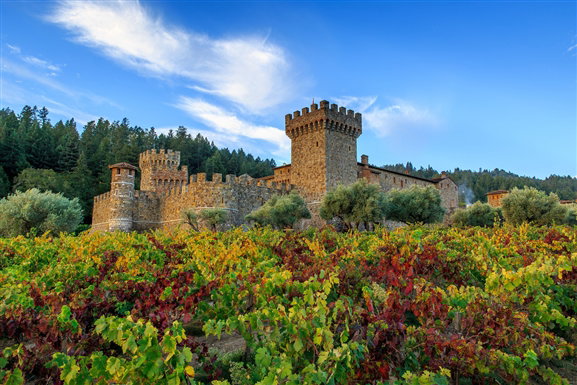
Stone, Barrel, and the Idea of Elsewhere
Approaching from the St. Helena Highway, the silhouette arrives before the signage does: crenellated towers, a drawbridge, walls of hand-hewn stone rising from a hillside of Napa oak and volcanic soil. The first question most visitors ask is whether it was always here. It was not. The castle is a meticulous recreation of a 13th-century Tuscan stronghold, built over more than a decade using period construction methods, and it opened to the public in 2007 with its first wine having already been bottled four years prior in 2003. The gap between those two dates matters: Castello di Amorosa was a winery before it was a landmark, which shapes how seriously the wine program operates inside what might otherwise read as a themed attraction.
Calistoga sits at the valley's northern terminus, where the topography narrows and geothermal heat pushes daytime temperatures higher than those in Oakville or Rutherford to the south. It is a town with its own distinct character, more spa town than wine village, and the wineries clustered around it occupy a different register from the manicured estate tasting rooms further south. Chateau Montelena Winery is the area's most historically documented address, with the 1976 Paris Tasting win as its anchor credential. Castello di Amorosa takes a different approach: the setting is the primary argument, and the wine earns its own separate case.
The Architecture as Editorial Statement
Few wine properties in California make the physical structure itself a subject of critical attention, but the castle demands it. The building contains over 107 rooms across multiple levels, including working barrel caves carved directly into the hillside. Construction required sourcing hand-crafted bricks and materials consistent with medieval Italian building practice, and the frescoes inside were painted by Italian artisans. Whether one reads this as scholarship or spectacle is a reasonable debate, but the sheer physical commitment of the project is not in dispute.
For visitors following the editorial angle of place over prestige, Calistoga offers a concentrated cluster of serious producers worth mapping against each other. Larkmead Vineyards operates as one of the area's most analytically rigorous estates, while Frank Family Vineyards covers a broader stylistic range. Castello di Amorosa competes on different terms from either, drawing visitors who want immersion in a setting that does not exist anywhere else in Napa Valley, and then offering a wine program that has enough structure to justify the visit on its own merits.
Brooks Painter and the Wine Program
Winemaker Brooks Painter has overseen production since the winery's early years. The program's first vintage was 2003, which places it in the generation of Napa producers who came of age during a period of significant stylistic debate about extraction, alcohol, and Californian identity in the cellar. By the time the castle opened to the public in 2007, the wine program already had several vintages of institutional memory to draw on, an advantage that single-site producers opening in the same era often lacked.
The 2025 Pearl 2 Star Prestige award from EP Club positions Castello di Amorosa in a recognised tier of California wine producers. For context on the northern Napa peer set, Aubert Wines and Newton Vineyard each operate within a different production philosophy and stylistic register. Aubert's Chardonnay and Pinot program operates at the allocation-heavy, critic-focused end of California wine. Newton's terraced hillside Cabernet work places it closer to the Old World structural model. Castello di Amorosa draws from Italian varieties alongside its Bordeaux-influenced program, which gives it a stylistic footprint that most Napa producers of similar scale do not replicate.
The Visitor Experience and the Layered Format
The tasting format at Castello di Amorosa operates across multiple experience levels, from general admission cave tours with wine to more structured seated tastings. This tiered model has become a feature of the premium Napa tasting landscape over the past decade, as producers have moved away from simple pour-and-go bar formats toward experiences with deliberate narrative arcs. The castle's physical complexity supports this particularly well: moving from the courtyard to the barrel caves to interior tasting rooms creates a genuine sequence that many flat-estate properties cannot engineer.
For visitors planning a Calistoga day, the property sits on Highway 29 (St. Helena Highway), making it accessible without significant detour from the main valley corridor. Booking ahead is the practical standard for any tasting experience here; the volume of visitors the property draws means walk-in availability is variable and often limited, particularly on weekends and during the harvest season in September and October. The surrounding Calistoga area rewards extended time: the town's geothermal spas, the quieter wine roads, and a dining scene that has grown in seriousness are all worth factoring into planning. Our full Calistoga wineries guide, Calistoga restaurants guide, Calistoga hotels guide, Calistoga bars guide, and Calistoga experiences guide cover all of this in depth.
Where This Fits in the Broader California Wine Picture
California's wine geography has become more legible to international visitors in recent years, partly because producers in distinct AVAs have worked harder to articulate what soil, elevation, and microclimate contribute to what ends up in the glass. Calistoga received its own AVA designation in 2009, formalising what growers had observed for decades: the area's volcanic soils, warm days, and cool nights produce fruit with particular textural density. That context matters when placing Castello di Amorosa in a wider frame.
For visitors whose California wine interests extend beyond Napa, there are meaningful comparisons to draw. Adelaida Vineyards in Paso Robles operates in a hotter, more geologically varied region with a different Rhone-leaning variety focus. Adelsheim Vineyard in Newberg anchors the Oregon Pinot conversation to the north. Accendo Cellars in St. Helena, just south of Calistoga on the valley floor, represents the ultra-premium Napa Cabernet model in its most allocation-restricted form. And for those who extend their wine travel to Europe, Abadía Retuerta in Sardón de Duero offers an instructive counterpoint: a Spanish estate whose historical architecture is genuinely medieval rather than reconstructed, with a wine program that invites similar questions about the relationship between place and production. Aberlour in Aberlour, operating in a completely different category as a Scotch distillery, raises adjacent questions about how built heritage and production craft are packaged for visitors in premium drink-tourism contexts.
Castello di Amorosa is positioned most usefully as a property where the architectural experience and the wine program operate in parallel rather than one subordinating the other. The 2025 Pearl 2 Star Prestige recognition indicates that the wine merits attention on its own terms, while the setting ensures the visit registers as something more than a standard tasting room afternoon.
Planning Your Visit
The property is located at 4045 St. Helena Highway, Calistoga, California 94515, directly on Highway 29. Advance booking is the practical default, with online reservations the most reliable route given the property's visitor volume. Harvest season (September through October) brings refined demand across the Napa Valley, and Castello di Amorosa's visibility means it fills earlier than less prominent properties during this period. Spring visits, particularly April through early June, offer more flexibility and typically cleaner views of the surrounding hillside before summer haze sets in.
Frequently Asked Questions
- How would you describe the overall feel of Castello di Amorosa?
- The property occupies a category that Napa Valley has very few examples of: a working winery inside a historically constructed building that demands engagement on architectural terms before the wine is even poured. The EP Club Pearl 2 Star Prestige rating for 2025 confirms that the wine program holds its own against Calistoga peers, so the experience does not require a visitor to prioritise spectacle over substance. The castle format means the atmosphere shifts depending on where you are in the visit: the courtyard reads differently from the barrel caves, which read differently again from the interior tasting rooms.
- What do visitors recommend trying at Castello di Amorosa?
- Given winemaker Brooks Painter's tenure and the winery's Italian-influenced variety program alongside its Bordeaux-based production, the wines that typically draw attention are those that depart most clearly from the standard Napa Cabernet template. The first vintage dates to 2003, which means the program has sufficient depth to include library wines at certain experience tiers. The 2025 Pearl 2 Star Prestige recognition from EP Club suggests the portfolio warrants structured attention rather than a single pour at the bar.
- Why do people go to Castello di Amorosa?
- Visitors arrive for reasons that split roughly into two camps: those drawn by the architecture and the novelty of a medieval-style castle in Napa Valley, and those who have followed the wine program and want to taste in context. The EP Club 2025 rating places the winery in a recognised prestige tier, which attracts the latter group in increasing numbers. Calistoga's position at the northern end of the valley also makes it a natural endpoint for visitors doing a full north-to-south or south-to-north tasting day.
- Do they take walk-ins at Castello di Amorosa?
- Walk-in availability exists but is not guaranteed, particularly on weekends and during peak harvest season in September and October. The property's visitor volume, driven by its architectural profile and the 2025 EP Club Pearl 2 Star Prestige recognition, means advance booking through the winery's website is the more reliable approach. Weekday visits in shoulder season offer the leading chance of accommodation without a reservation.
- What makes Castello di Amorosa different from other Italian-inspired wine estates in California?
- The distinction lies in the construction methodology: rather than applying Italian aesthetic references to a conventional winery building, Castello di Amorosa was built using period-appropriate techniques and materials over more than a decade, with artisan craftwork including hand-laid stone and painted frescoes. The wine program, which began its first vintage in 2003 under winemaker Brooks Painter, includes Italian grape varieties not widely planted in the Calistoga AVA, giving the portfolio a stylistic range that aligns with the architectural premise rather than simply decorating it. The 2025 Pearl 2 Star Prestige award recognises the wine program as a serious production effort operating within a setting that is genuinely without structural equivalent in California wine country.
Peer Set Snapshot
These are the closest comparables we have in our database for quick context.
| Venue | Awards | Notes |
|---|---|---|
| Castello di Amorosa | Pearl 2 Star Prestige | This venue |
| Aubert Wines | Pearl 3 Star Prestige | Mark Aubert, Est. 2000 |
| Bennett Lane Winery | Pearl 2 Star Prestige | |
| Carter Cellars | Pearl 2 Star Prestige | |
| Chaix Wines | Pearl 2 Star Prestige | |
| Chateau Montelena Winery | Pearl 3 Star Prestige | Matt Crafton, Est. 1973 |
Access the Cellar?
Our members enjoy exclusive access to private tastings and priority allocations from the world's most sought-after producers.
Get Exclusive Access