
Michelin Plate
Our verdict
Yong Feng Mian Guan (Huangpu) belongs to Shanghai’s practical noodle-house tradition rather than its trophy-dining circuit. In central Huangpu, the draw is place and rhythm: quick meals, local regularity, and a second-generation continuity that says more about neighbourhood eating than formal gastronomy.

Pearl is the En Primeur Club membership app, where members save venues, book tables and use the concierge.
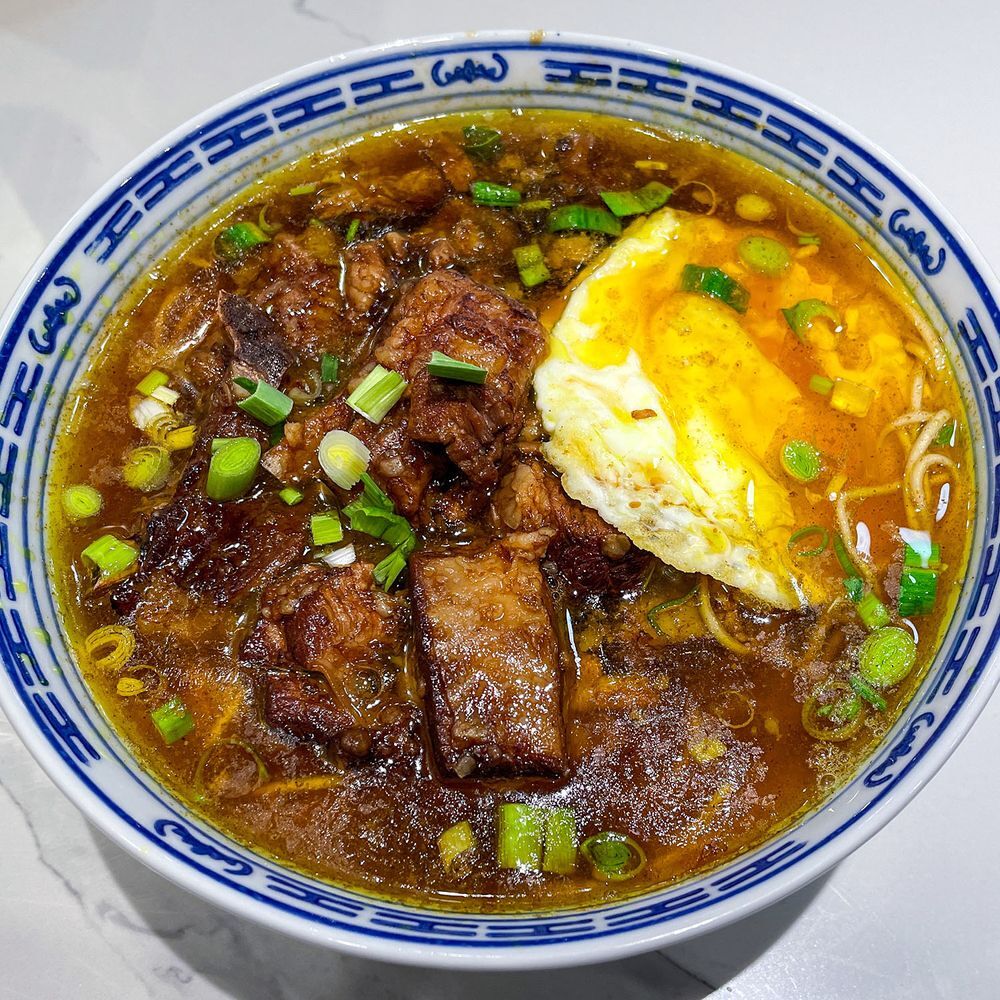
The menu
What to order
- Red-braised lamb noodles in curry beef stock
- Red-braised lamb noodles with scallion oil
- Curry beef noodles
- Fried egg topping on noodles
Shanghai’s older commercial rhythms do not announce lunch with ceremony. They do it through steam at the doorway, fast table turnover, clipped orders, and the compact choreography of workers eating before the afternoon resumes. Yong Feng Mian Guan (Huangpu) sits inside that Shanghai grammar: a mian guan is not built around ceremony, but around repetition, speed, and a kitchen format that has to survive daily judgment from people who can eat elsewhere tomorrow.
That matters in a city where dining can split sharply between expense-account rooms, mall dining, and street-level specialists. Shanghai’s polished end is well represented by hotel restaurants and chef-led rooms, including other formal dining rooms across the city. A compact Shanghai specialist works by different rules. The measure is not linen, cellar depth, or tasting-menu pacing; it is whether the room can feed regulars consistently without turning a simple meal into theatre.
Shanghai noodle culture, without the hotel-restaurant filter
Shanghai rewards narrow formats. The city has long made room for vendors and small restaurants that specialize tightly: dumplings, fried snacks, soups, quick meals, and comfort dishes that do not need a long menu to justify a visit. In that context, Yong Feng Mian Guan reads as part of a practical urban category rather than a destination restaurant in the international sense. Continuity in this tier is rarely decorative; it usually means a business has kept enough local trust to outlast rent pressure, shifting foot traffic, and the city’s appetite for newer concepts.
The comparison within Shanghai should be horizontal, not hierarchical. Yang’s Fry-Dumpling represents the dumpling side of the city’s fast, repeatable eating culture, while Rongjia Noodles Soup with Yellow Croaker (Jingan) sits closer to a defined specialist format. Yong Feng Mian Guan belongs to that same everyday-specialist band: the sort of place where the category tells the reader more than any inflated adjective would. It is better understood as a Shanghai eating pattern than as a chef narrative.
What the room tells you about the meal
The atmosphere is functional in the Shanghai sense: direct, busy at meal times, and driven by the pace of people who know what they came for. This is not the environment for lingering over a bottle list or treating lunch as an afternoon’s project. The appeal is compression. A Shanghai location, a familiar format, and a clear everyday identity give the experience its shape before any individual order arrives.
That makes it useful for travellers who want to understand the city beyond reservation-led dining. Shanghai can be read through its high-rise dining rooms, but it can also be read through the smaller operations that keep office workers, shoppers, and residents fed. For broader planning, Our full Shanghai restaurants guide maps the restaurant field, while wider Shanghai hotel, bar, winery, and experience planning can help place the stop within a broader city itinerary.
How to read it against China's regional dining map
For visitors building a China trip around food, the value of a place like this is comparative. It shows how Shanghai’s everyday eating can differ from stronger regional signatures found elsewhere in China, from heat-led cooking to coastal, heritage, private-kitchen, duck-focused, or snack-led traditions. Shanghai’s compact food rooms tend to be less about spectacle and more about the mechanics of daily urban appetite.
Internationally, that same specialist logic appears in different forms across casual dining cultures. The point is not equivalence; it is format discipline. Yong Feng Mian Guan (Huangpu) is strongest when approached as an everyday stop in Shanghai, where continuity, location, and category clarity carry more weight than ceremony.
Frequently asked questions
Is Yong Feng Mian Guan (Huangpu) okay with children?
Yes, it suits families that are comfortable with a straightforward, informal setting in Shanghai. The format is practical rather than ceremonial.
What's the vibe at Yong Feng Mian Guan (Huangpu)?
It reads as a working everyday place in Shanghai, with the kind of pace that comes from regular daytime trade. The appeal is continuity of format rather than polish.
Has Yong Feng Mian Guan (Huangpu) won any awards?
Yong Feng Mian Guan (Huangpu) is listed in the Michelin Guide with a MICHELIN Plate distinction.
Where do I go for Yong Feng Mian Guan (Huangpu)?
Shanghai.
How far ahead should I plan for Yong Feng Mian Guan (Huangpu)?
There is no booking detail in the provided record, so planning should start with the setting: Shanghai. For a place built around a straightforward everyday format, arriving with flexibility matters more than plotting weeks ahead. Check the venue's official channels for the latest details.
What's the defining dish or idea at Yong Feng Mian Guan (Huangpu)?
The defining idea is straightforward Shanghai eating, shaped by a focused format and the city setting. The appeal is continuity of format rather than a long menu of choices.
A Tight Comparison
Comparable venues by cuisine and price in the same metro.
| Venue | Cuisine | Price | Awards | Notes |
|---|---|---|---|---|
| Yong Feng Mian Guan (Huangpu)This venue (the venue you are viewing) | Halal Jiangnan Noodle Shop | $10–20 | Michelin Plate | Not listed |
| Chinese Restaurant | Traditional Chinese Restaurant | Not listed | Not listed | Not listed |
| Hi bowl | Asian and Western All-Day Dining | Not listed | Not listed | Not listed |
| 扬州饭店 | Ningbo Cuisine | Not listed | Not listed | Not listed |
| Yang’s Fry-Dumpling | Shanghainese Sheng Jian Bao | Not listed | Not listed | Dumplings |
| Rongjia Noodles Soup with Yellow Croaker (Jingan) | Yellow Croaker Noodle Soup | $20–30 | Michelin Bib Gourmand | Noodles |
Recognition history
Dated appearances from independent guides and award organizations, with the underlying list record or original source where available.
Michelin Plate
Michelin
Continue exploring
More in Shanghai
Restaurants in Shanghai
All restaurants in Shanghai →
Bars in Shanghai
All bars in Shanghai →
Details
- Lively
- Classic
- Solo
- Casual Hangout
- Family
- After Work
- Group Dining
- Standalone
- A La Carte
- Halal