
Yokobori sits in Osaka’s stand-up drinking culture rather than its formal restaurant lane, pairing tachinomi informality with a Chinese food angle in Kitahama. Its 2025 Tabelog 100 Tachinomi selection gives it a clear trust signal in a category where atmosphere, turnover, and snack-driven drinking matter as much as conventional dining polish.
Pearl is the En Primeur Club membership app — saves, bookings, and concierge access live there. Same editors, same standards.
- Address
- 大阪府大阪市中央区東高麗橋5-3 高麗橋双葉ビル 1F
- Website
- tabelog.com
 Saves & bookings on Pearl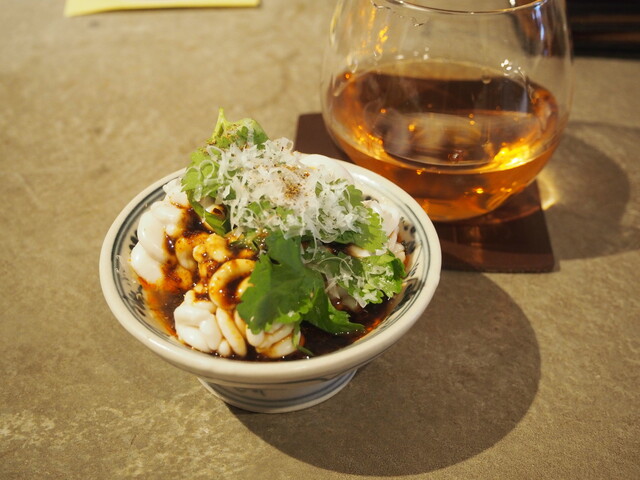
Kitahama changes character after office hours: the riverfront business district loosens its tie, shutters come half down, and compact counters begin doing the work that Osaka has always handled well. Tachinomi is not built for lingering ceremony. It is built for appetite, conversation, and quick judgment, with the room itself telling diners what kind of evening they are about to have: close quarters, visible pace, and a menu designed to sit beside drinks rather than perform as a formal course progression.
That is the useful frame for Yokobori. The draw is not luxury dining in miniature, but the way a stand-up bar can carry serious food intent without losing its low-friction Osaka rhythm. The category listed here is stand-up bar and Chinese, a combination that places the experience closer to a drinking counter with kitchen confidence than to either izakaya convention or full-service Chinese restaurant formality. In a city often reduced to takoyaki shorthand, this kind of room is a sharper lesson in how Osaka actually eats on ordinary nights.
Chinese cooking through Osaka's stand-up bar lens
Osaka’s tachinomi culture rewards immediacy. The format compresses service, space, and appetite into a smaller register than seated dining, so the cooking has to read quickly. Chinese food is especially compatible with that setting because it brings heat, salt, texture, and shareable portions into a drinking rhythm without demanding the architecture of a banquet meal. The point is not fusion as spectacle; it is a practical fit between wok-led cooking traditions and the social mechanics of standing with a glass in hand.
Recognition matters in this category because stand-up bars rarely announce themselves through the usual fine-dining signals. Yokobori was selected for Tabelog 100 Tachinomi in 2025, a more relevant credential here than a white-tablecloth award would be. It identifies the venue inside a national conversation about tachinomi rather than forcing it into a restaurant hierarchy that misses the format’s appeal. The Tabelog score of 3.58 adds another useful marker, not as a universal verdict, but as a signal of sustained diner approval in a crowded Osaka category.
The local comparison set also helps define the decision. Kitahama Choji operates in a nearby casual price lane, while Kashmir and Ganesh m Kitahama ten point to the area’s lunchtime and curry-driven audience. Manpuku Bakery shows another side of the district’s everyday food economy. Yokobori belongs to the same neighbourhood ecosystem but answers a different need: the after-work drink with food that carries enough personality to justify a detour within central Osaka.
Kitahama is the right neighbourhood for this kind of room
Kitahama has long been one of Osaka’s more interesting dining pockets because it sits between business formality and Nakanoshima’s riverside calm. The area does not behave like Dotonbori, where spectacle often reaches the street before the food does. Here, better rooms tend to be quieter in posture: bakeries for office workers, curry counters with repeat traffic, drinking spots that fill from the neighbourhood before they attract destination diners.
That context matters. A stand-up Chinese bar in Kitahama lands differently than it would in a nightlife district. The pleasures are smaller and more exact: a compact room, a direct exchange across the counter, and food that has to make sense in the time it takes to order another drink. For travellers, the value is cultural as much as culinary. This is Osaka dining without the souvenir posture, closer to the city’s working appetite than to its postcard image.
For a broader read on the city, Our full Osaka restaurants guide maps the dining range beyond single-category fame, while Our full Osaka bars guide is the better companion for understanding how drinking formats shape the night. Travellers building a larger itinerary can also cross-check Our full Osaka hotels guide, Our full Osaka wineries guide, and Our full Osaka experiences guide for the rest of the city around the table.
How to place it within an Osaka eating day
The smart approach is to treat this as a focused stop rather than the sole anchor of a long evening. Osaka rewards grazing, and tachinomi fits that grammar. A bakery or coffee stop earlier in the day, a stand-up counter in the early evening, and a second room later will usually teach more about the city than one over-planned dinner. Nearby and citywide references help calibrate that rhythm:.cafe, 52CHO-ME BAKERY, 551 Horai (551蓬莱), 99 Pizza Napoletana Gourmet, and a canto (Italian) all point to different ways Osaka moves between casual, portable, and more composed eating.
The better travel lesson is that Japan’s serious casual food culture is not confined to sushi counters, ramen queues, or kaiseki rooms. Stand-up bars have their own discipline: tight menus, fast reading of the room, and a crowd that usually knows exactly what it came for. In that sense, Yokobori is worth seeking out because it shows how Osaka’s appetite for drinking food can absorb Chinese cooking without turning the meal into a concept. The format stays direct, the category stays grounded, and the award recognition gives visitors a reason to prioritize it within a dense city.
Readers comparing Japanese casual dining beyond Osaka can usefully look at how other cities express similar everyday precision in different forms: -Grilled beef Sukiyaki- KAMAKURA TANUKIAN 鎌倉 たぬき庵 in Kamakura. 鮪と炭火焼き うお炭 秋葉原店 in Tokyo.know in Kumamoto, (Shoku) Vietnam in Kawasaki, [Curry Senmon Ten] Maruyama Kyoju. in Sapporo, and [ki:] in Kyoto. For overseas parallels in compact Japanese drinking and snack formats, Jōdo Saké Bar in Los Angeles and Onigiri Time in Pasadena show how portable, drink-adjacent Japanese food cultures translate outside Japan.
Cuisine and Recognition
Comparable venues at a glance for context.
| Venue | Cuisine | Price | Notes |
|---|---|---|---|
| YokoboriThis venue — the venue you are viewing | Creative Chinese Stand-up Bar | $$ | Not listed |
| Marusho Gyoza Ten Dai2 hanna ten | Gyoza-focused Chinese dumpling shop | $$ | Daito |
| Az/ Bifun Azuma Oosaka ten | Chinese Bistro | $$ | Kita |
| Fukushima Koto | Cantonese Chinese | $$ | Kita |
| Nama Gyoza Seizo Tokoro Tenshin no Kimochi | Handmade Gyoza & Taiwanese Mazesoba Izakaya | $$ | Taishō |
| Tachinomi Izakaya LIBERTY | Chinese Izakaya / Standing Bar | $$ | Kita |
Recognition history
Dated appearances from independent guides and award organizations, with the underlying list record or original source where available.
Tabelog 100 #46 · No. 46
Tabelog · Tabelog 100 - Tachinomi - 2025
Continue exploring
More in Osaka
Restaurants in Osaka
Browse all →




Bars in Osaka
Browse all →




Hotels in Osaka
Browse all →




Wineries in Osaka
Browse all →
At a Glance
- Lively
- Cozy
- Energetic
- After Work
- Casual Hangout
- Solo
- Group Dining
- Late Night
- Waterfront
- Standalone
- Beer Program
- Waterfront
A bustling standing-only tachinomi with a casual, non-smoking atmosphere where guests pack into a compact space along the river to enjoy inventive Chinese-inspired bar dishes and drinks after work or on weekends.