
Yakitori Saihi belongs to Osaka’s small-counter yakitori tier, where the meal is built as a sequence rather than a casual skewer order. Its Tabelog 100 Yakitori WEST selections in 2024 and 2025, seven counter seats, and reservation-only course format place it in the city’s more tightly edited grilled-chicken category.
Pearl is the En Primeur Club membership app — saves, bookings, and concierge access live there. Same editors, same standards.
- Address
- 大阪府大阪市中央区南船場4-10-22
- Phone
- +81662588166
- Website
- tabelog.com
 Saves & bookings on Pearl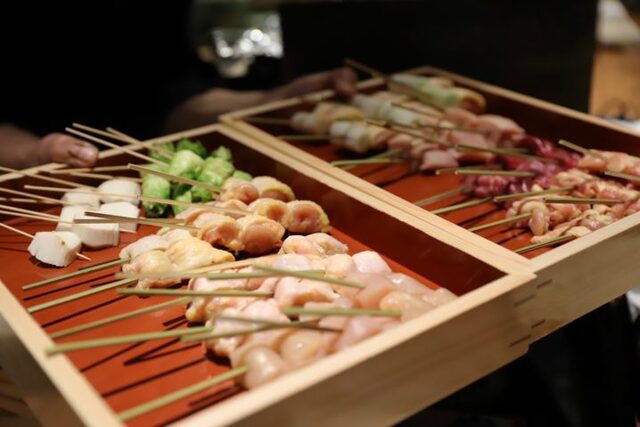
In Osaka, serious yakitori often announces itself through restraint rather than spectacle: a narrow counter, a grill doing the talking, and a room calibrated around timing. Yakitori Saihi fits that modern counter grammar. The format is compact, the meal is course-led, and the point is not abundance but sequence: heat, rest, seasoning, repetition, and contrast across cuts.
That matters in a city better known internationally for takoyaki, okonomiyaki, kushikatsu, and late-night appetite. Osaka has always been fluent in food that moves quickly from grill or griddle to hand, but yakitori at this level slows the exchange down. The skewer becomes less snack than structure. Each round has to justify its place in the progression, and the room’s scale leaves little cover for weak pacing.
A seven-seat counter built around sequence, not choice overload
The defining idea here is menu architecture. Reservation-only course meals remove the usual izakaya rhythm of ordering another round whenever the table feels like it. Instead, the kitchen controls tempo, a format closer to kappo logic than pub grazing. In yakitori, that control is useful: leaner cuts, fattier sections, vegetables, and closing dishes can be arranged so the grill’s intensity does not flatten the meal into smoke and salt.
Across Japan, higher-end yakitori has moved away from the image of beer-led after-work eating. The stronger counters now treat chicken with the same seriousness that sushi counters give to fish: sourcing, butchery, charcoal management, and the order of service carry the meal. Yakitori Saihi’s inclusion in Tabelog 100 Yakitori WEST in both 2024 and 2025 signals that it sits inside this specialist bracket rather than the broad casual field.
The format also makes the drinks program more than an accessory. Sake, shochu, and wine are all part of the listed offering, with particular attention to sake and wine. That spread reflects a wider shift in Japanese counter dining, where yakitori is no longer locked to lager and highballs. Smoke, tare, salt, skin fat, liver richness, and grilled aromatics ask different questions of a glass; a counter that takes wine seriously is positioning the meal for slower, more deliberate pairing.
There is a useful contrast with other Osaka categories. A place such as wad omotenashi cafe belongs to a lower-priced tea-and-cafe register, while BAR RARITY sits in the city’s compact cocktail economy. Teppanyaki MYDO, Oh.lala... and Sushi UKIYO occupy different forms of controlled counter theatre. Yakitori Saihi is narrower: chicken, charcoal, and course pacing. That narrowness is the point.
Minamisenba gives yakitori a quieter Osaka frame
Minamisenba sits close enough to Shinsaibashi to feel central, but its dining personality is less about tourist compression than small rooms tucked into the commercial grid. For visitors who only read Osaka through Dotonbori signage, this part of Chuo-ku offers a different version of the city: fashion offices, side-street restaurants, and counters where the evening is organized by reservation rather than foot traffic.
That neighbourhood context suits a seven-seat yakitori room. Small capacity changes the contract between diner and kitchen. A missed reservation is not an empty table among many; it is a visible gap in the evening’s entire structure. It also means the counter’s atmosphere depends on the whole seating, not just an individual party. In course-led yakitori, punctuality and pace are part of the craft.
The Tabelog score of 3.65 is useful when read in context. On Japanese restaurant platforms, yakitori specialists compete in a crowded field where small differences in consistency, service rhythm, and grill control matter. The more persuasive signal is the repeated Hyakumeiten selection for the WEST yakitori category, because it places the restaurant within a curated regional list rather than a general popularity pool.
Osaka diners tend to be unforgiving about value, even at higher spend levels. A course in the JPY 10,000 to JPY 14,999 dinner bracket has to make a case through product handling and progression, not decorative luxury. That is where a restrained yakitori counter can be compelling: the meal either builds cleanly or it does not. There is little room for distraction.
How to place it in an Osaka eating itinerary
For a first Osaka trip, this is not the meal that explains the city’s street-food mythology. It is better understood as a counterpoint to it. The city’s casual canon is immediate, democratic, and often loud; this style of yakitori is small-format, scheduled, and dependent on the discipline of a fixed course. Pairing both sides of Osaka gives a sharper reading of the city than chasing a single category.
Travelers building a wider food map can use Our full Osaka restaurants guide for restaurant planning, then separate the evening economy through Our full Osaka bars guide. Hotels matter in a city where late dinners and rail transfers shape the night; Our full Osaka hotels guide is the practical companion. For broader trip design, Our full Osaka experiences guide and Our full Osaka wineries guide round out the planning frame.
Within Osaka’s wider dining spread, contrasts help. Casual daytime stops such as.cafe, 52CHO-ME BAKERY, and 551 Horai (551蓬莱) serve a different purpose from a fixed-course counter. Italian-leaning addresses such as 99 Pizza Napoletana Gourmet and a canto (Italian) show how international formats sit alongside the city’s Japanese specialists.
For readers comparing Japanese dining categories beyond Osaka, the useful lesson is format. -Grilled beef Sukiyaki- KAMAKURA TANUKIAN 鎌倉 たぬき庵 in Kamakura. 鮪と炭火焼き うお炭 秋葉原店 in Tokyo.know in Kumamoto, (Shoku) Vietnam in Kawasaki, [Curry Senmon Ten] Maruyama Kyoju. in Sapporo, and [ki:] in Kyoto each ask a different question of service style and specialization. Even overseas Japanese-adjacent addresses such as Jōdo Saké Bar in Los Angeles and Onigiri Time in Pasadena show how tightly defined formats travel.
The editorial read is simple: choose the restaurant for a focused Osaka counter meal where the course structure is the argument. It is for diners who want yakitori treated as a full evening, not as a stop between drinks.
Peers You’d Cross-Shop
Comparable venues to place this listing in its category.
| Venue | Cuisine | Price | Notes |
|---|---|---|---|
| Yakitori SaihiThis venue — the venue you are viewing | Yakitori | $$$ | Not listed |
| Ryobo | Yakitori Omakase Counter | $$$ | Chūō |
| Tori Ichi | Traditional Osaka Yakitori & Chicken Dishes | $$$ | Chūō |
| Sumibi Yakitori Kichizo | Charcoal-Grilled Yakitori & Izakaya | $$$ | Nishi |
| epais | Premium Tonkatsu & Curry | $$$ | Kita |
| Goichi Nishitenma ten | Yakitori Omakase | $$$ | Kita |
Recognition history
Dated appearances from independent guides and award organizations, with the underlying list record or original source where available.
Tabelog 100 #50 · No. 50
Tabelog · Tabelog 100 - Yakitori - WEST - 2025
Continue exploring
More in Osaka
Restaurants in Osaka
Browse all →




Bars in Osaka
Browse all →




Hotels in Osaka
Browse all →



Wineries in Osaka
Browse all →
At a Glance
- Intimate
- Sophisticated
- Cozy
- Date Night
- Special Occasion
- Business Dinner
- Solo
- Chefs Counter
- Standalone
- Sake Program
- Beer Program
A small, hidden-gem counter setting with a quiet, focused, reservation-only atmosphere that feels tailored to a refined dinner experience.