Villa Crespi







Three Michelin stars and a 98-point La Liste score make Villa Crespi the most decorated address on Lake Orta. Chef Antonino Cannavacciuolo works from a late nineteenth-century Moorish villa, translating the intensity of Campanian flavour into a northern Italian setting. Two tasting menus and an à la carte format run Wednesday through Sunday, with the property operating as a Relais & Châteaux boutique hotel.
A Moorish Villa on the Edge of a Northern Lake
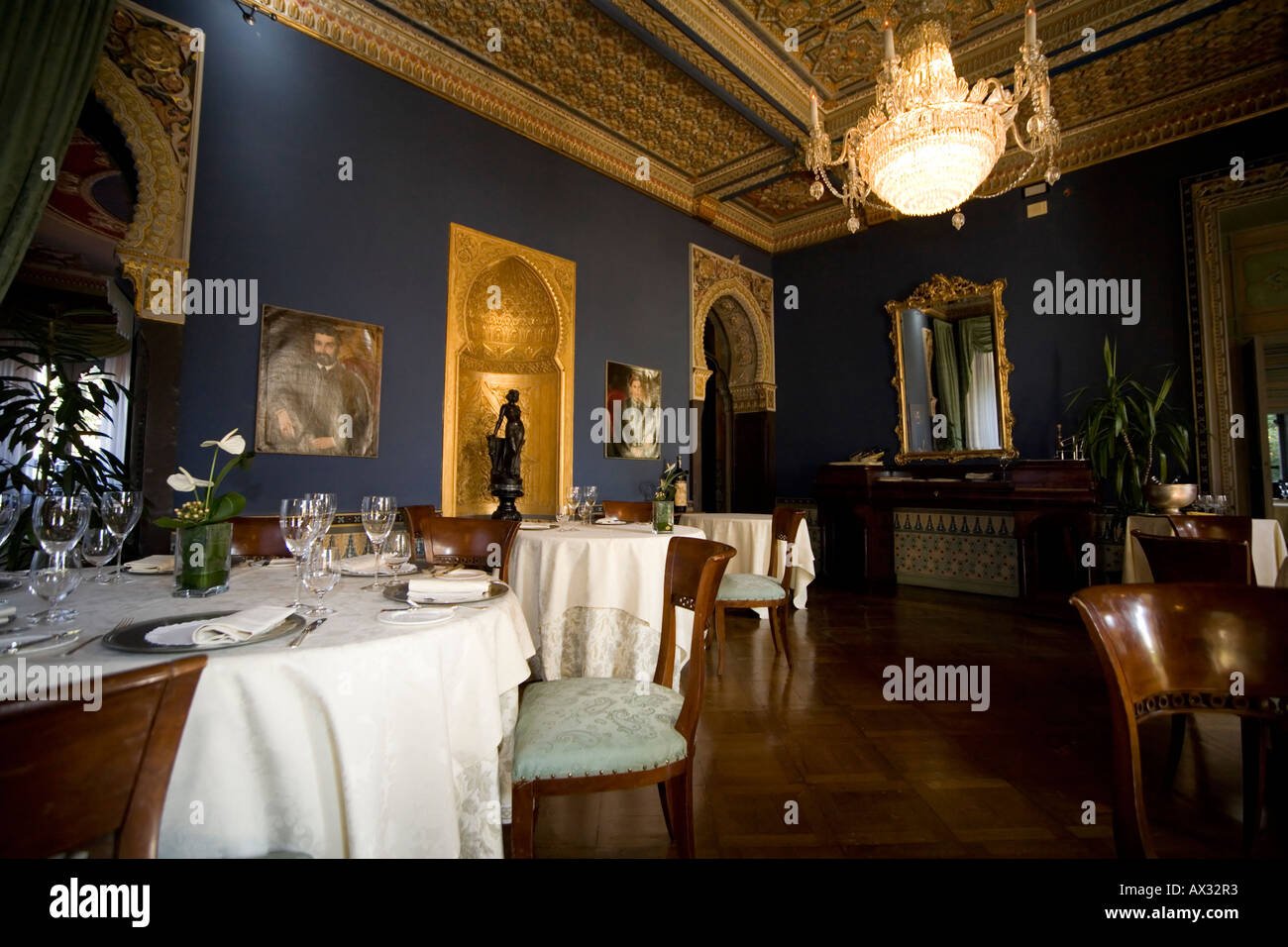
Arriving at Villa Crespi, the architecture registers before the food does. The building is a nineteenth-century Moorish fantasy — minarets, ornate facades, and a scale more consistent with a Levantine palace than a Piedmontese lakeside village. It was built by a wealthy cotton merchant, and the interiors sustain that register: elaborate coffered ceilings, parquet floors, and a veranda where natural light shifts through the day. The village of Orta San Giulio and the island of San Giulio are a short walk in one direction; Lake Orta opens in the other. Italy has no shortage of restaurants operating inside historically significant buildings, but few close this gap between architectural drama and culinary precision.
This matters because the setting is not incidental to the cooking. Italy's three-star tier is geographically dispersed — Osteria Francescana in Modena, Enoteca Pinchiorri in Florence, Piazza Duomo in Alba , and each carries a specific sense of place. Villa Crespi's particular position, operating as both a hotel and a destination restaurant in a town that most international visitors do not pass through by accident, creates a concentrated version of that experience. You come specifically for this.
Campanian Flavour in a Piedmontese Frame
The editorial angle that matters here is not complexity but clarity. Italy's serious cooking tradition has always rested on a principle that technique should intensify rather than obscure: fewer components, precisely sourced, cooked with the kind of attention that makes simplicity appear effortless. Chef Antonino Cannavacciuolo's trajectory illustrates this. He trained in Campania , from Vico Equense on the southern coast, where Torre del Saracino represents the same coastal tradition , and the flavour register of that region runs through his work at Villa Crespi: the intensity of southern seafood, the brightness of Mediterranean ingredients, the colours that mark Campanian cuisine from the more restrained palette of the north.
What Cannavacciuolo has built at Orta San Giulio over two decades is a synthesis. Piedmont contributes structure and seasonal discipline; Campania contributes heat, colour, and depth. The combination recurs across both tasting menus and the à la carte, where seafood, meat, and vegetarian preparations sit alongside each other without the usual hierarchy. The awards data tracks this steadily: three Michelin stars held across 2024 and 2025, a La Liste score of 98 points in 2026 (up from 97 in 2025), and a Relais & Châteaux membership with a 4.7/5 internal rating. Opinionated About Dining, which evaluates classical European restaurants with particular rigour, placed Villa Crespi at number 70 in its 2025 European ranking, up from 56 in 2024 and 110 in 2023 , a trajectory that reflects consistent improvement rather than plateau. Les Grandes Tables du Monde recognition in 2025 adds a third independent framework of validation.
Among Italy's three-star tier, Villa Crespi competes in a peer group that includes Le Calandre in Rubano, Uliassi in Senigallia, and Reale in Castel di Sangro , all restaurants where a strong regional identity shapes the cooking rather than an abstract internationalism. Enrico Bartolini in Milan and Atelier Moessmer Norbert Niederkofler in Brunico represent different poles of the Italian creative spectrum. Villa Crespi sits closer to the rooted-in-place school than the conceptual end of that axis.
The Menu Architecture
Two tasting menus run alongside an extensive à la carte. This structure is less common at the three-star level than it once was , many kitchens at this tier have moved to a single tasting format , and its persistence here signals something about the kitchen's confidence and the clientele it expects. Guests who commit to a tasting sequence get the full arc of the cooking; those who prefer to construct their own meal through the à la carte are accommodated without compromise. The wine list extends this generosity: two dedicated chapters cover Krug and Domaine de la Romanée-Conti, which positions the programme at a level where the cellar is an editorial statement in itself, not an afterthought.
The La Liste description references Sicilian scampi prepared with squid water and a pizzaiola application, alongside snails with white turnip and bagnetto verde. These combinations illustrate the north-south synthesis clearly: a southern crustacean and a Neapolitan sauce preparation meeting a Piedmontese green condiment. The logic is not fusion for its own sake but a demonstration that the two traditions have more in common , an insistence on ingredient primacy, a resistance to concealment , than their geography suggests.
For a comparable point of reference further along the Italian coastline, Quattro Passi in Marina del Cantone works the same Campanian seafood tradition. Dal Pescatore in Runate offers a different reference: a long-established family-run restaurant in the Po Valley where classical Italian cooking has been sustained across generations, a structural parallel to Villa Crespi's Relais & Châteaux family-run model.
Service and Setting
The dining rooms at Villa Crespi divide into four distinct spaces: a veranda with direct views and natural light, and three interior rooms with the ornate ceilings and floors of the original building. Service has been described in multiple independent evaluations as running with metronome precision , a phrase that recurs in the La Liste commentary and implies a kitchen-to-table coordination rarely achieved outside the top tier. Google reviewers (4.8 across 6,034 reviews) sustain this at a volume that suggests consistency rather than exceptional individual evenings.
As a Relais & Châteaux property, the hotel side integrates with the restaurant in a way that affects the planning decision significantly. Staying at the villa allows dinner without a drive on narrow lakeside roads and positions the meal as the centrepiece of a longer experience. The village itself warrants time: Orta San Giulio is one of the smaller lake towns in the Italian pre-Alps and rewards a day's exploration before or after the restaurant. For the wider context of what the area offers, see our full Orta San Giulio restaurants guide, hotels guide, bars guide, wineries guide, and experiences guide. For a more casual meal in the village, Andrea Monesi at Locanda di Orta offers country cooking at a different register entirely.
Planning a Visit
The kitchen operates Wednesday through Sunday, with lunch service running 12:30 to 2:00 pm and dinner from 7:30 to 9:30 pm. Monday and Tuesday the restaurant is closed. The price tier is €€€€, positioning it at the ceiling of Italian restaurant pricing alongside its three-star peers. Reservations at this level require meaningful lead time; the combination of a small boutique hotel and a destination restaurant drawing international visitors means tables move quickly, particularly for weekend dinner. Contacting the property directly through the Relais & Châteaux email (crespi@relaischateaux.com) or by phone (+39 0322 91 19 02) is the most reliable route. For guests also considering the Acquerello in Fagnano Olona, that restaurant represents a different creative Italian approach within the same Lombardy-adjacent region and could form a logical second stop for those building an itinerary around northern Italy's serious restaurant tier.
FAQ
What's the signature dish at Villa Crespi?
No single dish has been designated as a permanent signature, and the menu evolves with season and sourcing. The clearest expression of the kitchen's identity appears in its handling of Campanian seafood within a northern Italian frame: preparations like Sicilian scampi with squid water and bagnetto verde appear in independent evaluations as representative combinations, where a southern ingredient meets a Piedmontese condiment in a way that clarifies rather than complicates. The three Michelin stars and 98-point La Liste score across both tasting menus and the à la carte suggest the kitchen operates at full register regardless of which format a guest chooses.
Price Lens
These are the closest comparables we have in our database for quick context.
| Venue | Price | Awards | Notes |
|---|---|---|---|
| Villa Crespi | €€€€ | La Liste Top Restaurants (2026): 98pts; A short walk from the fairytale village and its postcard-perfect view of the lake and the island of San Giulio, the setting of this three-star restaurant is no less dazzling: a late nineteenth-century villa in Moorish style, an aristocratic dwelling where the Crespi family life unfolded, as imposing in its exterior appearance as it is fascinating in its interior rooms. Here the veranda offers glimpses and plays of natural light, while the other three rooms are embellished with elaborate ceilings and marvelous parquet floors. Today the star of the villa is Antonino Cannavacciuolo, a brilliant chef at the head of a small empire of starred restaurants, who here in Orta San Giulio has his flagship: the most awarded and celebrated establishment! From Vico Equense in Campania, over the years his dishes have become the quintessence of Mediterranean and Italian taste. In all offerings you’ll find that passion, those colors and that intensity of flavors typical of his region of origin, which we are grateful he has never abandoned. In the two tasting menus, as well as in the extensive à la carte menu, an uninterrupted fil rouge of refinement and goodness flows generously through seafood, meat, and even vegetarian recipes. You’ll be pampered by service that runs like a metronome, supported in turn by a profound wine list, where two chapters of great importance dedicated to Krug and Domaine de la Romanée-Conti stand out.; Villa Crespi is a 19th-century Moorish-style villa, built by a wealthy cotton merchant, close to Lago D’Orta. Now it is a luxurious five-star Relais & Châteaux boutique hotel with an excellent two-star restaurant where Antonino Cannavacciuolo is in charge. His dishes are inspired by the traditional kitchen of Campania and by extension Piedmont, with which he makes unexpected combinations. He weaves colours and flavours into a harmonious whole. His presentation is delightful. What to think about Sicilian scampi all "pizzaiola" with squid water? Or snails with white turnip and "bagnetto verde"?; Opinionated About Dining Classical in Europe Ranked #70 (2025); HIGHLIGHTS: • 3 MICHELIN STARS 2025 • 19TH-CENTURY MOORISH VILLA • VIEWS OF LAKE ORTA • FAMILY-RUN DIRECTIONS & ACCESS: Website and contact information E-mail: crespi@relaischateaux.com Tel. : +39 0322 91 19 02 MEMBER SINCE: 4.7/5; Les Grandes Tables Du Monde Award (2025); Chef: Antonino Cannavacciuolo document.addEventListener("DOMContentLoaded", function() { var el = document.getElementById("Achievements_chefs"); if (el && el.parentNode) { el.parentNode.removeChild(el); } });; La Liste Top Restaurants (2025): 97pts; Michelin 3 Stars (2025); Opinionated About Dining Classical in Europe Ranked #56 (2024); Michelin 3 Stars (2024); Opinionated About Dining Classical in Europe Ranked #110 (2023) | This venue |
| Atelier Moessmer Norbert Niederkofler | €€€€ | Michelin 3 Star, World's 50 Best | Italian, Creative, €€€€ |
| Dal Pescatore | €€€€ | Michelin 3 Star, World's 50 Best | Italian, Italian Contemporary, €€€€ |
| Enoteca Pinchiorri | €€€€ | Michelin 3 Star, World's 50 Best | Italian - French, Italian Contemporary, €€€€ |
| Enrico Bartolini | €€€€ | Michelin 3 Star, World's 50 Best | Creative, €€€€ |
| Osteria Francescana | €€€€ | Michelin 3 Star, World's 50 Best | Progressive Italian, Creative, €€€€ |
Need a table?
Our members enjoy priority alerts and concierge-led booking support for the world's most difficult tables.
Access the Concierge