
Tsuki to Kame is a compact Morishita curry counter that places Tokyo’s ingredient-driven curry culture in miniature: small scale, tight service rhythm, and cooking built around a narrow specialist identity rather than breadth. Its selection for Tabelog Curry TOKYO “Tabelog 100” in 2023 and 2024 gives it a clear trust signal in a city where curry ranges from railway-station comfort food to serious destination cooking.
Pearl is the En Primeur Club membership app — saves, bookings, and concierge access live there. Same editors, same standards.
- Address
- 3 Chome-7-3 Shinohashi, Koto City, Tokyo 135-0007, Japan
- Website
- tukitokame.jimdosite.com
 Saves & bookings on Pearl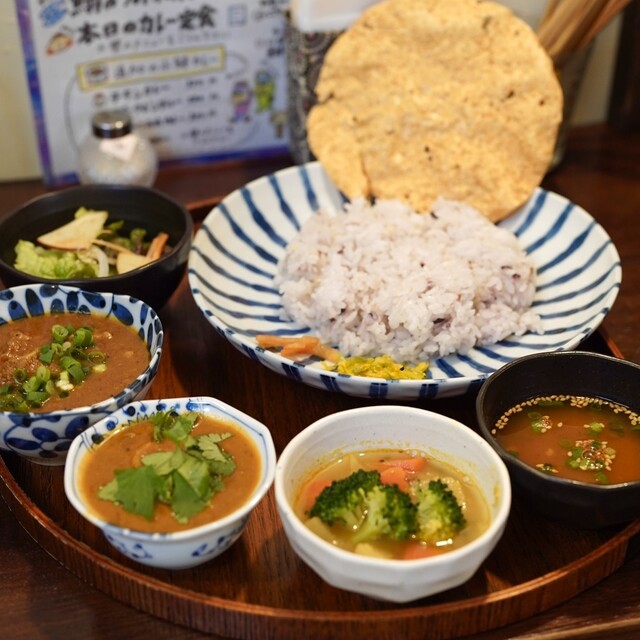
Morishita is not Tokyo’s hotel-lobby, tasting-menu version of itself. Around the station, the city sits lower: narrow shopfronts, fast lunch queues, and counters for people who know exactly what they came to eat. Curry is revealing here: inexpensive by Tokyo standards, personal in execution, and judged less by luxury cues than spice structure, rice handling, and short-menu discipline.
From abroad, Tokyo curry is often flattened into sweet Japanese curry versus Indian restaurant curry. The better reading is granular. The city has absorbed spice traditions through trade, postwar canteens, kissaten culture, South Asian migration, and independent cooks who treat curry as daily craft, not a fixed category. A small counter can be as serious, in its register, as sushi or ramen, because repetition sharpens the cooking. Tsuki to Kame belongs to that specialist lane: listed as Indian curry and selected for Tabelog Curry TOKYO “Tabelog 100” in both 2023 and 2024.
Morishita's small-counter curry culture rewards focus over theatre
The point is not spectacle. Tokyo’s stronger curry rooms run on compression: few seats, narrow hours, limited production, and kitchen rhythm built for consistency over choice. Tsuki to Kame is an extreme case, with five seats and take-out noted in the service format. That scale removes slack and fixes attention on the plate, queue, and turnover.
Sourcing matters because curry exposes shortcuts. Spice blends, aromatics, rice, oil, and garnish all register in the final balance; expensive tableware and service choreography cannot hide weak cooking. In Tokyo, serious curry discussion has moved beyond heat level. Better questions are where the spice profile sits between Indian references and Japanese adaptation, how sauce meets rice, and whether the cooking has enough clarity to justify a dedicated trip.
The Tabelog Hyakumeiten system is not a Michelin analogue. Its value is different: it identifies venues that cut through a crowded local category with enough consistency to matter to Japanese diners. For curry, that means something. Tokyo has hundreds of curry shops across railway hubs, office districts, residential streets, and student neighborhoods. A repeat place on the Curry TOKYO “Tabelog 100” list signals more than convenience; it belongs on the city’s serious curry map.
That matters because the price band remains everyday, not ceremonial. Tokyo dining can lean toward scarcity and performance, but curry’s appeal is partly democratic. A highly recognized curry shop can still belong to lunch culture rather than special-occasion dining. The tension between modest spend and obsessive execution is the category’s draw.
The defining idea is a narrow Indian-curry lens, not a broad restaurant brief
Read Tsuki to Kame as specialization. The listed category is Indian curry, but in Tokyo that spans North Indian restaurant formats and Japanese interpretations of spice-led plates built for counter service. Without reducing the cooking to biography or origin story, the key point is format: a small room, short service, and a curry identity specific enough to earn recognition in a city that takes the genre seriously.
Comparison needs care. Nearby Tokyo dining can mean bread culture at Cattlea, premium meat-led menus at BLESS, Neapolitan cooking at Pizzeria Bella Napoli, or quieter neighborhood addresses such as たかはし and Takahara Kiyosumi. They are not direct curry peers, but they show how eastern Tokyo often runs on specialist shops rather than grand dining rooms. Curry has its own grammar: regulars read aroma, viscosity, rice texture, and spice aftertaste as seriously as others read nigiri temperature or yakitori doneness.
For travelers, this is where Tokyo outgrows a famous-name checklist. A compact curry counter in Koto can teach as much about the city’s dining habits as high-price omakase in Ginza. The tempo is different: quick meal, compact room, simple choices. The reward is precision within a narrow frame.
The strongest reason to go is category fluency. Anyone trying to understand Tokyo through food should not stop at sushi, ramen, tempura, and kaiseki. Curry is an essential everyday form, and its serious practitioners show how Japanese dining absorbs outside references without freezing them. Tabelog curry recognition places Tsuki to Kame in that conversation, while the small-seat format keeps it grounded in neighborhood lunch culture, not destination-dining polish.
How to place it in a Tokyo eating itinerary
Morishita sits east of the heavier tourist circuits, giving this meal a different role. It suits diners who build Tokyo around neighborhoods and transit lines, not only reservations. Koto and the surrounding east-side wards reward that approach with old commercial streets, workshop density, and food businesses often uninterested in international signaling. Treat the visit as a focused curry stop, not a long multi-course meal.
Because the room is small and concise, it pairs better with a day of exploring than with a dressed-up evening. The spend also leaves room for a second food stop, a bar, or a formal dinner elsewhere. For a broader Tokyo restaurant itinerary, Our full Tokyo restaurants guide maps the city beyond single-category dining. Travelers planning a stay can also cross-reference Our full Tokyo hotels guide, Our full Tokyo bars guide, Our full Tokyo wineries guide, and Our full Tokyo experiences guide.
Within Tokyo, contrast this curry stop with other specialist formats: seafood and grill at. 鮪と炭火焼き うお炭 秋葉原店, Shinjuku dining at 12/10 Shinjuku ten, chicken-focused cooking at 124. KAGURAZAKA (Yakitori), visual café culture at 2D Cafe, and another curry reference point at 3 Chome no Curry Ya San. The point is not ranking them, but seeing how Tokyo’s dining intelligence often lives in narrowly defined rooms.
For Japan-wide context, compare the category with beef sukiyaki in Kamakura at -Grilled beef Sukiyaki- KAMAKURA TANUKIAN 鎌倉 たぬき庵 in Kamakura, café minimalism at.cafe in Osaka, Kumamoto dining at.know in Kumamoto, Vietnamese cooking in Kawasaki at (Shoku) Vietnam in Kawasaki, Sapporo curry at [Curry Senmon Ten] Maruyama Kyoju. in Sapporo, and Kyoto’s contemporary dining at [ki:] in Kyoto. Across the Pacific, Japanese-adjacent drinking and casual food culture take different forms at Jōdo Saké Bar in Los Angeles and Onigiri Time in Pasadena. The restaurant’s value is sharper against that wider map: a small Tokyo curry address where sourcing, spice logic, and counter discipline carry the experience.
Cuisine-First Comparison
Comparable venues side-by-side for orientation.
| Venue | Cuisine | Price | Notes |
|---|---|---|---|
| Tsuki to KameThis venue — the venue you are viewing | Japanese Curry | $ | Not listed |
| Spice Palette | Japanese curry house | $ | Taitō |
| Kobiki Cho Yuzukamiya | Traditional Soba & Tempura | $ | Chūō |
| Toranomon Okanoeisen | Traditional Japanese Wagashi & Daifuku | $ | Minato |
| Ichigenya | Traditional Japanese Sweets (Wagashi) | $ | Chiyoda |
| Tsukemen Michi | Tsukemen ramen shop | $ | Katsushika |
Recognition history
Dated appearances from independent guides and award organizations, with the underlying list record or original source where available.
Tabelog 100 #54 · No. 54
Tabelog · Tabelog 100 - Curry - TOKYO - 2024






At a Glance
- Cozy
- Intimate
- Quiet
- Solo
- Casual Hangout
- Standalone
Current opening hours
- Monday
- 11:30 AM–2 PM
- Tuesday
- 11:30 AM–2 PM
- Wednesday
- 11:30 AM–2 PM
- Thursday
- Closed
- Friday
- Closed
- Saturday
- 11:30 AM–2 PM
- Sunday
- 11:30 AM–2 PM
Hours can change for holidays and private events. Last verified .
A small, counter-led neighborhood restaurant with a calm, unpretentious feel and limited seating across two floors.