


A Michelin Bib Gourmand fixture in Madrid's Goya district, Tres por Cuatro runs a split à la carte that separates signature classics from daily seasonal plates. Chef Álex Marugán works Latin American influences — particularly Mexican and Peruvian — into contemporary Spanish cooking at a mid-range price point that makes it one of the more serious value propositions in Salamanca.
Pearl is the En Primeur Club membership app — saves, bookings, and concierge access live there. Same editors, same standards.
- Address
- C. de Montesa, 9, Salamanca, 28006 Madrid, Spain
- Phone
- +34 915 65 45 57
- Website
- tresporcuatromadrid.com
- Directions
- Get directions
 Saves & bookings on Pearl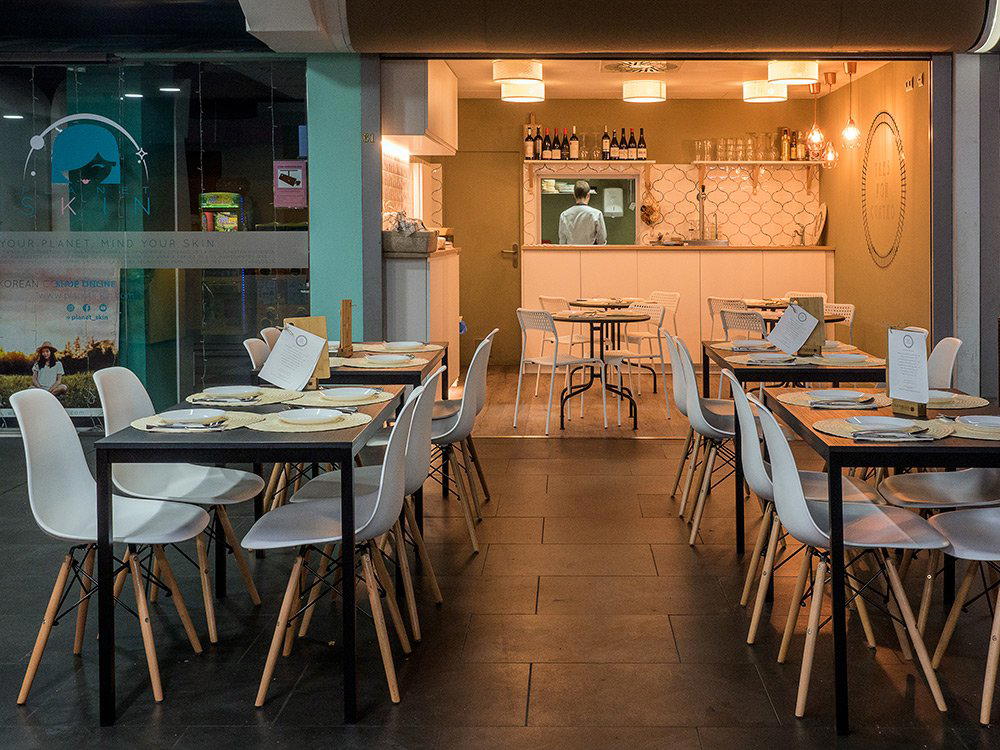
Where the Menu Does the Talking
Calle de Montesa sits on the quieter residential edge of the Goya district, a few blocks south of where Salamanca's boutique density thins out into neighbourhood life. The address puts Tres por Cuatro slightly off the main Serrano-to-Velázquez axis that draws most first-time visitors to the barrio, which means the room fills largely with people who came specifically for it. That deliberateness shows in the crowd and, more to the point, in the menu format that has earned the restaurant consecutive Michelin Bib Gourmand recognition in both 2024 and 2025.
A Menu Built Around Two Distinct Logics
Madrid's contemporary bistro tier has settled into a fairly predictable format over the past decade: a short seasonal card, a wine list weighted toward natural producers, and a prix-fixe option for lunch. Tres por Cuatro breaks from that template with a structural decision that tells you something specific about what the kitchen is trying to do. The à la carte divides into two named sections with different functions.
The first, "Los de siempre" (roughly, "the regulars"), anchors the menu with dishes that have become fixtures of the restaurant's identity. The fried torrezno and the ossobuco pibil taco sit here — the kind of plates that earn a restaurant its regulars and that a kitchen refines through repetition rather than reinvention. In the broader context of Spanish contemporary cooking, this section represents a clear editorial position: some dishes are worth keeping, and a rotating menu that erases them to signal seasonal credentials is not always the correct choice.
The second section, "Los de hoy" ("today's"), is where the kitchen responds to the market and the season. This is the more conventional half of the format, but its placement alongside a permanent section changes how you read it. The seasonal dishes aren't performing novelty for its own sake; they're in conversation with a fixed reference point, which gives both halves more definition than either would have alone. For a reader familiar with how tasting menus at Madrid's upper tier operate — places like DSTAgE or Deessa, this dual-logic structure at a €€ price point is a meaningful departure from the category norm.
Latin American Influence as a Working Method, Not a Theme
Contemporary Spanish cooking has absorbed Latin American technique and ingredient logic at multiple price points, from the elaborate constructions at DiverXO down through mid-market bistros. What varies is how that influence operates: as a concept, as a flavour palette, or as a genuine structural element of the cooking. At Tres por Cuatro, the Mexican and Peruvian references appear as working methods, the pibil preparation on the ossobuco taco being a clear example, where a slow-braised central European cut meets an Yucatecan achiote-and-citrus technique. The result is not fusion in the mid-1990s sense but something that reflects how a Madrid kitchen in the 2020s actually thinks about ingredients and process.
Chef Álex Marugán developed the approach through earlier work at Mercado Torrijos, also in the Goya neighbourhood, before opening this room. That proximity matters less as biography than as context: the Goya-Torrijos axis has become a reference point for the kind of serious-but-informal cooking that Madrid's younger restaurant culture has embraced, and Tres por Cuatro sits firmly within that tradition.
A Michelin Bib Gourmand designation means, by definition, that Michelin's inspectors found the cooking to exceed what the price point would normally predict. Two consecutive years of that recognition (2024 and 2025) suggests the kitchen has maintained a level of consistency that the guide's methodology requires. On Opinionated About Dining's European Casual ranking for 2025, the restaurant appears at position 543, a data point that places it within a large but competitive field of informally positioned restaurants across the continent.
Within Madrid specifically, the relevant comparison is not with the city's starred fine-dining rooms. Coque and Paco Roncero operate at €€€€ with full tasting-menu formats and the production infrastructure those require.
For broader context on what Spanish contemporary cooking looks like across different price points and regions, the full range runs from Salamanca bistros through coastal destination restaurants like Aponiente in El Puerto de Santa María and Quique Dacosta in Dénia, to the Basque reference points of Arzak in San Sebastián and Azurmendi in Larrabetzu, and the Catalan technical tradition represented by El Celler de Can Roca in Girona and Disfrutar in Barcelona. Similar bistro-level contemporary cooking in other Spanish cities appears at Atelier Casa de Comidas in Granada and Casa Antonio in Jaén.
Planning Your Visit
| Detail | Tres por Cuatro | Typical €€€€ peers (DiverXO, Coque) |
|---|---|---|
| Price range | €€ | €€€€ |
| Menu format | À la carte (two sections) | Tasting menu, often fixed |
| Lunch service | Mon–Fri, 1:30–5:30 pm (Fri until 6 pm) | Varies; some lunch-only or dinner-only |
| Dinner service | Mon–Fri, 8:30 pm–12:30 am (Fri until 1 am) | Typically from 8 or 8:30 pm |
| Weekend availability | Closed Saturday and Sunday | Often open weekends |
| Michelin recognition | Bib Gourmand 2024, 2025 | Full stars (1–3) |
The Saturday and Sunday closure is worth noting before you plan around a weekend visit. Lunch on a weekday, the extended 1:30 to 5:30 pm window, is the more relaxed entry point. The Goya Metro stop (Line 4) puts the address within a short walk. For a fuller picture of where Tres por Cuatro fits within Madrid's dining, drinking, and hotel options, see our full Madrid restaurants guide, our Madrid hotels guide, our Madrid bars guide, our Madrid wineries guide, and our Madrid experiences guide.
Reputation Context
| Venue | Cuisine | Price | Awards |
|---|---|---|---|
| Tres por CuatroThis venue — the venue you are viewing | Spanish, Contemporary | €€ | Bib Gourmand |
| DiverXO | Progressive - Asian, Creative | €€€€ | Michelin 3 Star |
| Deessa | Modern Spanish, Creative | €€€€ | Michelin 2 Star |
| Smoked Room | Progressive Asador, Contemporary | €€€€ | Michelin 2 Star |
| Coque | Spanish, Creative | €€€€ | Michelin 2 Star |
| Paco Roncero | Creative | €€€€ | Michelin 2 Star |
Recognition history
Dated appearances from independent guides and award organizations, with the underlying list record or original source where available.
Macarfi 7.7 Food Rating
Macarfi
Michelin Bib Gourmand
Michelin
Opinionated About Dining Casual in Europe Recommended
Opinionated About Dining
Michelin Bib Gourmand
Michelin
Opinionated About Dining Casual in Europe Ranked #543
Opinionated About Dining
Michelin Bib Gourmand
Michelin
Continue exploring
More in Madrid
Restaurants in Madrid
Browse all →
Bars in Madrid
Browse all →
Hotels in Madrid
Browse all →


At a Glance
- Cozy
- Modern
- Intimate
- Date Night
- Business Dinner
- Open Kitchen
- Extensive Wine List
- Local Sourcing
Current opening hours
- Monday
- 1:30–3:30 p.m., 8:30–10:30 p.m.
- Tuesday
- 1:30–3:30 p.m., 8:30–10:30 p.m.
- Wednesday
- 1:30–3:30 p.m., 8:30–10:30 p.m.
- Thursday
- 1:30–3:30 p.m., 8:30–10:30 p.m.
- Friday
- 1:30–4 p.m., 8:30 p.m.–12 a.m.
- Saturday
- Closed
- Sunday
- Closed
Hours can change for holidays and private events. Last verified .
Cozy and welcoming with large windows, light-filled space in whites and sands, exposed brick, and a relaxed bistro atmosphere.
Know Before You Go
- Getting there
- C. de Montesa, 9, Salamanca, 28006 Madrid, Spain