Thirteen

Michelin Plate
Our verdict
Thirteen on Ashley Road in Parkstone is an intimate six-table restaurant built around Head Chef Alex Naik's open kitchen. The family-run dining room has been included in the MICHELIN Guide in 2024, 2025 and 2026. Menus range from the £90 6.5-plate format to the £135 signature 13-plate tasting menu, with an £80 à la carte lunch on alternate Sundays.

Pearl is the En Primeur Club membership app — saves, bookings, and concierge access live there. Same editors, same standards.
- Address
- 222, Ashley Road Parkstone, Poole BH14 9BY, United Kingdom
- Phone
- +44 1202 376635
- Hours
- Mon–Tue ClosedWed 6:30–11 p.m.Thu–Sat 12–3 p.m., 6:30–11 p.m.Sun 12:30–4 p.m.
- Website
- thirteenrestaurant.com
- Directions
- Get directions
- Booking
- Book on the venue's website
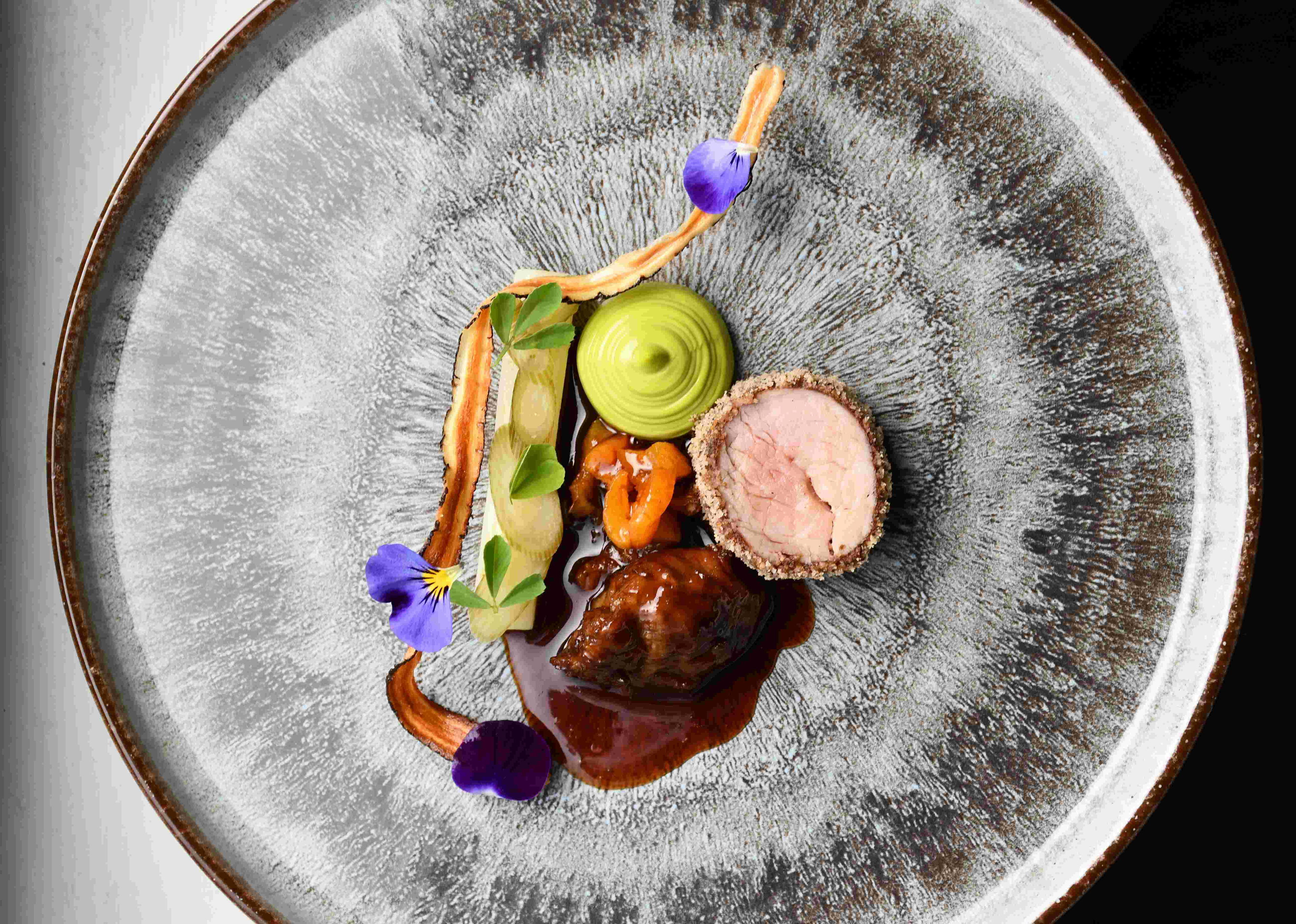
Counter Culture, Dorset Edition
The open kitchen as theatre is not a new idea. From the counter seats at Frantzén in Stockholm to the chef's table formats popularised across London's £££ tier, the arrangement of diners facing their food being made has become a defining feature of serious modern restaurants. What is less expected is finding that format on Ashley Road in Parkstone, a residential stretch of Poole that does not announce itself as a dining destination. Thirteen, sitting at number 222, makes the argument that ambitious tasting menu cooking does not require a capital city postcode.
The room holds six tables, all positioned to face the chefs working in the open kitchen. Two counter seats bring guests to the front row, the closest the format gets to a full omakase-style interaction between cook and diner. The physical arrangement is deliberate: it collapses the distance between preparation and consumption in a way that larger dining rooms cannot replicate. At this scale, a kitchen is not a separate department. It is the dining room.
A Family Operation in a Lean Format
Small, independently run restaurants in the UK have faced consistent pressure from rising ingredient and energy costs since 2021, and many tasting menu formats outside London have consolidated or closed. The ones that survive tend to operate with tight, committed teams rather than conventional brigade structures. Thirteen fits that pattern: Chef Alex Naik works alongside his parents and sister, who run service. The family-run model is not incidental to the restaurant's character; it is the structural reason a kitchen of this ambition can operate at this address and at this price tier.
That operating model places Thirteen in a specific peer group. Restaurants like hide and fox in Saltwood represent a similar dynamic: technically serious, tightly run, and located outside the obvious metropolitan circuits. The comparison is instructive. Both operate in areas where the local dining public is not necessarily the primary audience, and both depend on guests who travel specifically for the food rather than proximity.
The Tasting Menu and Its Ingredients
Modern British tasting menus divide broadly into two camps. The first prioritises technique as spectacle, with cooking that foregrounds transformation, fermentation, or multi-stage processes as ends in themselves. The second uses technique as a supporting structure for ingredient quality, where the menu's ambition shows in sourcing and seasonality as much as in method. Thirteen occupies the second camp. The menu's dish descriptions are deliberately sparse, which is a recognisable signal in this register: understatement on the page is a way of letting the plate speak without over-promising.
The ingredients lean local and seasonal, with foraged elements incorporated where the season supports it. In the context of Dorset and the wider Poole area, that access to quality is not incidental. The county sits within reach of Portland's seafood, the Jurassic Coast's foraging grounds, and agricultural suppliers who have supplied restaurants at the level of Gidleigh Park in Chagford for decades. Thirteen draws on a supply geography that is richer than its address suggests.
For comparison, the format of ambitious tasting menus in UK destination restaurants, from L'Enclume in Cartmel to Moor Hall in Aughton, has long centred on the relationship between kitchen and landscape. The difference at Thirteen is scale: those properties operate in settings that frame the food with architectural or natural grandeur. Here, the kitchen is the frame, and it is a more intimate one.
MICHELIN Guide Recognition: 2024-2026
Thirteen has been included in the MICHELIN Guide for three consecutive years: 2024, 2025 and 2026. For a restaurant that opened in September 2023, that sustained recognition is a meaningful signal of the kitchen's consistency and ambition.
The recognition matters in Poole specifically. Dorset is not dense with MICHELIN Guide-listed addresses, and Thirteen's place in the Guide helps diners identify a small, independently run restaurant worth travelling for.
Poole as a Dining Context
Poole's dining scene is not structured around fine dining in the way that, say, Marlow is, where Hand and Flowers has anchored a small cluster of serious restaurants around a single destination address. The town's culinary identity runs more towards seafood and harbour-adjacent dining, with places like Guildhall Tavern representing the more established end of that tradition. Thirteen operates in a different register entirely, and its location on Ashley Road rather than the quayside is part of that separation. It is not competing with harbour views. It is competing on food alone.
That positioning is not unusual in British dining. Some of the country's most closely watched restaurants sit in settings that work against expectation: The Fat Duck in Bray occupies a converted pub on a village high street; Restaurant Andrew Fairlie in Auchterarder is reached through a hotel basement corridor. The building is rarely the point. Thirteen, with its residential Parkstone address and six-table room, belongs to that tradition of kitchens that ask diners to reorient their expectations before they arrive.
Menus, Prices and Booking
The signature 13-plate tasting menu is served Wednesday to Saturday evenings at £135 per person. A shorter 6.5-plate tasting menu is available at lunchtime and on Wednesday and Thursday evenings at £90 per person. On alternate Sundays, Thirteen serves a six-course à la carte lunch at £80 per person.
Thirteen cannot accommodate walk-in guests. Advance booking is essential, although late bookings can often be accommodated when guests call the restaurant directly on +44 1202 376635. The restaurant is at 222 Ashley Road, Parkstone, Poole BH14 9BY; its website is thirteenrestaurant.com.
Frequently asked questions
What menus does Thirteen offer and how much do they cost?
The signature 13-plate tasting menu is £135 per person on Wednesday to Saturday evenings. The shorter 6.5-plate tasting menu is £90 per person at lunchtime and on Wednesday and Thursday evenings. A six-course à la carte Sunday lunch is £80 per person on alternate Sundays.
Can I walk in or make a late booking at Thirteen?
Thirteen cannot accommodate walk-in guests. Late bookings are often possible, so call the restaurant directly on +44 1202 376635 to ask about current availability.
What MICHELIN recognition does Thirteen have?
Thirteen has been included in the MICHELIN Guide for three consecutive years: 2024, 2025 and 2026. The restaurant opened in September 2023.
Who runs Thirteen?
Head Chef Alex Naik leads the kitchen. Thirteen is a family operation with his sister Frances, and their parents and co-owners Hem and Elisabeth.
Where is Thirteen and how can I contact it?
Thirteen is at 222 Ashley Road, Parkstone, Poole, Dorset BH14 9BY. Call +44 1202 376635, email info@thirteenrestaurant.com, or visit thirteenrestaurant.com.
Cost Snapshot
| Venue | Cuisine | Price | Awards |
|---|---|---|---|
| ThirteenThis venue — the venue you are viewing | Modern British Fine Dining | $150–200 | Michelin Plate |
| The Ledbury | Modern European, Modern Cuisine | Not listed | Michelin 3 Star |
| Sketch, The Lecture Room and Library | Modern French | Not listed | Michelin 3 Star |
| CORE by Clare Smyth | Modern British | Not listed | Michelin 3 Star |
| Restaurant Gordon Ramsay | Contemporary European, French | Not listed | Michelin 3 Star |
| Dinner by Heston Blumenthal | Modern British, Traditional British | Not listed | Michelin 2 Star |
Recognition history
Dated appearances from independent guides and award organizations, with the underlying list record or original source where available.
Michelin Plate
Michelin
Full recognition history (2 entries)
Michelin Plate
Michelin
Continue exploring
More in Poole
Restaurants in Poole
Browse all →
Bars in Poole
Browse all →
Hotels in Poole
Browse all →

Details
- Intimate
- Cozy
- Elegant
- Sophisticated
- Special Occasion
- Date Night
- Celebration
- Open Kitchen
- Chefs Counter
- Extensive Wine List
- Local Sourcing
- Tasting Menu
- Vegetarian Friendly
- Allergy Accommodating
- Vegan Options
Current opening hours
- Monday
- Closed
- Tuesday
- Closed
- Wednesday
- 6:30–11 p.m.
- Thursday
- 12–3 p.m., 6:30–11 p.m.
- Friday
- 12–3 p.m., 6:30–11 p.m.
- Saturday
- 12–3 p.m., 6:30–11 p.m.
- Sunday
- 12:30–4 p.m.
Hours can change for holidays and private events. Last verified .
Intimate and relaxed atmosphere likened to dining in a special friend's home, with subtle lighting, calm ambience, and warm welcoming service.