Temple Canteen

Our verdict
Beneath the Hindu temple at 143-09 Holly Ave in Flushing, Queens, Temple Canteen operates as a basement cafeteria where South Indian staples, dosa, idli, vada, uttapam, are served on stainless steel trays to long communal tables of families and devotees. The rava masala dosa, speckled with chiles and onions, draws. Service is direct, the food matches that register, and nothing about the experience is incidental.

Pearl is the En Primeur Club membership app, where members save venues, book tables and use the concierge.
The menu
What to order
- Masala dosa
- Paper dosa
- Mysore masala dosa
- Medu vada
A Basement That Predates the Brunch Trend by Decades
South Indian vegetarian cooking has existed in New York City considerably longer than the current wave of Chennai-referencing tasting menus and chaat-driven cocktail bars. Temple canteens, attached to Hindu religious institutions and funded through community donation rather than investor capital, represent one of the oldest formats for this food in the city. The Flushing Hindu Temple at 143-09 Holly Ave has operated its basement cafeteria for years, feeding worshippers arriving from morning puja and families who treat the Sunday meal here as a religious observance in its own right. That continuity matters when placing this space in the wider context of New York's Indian dining scene, which spans everything from the tasting counter format at aRoqa to the subcontinental comfort register of Bungalow.
The Architecture of the Experience
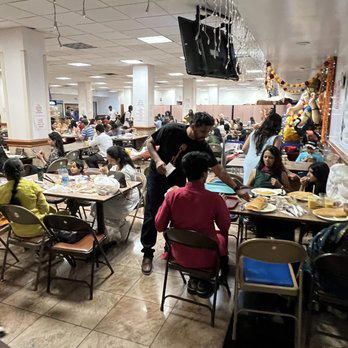
The physical container here is the editorial subject. Temple Canteen does not operate in a designed dining room. It occupies a functional basement beneath a place of worship, and that lineage shapes every element of the space. Long communal tables run the length of a room that has never been renovated for atmosphere. Fluorescent lighting, stainless steel trays, and the ambient noise of families in conversation at close quarters define the sensory register. There are no partitions, no acoustic panels, and no curated soundtrack. What you get instead is the architecture of a shared meal stripped of all hospitality-industry scaffolding.
This format has strong parallels in South India, where temple feeding halls, known as annadanam spaces, operate on the principle that food offered near a place of worship carries its own significance independent of presentation. New York's version is compressed and urban, but the logic is the same. The long tables invite proximity with strangers. The stainless steel trays communicate that the point is the food, not the vessel. Families polish off the last traces of coconut chutney and sambhar with torn pieces of uttapam rather than reaching for paper napkins, a practice that implies comfort with the format and familiarity with the food.
For readers who have spent time eating in similar institutional settings in Tamil Nadu, Karnataka, or Andhra Pradesh, the spatial grammar here will feel immediately legible. For those who have not, it functions as an introduction to a format that predates the contemporary restaurant model entirely. High-end Indian dining in other cities, such as Trèsind Studio in Dubai or Opheem in Birmingham, works at the opposite end of the spatial register, where plating precision and architectural interiors are central to the proposition. Temple Canteen operates in a category where neither of those variables is relevant.
The South Indian Repertoire
The menu concentrates on the three foundational formats of South Indian vegetarian cooking: fermented rice-batter preparations in the dosa and uttapam family, steamed rice-batter items in the idli category, and fried lentil preparations anchored by vada. This is a tightly defined repertoire, and the kitchen does not attempt to expand beyond it toward North Indian styles or fusion registers.
The rava masala dosa draws specific attention in the venue's documented record. Rava dosa, made with semolina rather than the standard fermented rice and lentil batter, produces a thinner, lacier crepe with a more pronounced crunch at the edges. The masala filling, with chiles and onions, follows the standard Tamil template. The fact that the edges are described as wispy rather than uniformly crisped is a detail that points to the wood-fired or high-flame cooking typical of this format when done at volume. This is not the same dish you encounter at sit-down South Indian restaurants in Midtown, where dosas are frequently made to a standardised tourist-facing specification. The Flushing version operates at a different register of authenticity, shaped by a congregation that would notice the difference.
Coconut chutney and sambhar arrive as the standard accompaniments. These are not incidental condiments. Sambhar, the thin lentil soup seasoned with tamarind and a tempering of mustard seeds and dried chiles, is the dish that most reveals the kitchen's provenance: the balance of sourness, the depth of the lentil base, and the quality of the vegetable additions vary considerably from one kitchen to another. A sambhar made for a Tamil congregation at a religious institution will typically reflect the home-cooking traditions of that community rather than an adjusted version calibrated for a general audience.
Flushing as a Dining District
Flushing in Queens holds a place in the New York dining conversation that its geography, forty minutes from Midtown on the 7 train, often undersells. The neighbourhood is one of the most concentrated and diverse Asian food corridors in the United States, with representations of regional Chinese, Korean, and South and Southeast Asian cooking that have no equivalent in Manhattan. Within this context, the Hindu temple canteen occupies a specific and relatively uncrowded niche: it is not a restaurant in the commercial sense, does not operate for profit in the way a commercial venue would, and is not marketed toward the food-media audience that drives reservation demand at places like Cardamom or Chola.
The audience is primarily the South Asian Hindu community of Queens and the broader tri-state area, which means the food is calibrated for recognition rather than introduction. That is a different brief than almost any commercial Indian restaurant in the city, including the Hyderabadi-focused register of Hyderabadi Zaiqa, which is itself a community-facing rather than media-facing operation. Both sit well outside the city's fine-dining conversation, anchored by French and Japanese tasting counters at the top of the price range, but they occupy a category where provenance and regularity of clientele are the relevant quality signals.
Readers interested in mapping the full range of New York's Indian dining, from basement canteens to contemporary tasting menus, will find the full New York City restaurants guide a useful starting frame. The city also supports extensive hotel, bar, and experience programming covered across hotels, bars, wineries, and experiences guides.
Planning Your Visit
Temple Canteen operates beneath the Flushing Hindu Temple at 143-09 Holly Ave, Flushing, NY 11355. The 7 train to Flushing-Main Street places you within walking distance. The space fills quickly on weekends, when temple attendance peaks and families arrive for post-puja meals. Arriving during a weekday or early in the morning service window reduces wait time for seating at the long communal tables. No reservation system exists; the format is walk-in. Pricing is low by any New York standard, consistent with the community-service rather than commercial-restaurant model.
For comparable high-end dining experiences in other American cities, the editorial contrast is instructive: Lazy Bear in San Francisco, Alinea in Chicago, The French Laundry in Napa, Single Thread Farm in Healdsburg, Providence in Los Angeles, and Emeril's in New Orleans all operate in the maximalist-hospitality tier. Temple Canteen represents the opposite end of the format spectrum, where the absence of hospitality infrastructure is precisely the point.
Quick reference: 143-09 Holly Ave, Flushing, NY 11355. Walk-in only. 7 train to Flushing-Main Street.
Frequently asked questions
What kind of recognition has Temple Canteen received?
Temple Canteen has received recognition including: Beneath the Hindu temple in Flushing, where devotees pray to Lakshmi and Ganesh, you’ll find a cafe serving devotees of dosa, idli and vada. This basement cafeteria specializes in those South Indian stalwarts, offering an impressive variety….
What do people recommend at Temple Canteen?
The rava masala dosa draws the most consistent attention. Made with semolina batter rather than a fermented rice base, it arrives speckled with chiles and onions with crisped edges, the preparation most cited in documented accounts of the canteen. The coconut chutney and sambhar served alongside are standard accompaniments to most orders.
Is Temple Canteen reservation-only?
No. Temple Canteen runs on a walk-in basis with no reservation system, consistent with the community-canteen model it follows. Long tables shared with families mid-meal are the norm at 143-09 Holly Ave, Flushing, seats turn quickly and the format does not lend itself to waiting lists.
What makes Temple Canteen worth seeking out?
The food is calibrated for a community that eats dosa, idli, and vada as a domestic staple rather than a restaurant novelty, that changes the baseline standard. The canteen sits beneath an active Hindu temple in Flushing, Queens, a neighbourhood that concentrates some of New York's most serious South Asian cooking within a few blocks of the 7 train terminus.
Style and Standing
Comparable venues nearby, for context on price, style, and recognition.
| Venue | Cuisine | Price | Notes |
|---|---|---|---|
| Temple CanteenThis venue (the venue you are viewing) | Authentic South Indian Vegetarian | $10–20 | Not listed |
| Thelewala | Indian Street Food - Nizami Rolls & Chaat | $10–20 | Greenwich Village |
| Gandhi Cafe | Authentic Anglo-Indian | $20–30 | West Village |
| Kati Roll Co. | Kolkata-Style Kati Rolls | $10–20 | Midtown-Times Square |
| Kabab King | 24/7 Pakistani & Indian kebab diner | $10–20 | Jackson Heights |
| Bombay Grill house | Traditional Indian | $20–30 | Greenpoint |
Recognition history
Dated appearances from independent guides and award organizations, with the underlying list record or original source where available.
New York Times Best Restaurants in New York City #97
New York Times
Full recognition history (2 entries)
New York Times Best Restaurants in New York City
New York Times
Continue exploring
More in New York City
Restaurants in New York City
All restaurants in New York City →
Bars in New York City
All bars in New York City →




Details
- Cozy
- Casual Hangout
- Family
- Historic Building
- A La Carte
- Vegetarian Friendly
- Gluten Free Options
Current opening hours
- Monday
- 8:30 AM–8:30 PM
- Tuesday
- 8:30 AM–8:30 PM
- Wednesday
- 8:30 AM–8:30 PM
- Thursday
- 8:30 AM–8:30 PM
- Friday
- 8:30 AM–8:30 PM
- Saturday
- 8:30 AM–8:30 PM
- Sunday
- 8:30 AM–8:30 PM
Hours can change for holidays and private events. Hours as of .
Humble, bustling cafeteria-style space with a welcoming spiritual atmosphere under the temple.