
A Michelin Plate-recognised trattoria on Hannoversche Strasse, Taverna & Trattoria Palio brings the cadence of Italian home cooking to a mid-sized Lower Saxon city. The open kitchen anchors a relaxed, informal room, while a terrace shaded by old chestnut trees extends the dining space through warmer months. Pasta dishes and seasonal set menus define the kitchen's focus, placing it in a small but committed tier of Italian cooking within Celle's dining circuit.
Pearl is the En Primeur Club membership app — saves, bookings, and concierge access live there. Same editors, same standards.
- Address
- Hannoversche Str. 55-56, 29221 Celle, Germany
- Phone
- +49 5141 2010
- Website
- althoffcollection.com
- Directions
- Get directions
 Saves & bookings on Pearl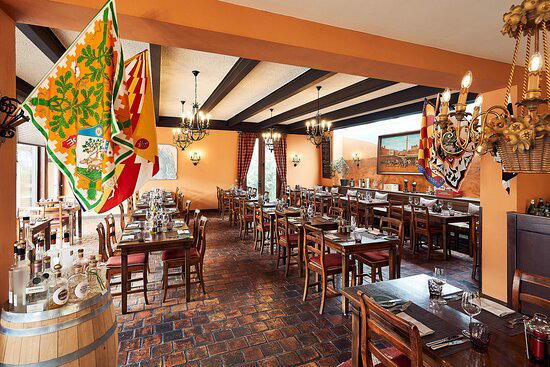
Shade, Pasta, and the Logic of the Open Kitchen
There is a particular register of Italian trattoria that does not translate easily across borders: the kind where the room is informal but the kitchen is serious, where the pasta arrives hand-made and the menu shifts with what is seasonal rather than what is safe. Celle, a well-preserved half-timbered town in Lower Saxony, is not that kind of city. Which makes the presence of an Italian kitchen on Hannoversche Strasse worth noting in its own right.
Taverna & Trattoria Palio sits at numbers 55 to 56 on that street, operating at the €€ price tier, which in the context of Celle's dining scene places it alongside Das Esszimmer and der allerKrug, both working in different directions from a similar mid-market position. Köllner's Landhaus operates at the same price band with a seasonal European focus, while Schapers, the one restaurant in Celle operating at the €€€ tier, takes a farm-to-table approach that requires a different kind of commitment from the diner. Palio occupies its own lane: relaxed format, Italian heritage, and a Michelin Plate that signals a kitchen operating above the baseline.
The Open Kitchen as Editorial Statement
The format of the open kitchen is not incidental. In trattoria culture, the kitchen has historically been a semi-public space, a place where recipes move between generations through observation as much as instruction. The grandmother watching the pasta being rolled, the apprentice absorbing technique by proximity rather than curriculum. At Palio, the open kitchen continues this logic in a contemporary restaurant context. What the diner sees is not theatre staged for effect; it is the functional transparency of a kitchen that has nothing to conceal about its process.
Italian cooking of the trattoria tradition relies on this kind of inherited knowledge more than almost any other European culinary tradition. The question of what to put in a ragù, how long to let a dough rest, when a sauce has reduced to the right consistency, these are not questions answered by recipe cards. They are answered by the accumulated weight of repetition and correction passed through kitchens across time. When Michelin awards a Plate to a restaurant in this category, the signal is that the kitchen is executing its tradition with genuine competence, not simply filling a niche in a market that lacks Italian options.
What the Kitchen Focuses On
The pasta dishes are the clear priority, and the Michelin annotation specifically calls them out. In trattoria terms, this is appropriate: pasta is the category where a kitchen's relationship to its source tradition is most legible. Fresh pasta demands precision in texture and timing; dried pasta demands an understanding of how to build a sauce that coats rather than drowns. Either way, pasta is not forgiving of approximation in the way that, say, a grilled protein might be.
Alongside the pasta focus, Palio runs seasonal set menus that shift the offer toward a more structured dining format. This dual structure, à la carte pasta alongside seasonal tasting menus, is increasingly common in Italian restaurants that want to serve both the midweek regular and the occasion diner without compromising either. It positions Palio in a different competitive set than the pure trattoria, which would typically resist the formality of a tasting menu, and suggests a kitchen confident enough in its range to operate across formats.
The terrace, shaded by old chestnut trees, is a meaningful practical consideration. Celle's summer months, while not Mediterranean, are warm enough to make outdoor dining genuinely pleasant rather than merely available. A terrace in shade, as opposed to the full-sun options that proliferate in German restaurant marketing, represents a considered decision about the comfort of the guest over the visual appeal of the setting.
Italian Cooking at Distance from the Source
The broader question for any Italian restaurant operating outside Italy is the distance, literal and cultural, from the tradition it draws on. Italy's regional cooking cultures are highly specific: what constitutes a proper carbonara in Rome, a correct ribollita in Florence, or a credible risotto in Milan are not matters of opinion to the communities that produced those dishes. When Italian cooking travels, it typically loses that regional specificity and converges toward a generalised Italian idiom that serves the market rather than the tradition.
Better Italian restaurants operating outside Italy tend to be those that choose a specific region and stay honest to it, or those that adopt the trattoria format not as branding but as a genuine operating philosophy: seasonal, ingredient-driven, without the inflation of portion theatre or sauce complexity that marks a kitchen trying to impress rather than feed. The Michelin Plate at Palio, combined with the editorial emphasis on fresh pasta and seasonal menus, suggests the latter orientation. For comparison, Italian restaurants earning higher Michelin recognition in Asia, 8 1/2 Otto e Mezzo Bombana in Hong Kong and cenci in Kyoto, do so by choosing specificity over generality, anchoring their menus in a particular Italian sensibility rather than diffusing it across a broad offer.
Palio operates in a different register and at a different scale than those addresses, but the underlying discipline is the same: a focused kitchen with a coherent relationship to its source cuisine, operating in a market where that relationship is not taken for granted.
Planning a Visit
Palio sits on Hannoversche Strasse in central Celle, accessible from the old town on foot. The €€ price positioning keeps it within range of a casual dinner rather than a special-occasion commitment, though the seasonal set menus shift that calculus slightly. For anyone building a broader picture of the city's dining options, the full Celle restaurants guide covers the complete circuit. Other useful references: hotels in Celle, bars in Celle, wineries, and experiences.
Palio occupies the Plate tier, recognition for consistent quality rather than the refined ambition signalled by star awards, which is the appropriate benchmark for a trattoria-format kitchen at this price point.
Credentials Lens
Comparable venues nearby, for context on price, style, and recognition.
| Venue | Cuisine | Price | Awards | Notes |
|---|---|---|---|---|
| Taverna & Trattoria PalioThis venue — the venue you are viewing | Italian Trattoria | $$$ | Michelin Plate | Not listed |
| Schapers | Classic German | $$ | Michelin Plate | Neustadt |
| Das Esszimmer | Modern European Fine Dining | $$$$ | Michelin Plate | Not listed |
| Köllner's Landhaus | Regional German with Mediterranean Influences | $$$ | Michelin Plate | Celle-Boye |
| der allerKrug | German Country Cuisine | $$$ | Michelin Plate | Not listed |
| Weinkeller Postmeister von Hinüber | Modern German with International Influences | $$$ | Not listed | Altstadt (Old Town) |
Recognition history
Dated appearances from independent guides and award organizations, with the underlying list record or original source where available.
Michelin Plate
Michelin · 2026 Michelin Plate
Michelin Plate
Michelin
Michelin Plate
Michelin
Continue exploring
More in Celle
Restaurants in Celle
Browse all →
Bars in Celle
Browse all →
Hotels in Celle
Browse all →
Wineries in Celle
Browse all →
At a Glance
- Classic
- Cozy
- Elegant
- Rustic
- Date Night
- Business Dinner
- Group Dining
- Open Kitchen
- Terrace
- Extensive Wine List
Current opening hours
- Monday
- Closed
- Tuesday
- 6–9 PM
- Wednesday
- 6–9 PM
- Thursday
- 6–9 PM
- Friday
- 6–9 PM
- Saturday
- 6–9 PM
- Sunday
- 6–9 PM
Hours can change for holidays and private events. Last verified .
Relaxed trattoria-style with pleasant, well-kept atmosphere inside and outside under beautiful old trees.