Steinhalle

Inside a landmark hall on Helvetiaplatz, Steinhalle holds a Michelin star under chef Markus Arnold, whose set menus rotate between South Korean, Japanese, and Portuguese reference points. The open kitchen anchors the room, while a separate easy lunch format serves the midday crowd. The on-site Finefood-Store extends the experience beyond the table.
Pearl is the En Primeur Club membership app — saves, bookings, and concierge access live there. Same editors, same standards.
- Address
- Helvetiapl. 5, 3005 Bern, Switzerland
- Phone
- +41 31 351 51 00
- Website
- steinhalle.ch
- Directions
- Get directions
 Saves & bookings on Pearl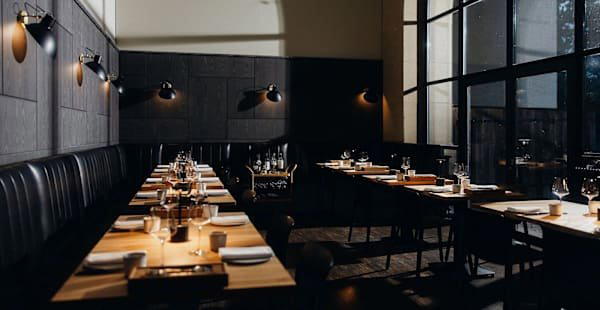
A Room That Frames the Cooking
The building at Helvetiaplatz 5 does much of the framing before a single dish arrives. High ceilings, grand arched windows, and a gallery level give Steinhalle the proportions of a civic hall repurposed for serious eating, a spatial logic that is common in northern Europe but relatively rare in Bern's compact old city. The open kitchen, positioned as the room's centrepiece with a food bar that doubles as a chef's table, makes the cooking visible from most seats. In rooms like this, that transparency is a design statement: the production of the meal is part of the atmosphere, not hidden away. It is a format that has become a marker of a certain kind of modern fine dining across Switzerland and beyond, placing the chef's process on equal footing with the dining room itself.
Bern's fine dining offer has historically operated in the shadow of Zurich and Geneva, but the city's Michelin presence has grown steadily. Steinhalle sits inside that shift, holding a star in the 2024 guide alongside a handful of other Bern addresses. The comparison set at the €€€ price tier in the city includes moment and Wein & Sein (Modern Cuisine), both of which operate in more conventional fine dining registers. Steinhalle's global reference architecture sets it apart within that local peer group.
How the Menu Is Built
The structural logic of Steinhalle's menu is where its identity becomes clearest. Rather than anchoring to a single culinary tradition or regional identity, chef Markus Arnold constructs set menus around a rotating international reference point, South Korea, Japan, Portugal, and other destinations have all served as the organising frame for a given menu cycle. This is not fusion in the blunt sense of the word. It is a more considered approach: each menu cycle takes a single cuisine as its primary grammar, then applies fine dining technique and Arnold's own editorial instincts to produce something coherent rather than eclectic. The result, at its leading, is a menu where every course speaks to the same set of flavour references, giving the progression a logic that multi-cuisine tasting menus often lack.
This approach places Steinhalle in a specific category of creative fine dining that has emerged more prominently across Europe over the past decade. Chefs at Alléno Paris au Pavillon Ledoyen and Enrico Bartolini in Milan have developed their own versions of menu architecture that moves beyond national tradition, though the mechanics differ. What links them is a willingness to treat the set menu as a curated argument rather than a greatest-hits sequence. At Steinhalle, that argument shifts with each menu cycle, which gives the restaurant a reason for return visits that a fixed signature-dish model does not.
The experience in a Japan-influenced cycle will differ meaningfully from one built around Portuguese cuisine, not just in flavour but in pacing, texture, and the kind of wine or drink pairing that makes sense alongside it.
The Lunch Architecture
A second menu structure operates in parallel during midday hours, and it deserves attention as a distinct format rather than a lesser version of the evening. The easy lunch concept is calibrated for business diners and visitors to the nearby Kunstmuseum Bern, offering freshly prepared dishes that draw on the same kitchen discipline as the evening menus but without the full set-menu commitment. Wednesday through Saturday, the restaurant opens at 11 AM, making it accessible for a late morning or lunchtime sitting. On Sundays, the kitchen runs the lunch format through to 5 PM. Mondays are closed entirely.
This dual-format model is increasingly common among Michelin-starred restaurants in mid-sized European cities, where the economics of a single nightly service are difficult to sustain without daytime revenue. It also serves a practical function for visitors: the easy lunch provides access to the kitchen and the room at a lower price commitment, while still reflecting the quality standards that the star implies. For those whose schedule or budget does not align with the full evening set menu, the lunch format is the more sensible entry point. Comparison addresses at the €€€ tier in Bern, including Casino Restaurant (Modern French) and Essort (International), offer their own midday options, but Steinhalle's explicit easy lunch branding signals a more deliberate effort to separate the two experiences rather than simply offering an abbreviated evening menu.
The Finefood-Store as Extension
On-site retail at fine dining restaurants has moved from novelty to standard practice in many European cities, and Steinhalle's Finefood-Store represents a considered version of this model. The shop sells house-made preserves and prepared items, Japanese goods, tableware, and kitchen utensils. The inclusion of Japanese products is directly coherent with the menu's recurring Japanese reference point, giving the retail offer a connection to the cooking rather than functioning as generic merchandise. For guests who want a tangible reference point from the meal, or for those visiting without a booking, the store provides a meaningful point of contact with the restaurant's sourcing and aesthetic sensibility.
This kind of retail extension also anchors the venue in the broader neighbourhood ecosystem around Helvetiaplatz. The square and its surroundings form part of Bern's Länggasse district, a residential and cultural zone that sits adjacent to the university and operates at a remove from the tourist density of the Altstadt. The Kunstmuseum proximity brings a specific kind of visitor foot traffic, culturally literate and comfortable with considered spending, which is precisely the profile that a Finefood-Store with Japanese tableware and artisan preserves is designed to attract.
Steinhalle in Switzerland's Fine Dining Context
Switzerland carries a disproportionately high concentration of Michelin-starred restaurants relative to its population, a function of both the country's premium hospitality culture and the wealth density of its urban centres. The extreme end of that spectrum includes Hotel de Ville Crissier in Crissier, Schloss Schauenstein in Fürstenau, and Cheval Blanc by Peter Knogl in Basel, all of which operate at the two- or three-star level with correspondingly refined price and formality. Further afield, Memories in Bad Ragaz, 7132 Silver in Vals, and Colonnade in Lucerne each represent the country's one-star tier in distinct regional contexts.
Steinhalle operates within this one-star cohort but with a menu architecture that is more internationally oriented than most Swiss peers, where terroir and regional produce typically dominate the editorial logic. Arnold's model, anchored to a rotating global reference cuisine, is closer in spirit to what certain urban fine dining rooms in London or Copenhagen have pursued, where the chef's curatorial intelligence rather than a fixed regional identity provides the through-line. For Bern, a city whose fine dining reputation remains less established than Zurich's or Geneva's, that approach carries some strategic clarity: it builds an identity that cannot easily be replicated by leaning on local ingredients alone.
Visitors planning a broader stay in Bern can cross-reference the room against the city's wider offer across all categories, from ZOE (Vegetarian) at a more accessible price point to
Planning a Visit
Steinhalle is located at Helvetiaplatz 5 in Bern's Länggasse district, a short distance from the city centre and easily reachable by tram. The restaurant is closed on Mondays. Evening service runs Tuesday through Saturday, with the kitchen open until midnight, which makes Steinhalle one of the later-running fine dining addresses in the city. Sunday lunch runs until 5 PM. For those scheduling around the Kunstmuseum Bern, which sits nearby, a Sunday lunch sitting at Steinhalle aligns naturally with a museum visit. The €€€ price tier applies to the evening set menu; the easy lunch format operates at a lower price point. Booking in advance is advised, particularly for weekend evenings, given the combination of limited covers at starred restaurants and growing awareness of the address in the wider Swiss dining circuit.
Peers You’d Cross-Shop
Comparable venues nearby, for context on price, style, and recognition.
| Venue | Cuisine | Price | Notes |
|---|---|---|---|
| SteinhalleThis venue — the venue you are viewing | Modern Global Fusion Casual Fine Dining | $$$ | Not listed |
| ZOE | Modern Vegetarian Fine Dining | $$$$ | Grünes Quartier |
| Wein & Sein | Modern Swiss Fine Dining | $$$$ | Grünes Quartier |
| noumi | Modern Global Fusion Grill & Bowls | $$$ | Gelbes Quartier |
| moment | Contemporary Swiss Terroir | $$$ | Weisses Quartier |
| Pangäa Moléson | International Fusion | $$$ | Rotes Quartier |
Recognition history
Dated appearances from independent guides and award organizations, with the underlying list record or original source where available.
Falstaff Restaurant - 94 Falstaff Points
Falstaff
Continue exploring
More in Bern
Restaurants in Bern
Browse all →
Bars in Bern
Browse all →
Hotels in Bern
Browse all →

At a Glance
- Modern
- Trendy
- Lively
- Date Night
- Special Occasion
- Open Kitchen
- Historic Building
- Extensive Wine List
- Local Sourcing
- Garden
Current opening hours
- Monday
- Closed
- Tuesday
- Closed
- Wednesday
- 11 AM–12 AM
- Thursday
- 11 AM–12 AM
- Friday
- 11 AM–12 AM
- Saturday
- 11 AM–12 AM
- Sunday
- 10 AM–5 PM
Hours can change for holidays and private events. Last verified .
Modern, trendy interior with high ceilings, open kitchen, and dynamic atmosphere in a historic building.