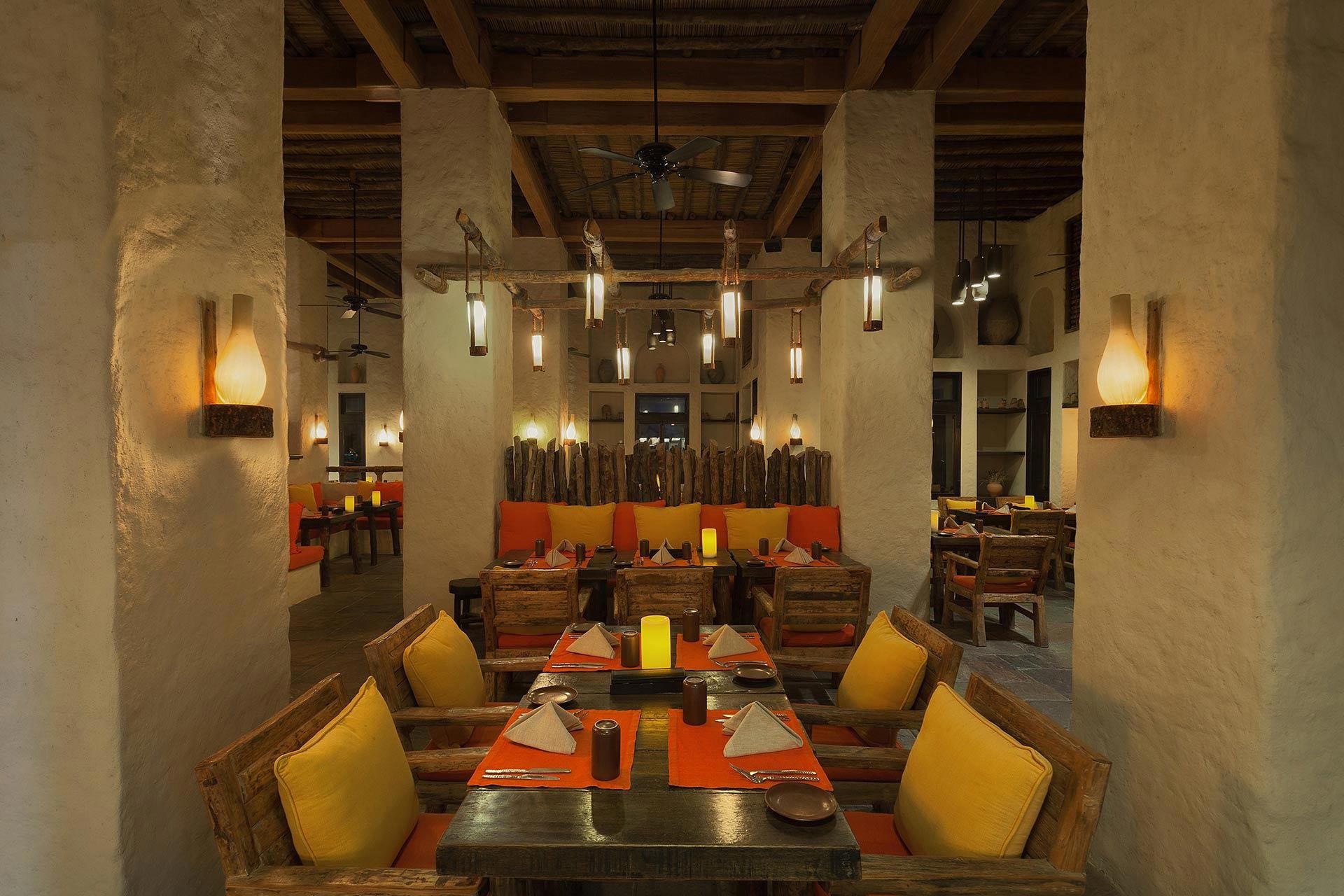
Set within the Six Senses Zighy Bay resort on Oman's Musandam Peninsula, Spice Market draws on the Gulf's deep trade heritage, framing its menu around the spice routes that once defined this coastline. The setting alone, mountain, sea, and village architecture, shapes what arrives at the table. For guests seeking a more dramatic counterpoint, Sense on The Edge occupies a different register entirely.

Pearl is the En Primeur Club membership app — saves, bookings, and concierge access live there. Same editors, same standards.
Where the Arabian Sea Meets the Spice Route
The Musandam Peninsula has always been a corridor. For centuries, dhows moving between the Indian subcontinent and the Gulf stopped along this coastline, depositing cardamom, turmeric, dried limes, and rose water into the kitchens of coastal Oman. That trading logic still runs through the food culture here, and Spice Market at Six Senses Zighy Bay draws directly on that lineage. The restaurant's framing is not merely decorative: it places Omani cuisine inside a broader story about ingredient geography, tracing what arrived on ships and what grew in the wadi valleys above the resort.
This is a corner of the Arabian Peninsula that most international visitors approach by sea plane, paraglider, or a dramatic mountain road descent into the bay, all three options tell you something about how deliberately removed Zighy Bay is from the rest of the country's hospitality infrastructure. That remoteness is the point.
Ingredients as Argument
Across the Gulf region, the question of sourcing defines the difference between a kitchen that performs authenticity and one that achieves it. Oman's own culinary tradition is built around a short list of intensely worked ingredients: dried limes (loomi) that arrive from Persian Gulf trade routes, frankincense from the Dhofar region in the south, fish pulled from waters that rank among the more biodiverse in the Arabian Sea, and the date varieties that shift dramatically by microclimate across the country's interior.
Spice Market's position within a Six Senses property matters for sourcing context. Zighy Bay's on-site organic garden supplies herbs and vegetables directly to the resort's kitchens. That kind of farm-to-kitchen loop is rarer in Gulf resort dining than the marketing language around it suggests. At Zighy Bay, the short distance between garden and plate is a structural feature of the site, not a seasonal gesture.
The broader Omani pantry that any serious kitchen in this region works from includes spices introduced via maritime trade that are now entirely naturalized: cinnamon, cloves, and black pepper that entered through Zanzibar connections, rose water and saffron that traveled overland from Persia. What makes this geography interesting from a culinary standpoint is that these ingredients arrived centuries ago and have been absorbed so completely that they now read as indigenous. A kitchen that understands this history can trace those layers on a plate. One that doesn't reduces Omani food to a set of flavour notes without argument.
Setting and Atmosphere
The physical environment at Zighy Bay operates as an argument for a particular kind of eating. The resort sits at the foot of the Hajar Mountains, with the Gulf of Oman directly in front and the rocky escarpment rising behind. Village-style architecture built from local stone and adobe gives the property a texture that larger Gulf resort developments consistently fail to replicate, because that texture requires working with local material rather than importing it.
Dining at Spice Market happens within that context. The atmosphere is shaped by the bay itself, by the quality of light off the water at different hours, and by the architectural restraint that keeps the resort buildings low and material-honest. These are conditions that few resort dining rooms in the Gulf can claim, and they matter because they anchor the food in a specific geography rather than floating it in the generic luxury register that dominates the region's hotel restaurant category.
For guests who want the highest-altitude counterpart within the same property, Sense on The Edge @ Six Senses Zighy Bay occupies a cliff-face setting that offers a deliberately different register to Spice Market's bay-level warmth.
Oman's Dining Scene in Wider Context
Oman's restaurant culture has developed differently from the UAE's. Where Dubai and Abu Dhabi built out quickly on international imports, Muscat's dining scene has moved more slowly toward a model that takes Omani cuisine seriously as a subject in its own right. Restaurants like Bait Al Luban in Muscat and Bait Al Luban (بيت اللبان) in مطرح have been part of that shift, building menus around dishes like shuwa (slow-cooked spiced meat) and harees that most visitors to the Gulf never encounter in a sit-down format. Al Mandoos (المندوس) in Seeb and Harvest in مسقط represent further points on that developing map.
Spice Market sits within that movement, but from the resort side of it. The Six Senses platform gives it access to resources, organic supply chains, and international visibility that standalone Omani restaurants don't carry. That comes with trade-offs: the price point and setting are calibrated to international resort guests rather than the local dining public, which shapes what the kitchen does and who it does it for. Both things can be true simultaneously: a resort restaurant can be sourcing-serious and still operate primarily for international visitors. The question worth asking is whether the food makes the case on its own terms.
For a sense of the broader Omani street-level register, Bypass Grills & Shawarma in Salalah and Tuk Tuk (توك توك) in Al Mawalih offer a useful contrast to the resort end of the spectrum.
Planning Your Visit
Access to Zighy Bay is itself a commitment. The resort sits approximately 150 kilometres north of Muscat and is reached either by a winding mountain descent, by boat, or by paraglider for the adventurous. Because Spice Market operates within a resort property, dinner is most practically planned as part of a stay rather than a standalone excursion. The Musandam Peninsula's temperatures are most comfortable between October and April, which is when the bay is also most active with water access. Summer months bring intense heat to the region.
Quick Comparison
Comparable venues nearby, for context on price, style, and recognition.
| Venue | Cuisine | Price | Notes |
|---|---|---|---|
| Spice Market @ Six Senses Zighy BayThis venue — the venue you are viewing | Arabic / Middle Eastern | $$$$ | Not listed |
| Bait Al Luban Omani Restaurant - Mutrah | Traditional Omani | $$ | Mutrah |
| Mazahbi Salalah Restaurant | Traditional Omani Mandi & Grilled Meats | $ | Al Ghubra Ash Shamaliyyah, Bawshar |
| Harvest | International Healthy Seasonal | $$$ | Shatti Al Qurum |
| Bait Al Luban (بيت اللبان) | Traditional Omani | $$ | Muttrah |
| Al Mandoos | Authentic Omani | $$ | Al Mouj |
At a Glance
- Elegant
- Scenic
- Cozy
- Family
- Group Dining
- Hotel Restaurant
- Open Kitchen
- Local Sourcing
Relaxed Arabic environment with bold colors, comfortable ambience, and live kitchen elements.