
Tabelog 100 #62
Our verdict
SOBA-Shiro Kuro belongs to Tokyo’s small-counter ramen culture rather than the city’s louder destination-dining circuit. Its six-seat counter, repeated Tabelog Ramen TOKYO “Tabelog 100” selections from 2020 through 2025, and Hachimanyama setting make it a precise example of how serious ramen has moved beyond central wards without losing its specialist edge.

Pearl is the En Primeur Club membership app, where members save venues, book tables and use the concierge.
The menu
What to order
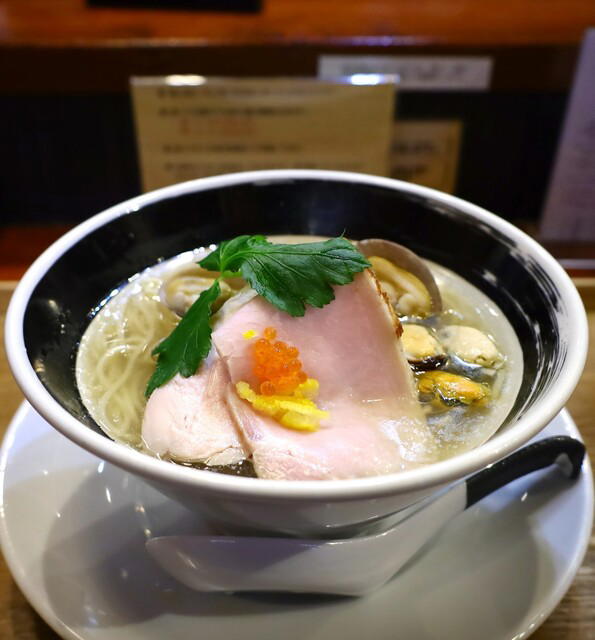
- Asari clam soba
- Shellfish-based ramen
- Shoyu ramen
- Shio ramen
- Tsukemen dipping noodles
SOBA-Shiro Kuro is not presented here as Tokyo’s hotel-lobby omakase or Ginza-counter world. Its place in the city is more specific and practical: a Tokyo ramen venue whose reputation is best read through category recognition, diner ratings, and the expectations that surround a focused bowl rather than a long-form restaurant occasion. Here, SOBA-Shiro Kuro reflects a more interesting Tokyo ramen story: serious attention can gather around accessible, highly scrutinized dining.
Tokyo ramen is often discussed through small differences in style, texture, timing, and personal preference. This venue belongs in that conversation because the available signals point to a ramen specialist rather than a broad all-purpose restaurant. The meal should be read as a category experience, not as hotel dining, destination fine dining, or a room built around lingering. The emphasis is on the bowl, the rating context, and the way Tokyo diners compare ramen venues with unusual intensity.
A ramen listing in Tokyo
Tokyo has become fertile ground for ramen shops that do not need central-district theatre to draw attention. Diners follow lists, ratings, and word of mouth across the city, and SOBA-Shiro Kuro sits within that pattern as a Tokyo ramen venue rather than an anonymous stop. Its location should be understood simply as Tokyo, with planning shaped by the practical realities of visiting a specialist ramen venue in the city.
The recognition is not incidental. Selection in the 2025 Tabelog Hyakumeiten ramen listing puts the shop in a serious peer group rather than leaving it as an unmarked neighborhood counter. A Tabelog score of 3.88 adds another signal in a category where Tokyo diners compare small differences in ramen with unusual intensity. That does not make the shop a luxury restaurant; it places it among ramen venues where accessible prices and high scrutiny coexist.
That tension is central to modern Tokyo ramen. A bowl can sit in an everyday price band while expectations resemble specialist dining. Compared with Tokyo peers such as Gyoza Kan, Seijo Seika, and Ramen Koike, the question is not whether the meal feels grand. It is whether the category recognition, rating, and local commitment justify making room for it in a Tokyo dining plan. Here, the case is strongest for diners who already understand ramen as a precision category, not a casual fallback.
The evolution is in restraint, not expansion
Many successful ramen venues are judged not by breadth but by clarity. The more persuasive Tokyo model often favors a narrow identity, few distractions, and a clear reason to visit. SOBA-Shiro Kuro keeps its public identity tied to ramen rather than a general restaurant category. In a city where attention turns quickly, 2025 Hyakumeiten recognition suggests that the venue has earned notice within a format where diners look closely at execution.
The structure also belongs to ramen’s democratic code. Tokyo has many dining rooms where access is mediated by hotel concierges, booking platforms, or introductions. Ramen remains different: diners often trade ceremony for immediacy, and the category tends to reward directness. That means visitors should plan practically. Timing, group size, and flexibility can matter, especially when the goal is a focused ramen stop rather than a long restaurant sitting.
There is a useful contrast with Tokyo’s premium sushi economy. A counter at Sushi Ichigo, for instance, belongs to a different financial and cultural bracket, where the meal is judged through procurement, cadence, and the chef-guest relationship. Ramen venues use another grammar. Attention turns to the bowl, the category, and the compressed satisfaction of a short-format meal. That compression is why serious ramen can feel exacting without adopting fine-dining signals.
For visitors building a broader Tokyo itinerary, this stop suits category-led eating more than a hotel-centered dining plan. The same city can hold yakitori, curry, cafe culture, sushi, soba, and casual dining in many forms; the point is not to rank them together, but to see how Tokyo’s dining depth comes from formats that stay specific.
How to read the meal before going
Expect a ramen-focused venue, not a flexible restaurant room. The appeal is concentration rather than breadth: a short-format meal, a category with exacting local standards, and a Tokyo address that places it inside one of the world’s most competitive ramen cities. Diners should think in practical terms, especially when visiting as a group, because this kind of ramen experience is usually more direct than comfort-driven.
Payment and access details should be checked before visiting, as ramen venues in Tokyo can operate differently from larger restaurants. For international travelers, practical planning matters as much as the journey across the city. The location is Tokyo, but the dining window is governed more by the venue’s specialist category than by broad restaurant hospitality.
The stronger editorial recommendation is to treat SOBA-Shiro Kuro as a specialist ramen stop within a Tokyo day, not a standalone evening built around atmosphere. Pair it with a walk elsewhere in the city, or use it as a counterpoint to central Tokyo reservations. For a wider city plan, start with Our full Tokyo restaurants guide, then fold in category-specific research through Our full Tokyo hotels guide, Our full Tokyo bars guide, Our full Tokyo wineries guide, and Our full Tokyo experiences guide.
Readers comparing Japan-focused casual dining beyond this venue can also look at other Tokyo dining rooms and ramen-adjacent casual spots across Japan and abroad. The useful comparison is not a roll call of names, but the way modest formats can carry serious culinary intent when the identity stays narrow and the execution is closely watched.
Frequently asked questions
Is SOBA-Shiro Kuro good for families?
SOBA-Shiro Kuro is a ramen-focused venue in Tokyo. It is best approached with practical expectations around timing, group size, and the direct pace typical of specialist ramen venues.
What should I expect atmosphere-wise at SOBA-Shiro Kuro?
Expect a ramen-focused setup in Tokyo. The pace is shaped by a specialist ramen format rather than a full-service dining room built around extended stays.
Is SOBA-Shiro Kuro more mid-range or high-end?
Pricing at SOBA-Shiro Kuro is listed as - JPY 999 JPY 1,000 - JPY 1,999, with budget guidance of Dinner: - JPY 999; Lunch: JPY 1,000 - JPY 1,999.
What's the address for SOBA-Shiro Kuro?
Tokyo
Comparable Spots, Quickly
Comparable venues at a glance for context.
| Venue | Cuisine | Price | Awards | Notes |
|---|---|---|---|---|
| SOBA-Shiro KuroThis venue (the venue you are viewing) | Specialty ramen / soba shop | $10–20 | Tabelog 100 #62 | Not listed |
| Ayu Ramen Plus (鮎ラーメンプラス) | Traditional Ayu Ramen | $1–10 | Not listed | Toranomon |
| Hishida Ya | Japanese teishoku cafeteria | $10–20 | Tabelog 100 #77 | Meguro |
| E-chan Shokudo | Early-morning Tokyo ramen counter | $10–20 | Tabelog 100 #63 | Meguro |
| Shiroi Kuro | Modern Japanese sweets & roll cake café | $1–10 | Tabelog 100 #95 | Minato |
| Ramen Jiro Mita honten | Japanese Ramen | Not listed | Tabelog 100 #86 | Minato |
Recognition history
Dated appearances from independent guides and award organizations, with the underlying list record or original source where available.
Tabelog 100 #62 · No. 62
Tabelog · Tabelog 100 - Ramen - TOKYO - 2025
Continue exploring
More in Tokyo
Restaurants in Tokyo
All restaurants in Tokyo →




Bars in Tokyo
All bars in Tokyo →







Details
- Cozy
- Intimate
- Solo
- Family
- Casual Hangout
- After Work
- Standalone
- A La Carte
- Counter Dining
small, counter-only neighborhood ramen shop with a simple, functional interior; the atmosphere is relaxed and friendly, suited to solo diners and families grabbing a focused, high-quality bowl rather than lingering.