Russ & Daughters
Open since 1914 on the Lower East Side, Russ & Daughters is one of New York City's most enduring purveyors of Ashkenazi Jewish appetizing, smoked fish, cured salmon, and caviar served with the kind of institutional authority that comes from four generations of the same family. The shop at 179 E Houston St sits at the centre of a culinary tradition that shaped downtown Manhattan's food identity long before the neighbourhood became a destination.
Pearl is the En Primeur Club membership app — saves, bookings, and concierge access live there. Same editors, same standards.
- Address
- 179 E Houston St, New York, NY 10002
- Phone
- +1 212 475 4880
- Website
- russanddaughters.com
- Directions
- Get directions
 Saves & bookings on Pearl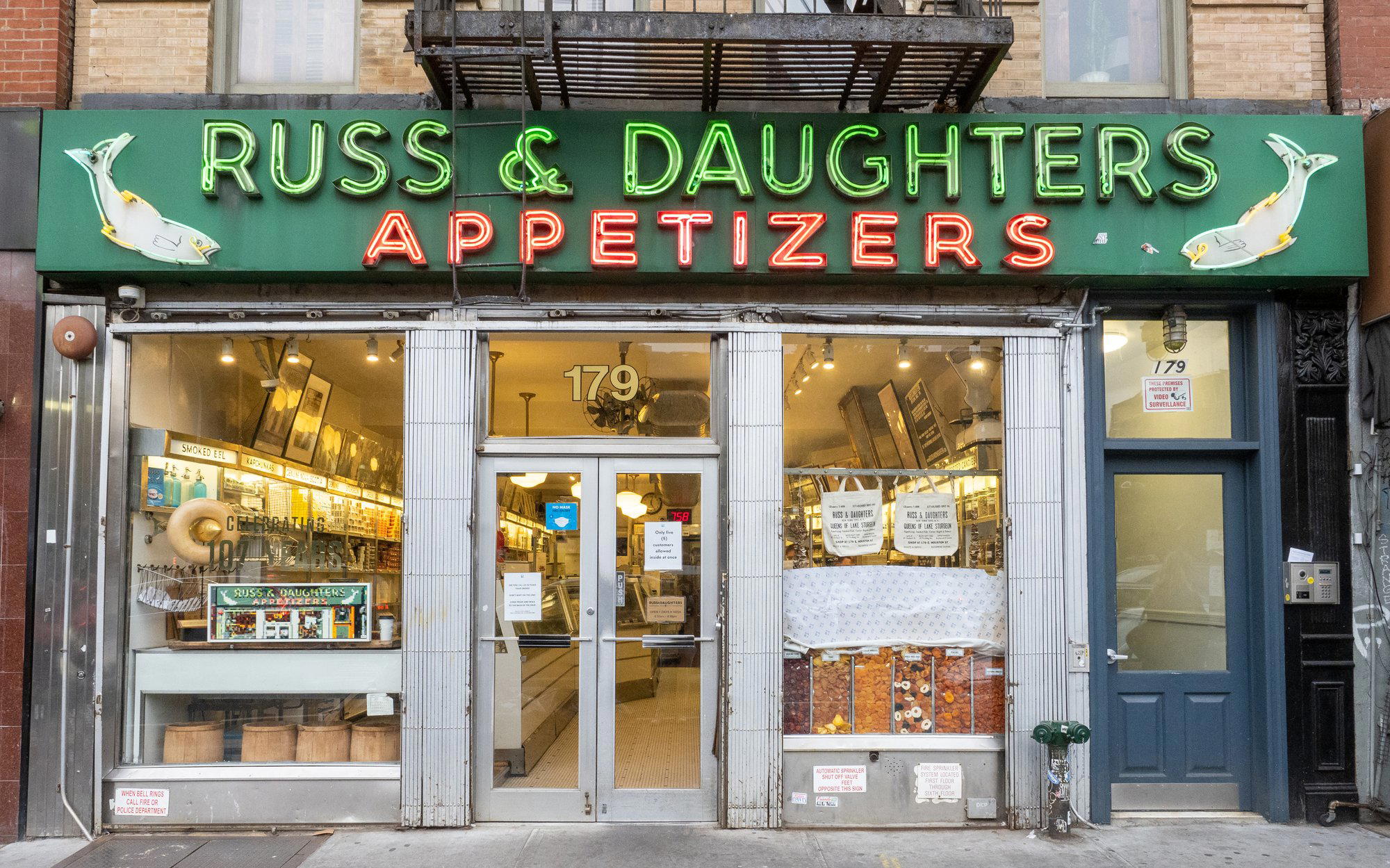
A Century of Appetizing on the Lower East Side
When Russ & Daughters opened in 1914, the Lower East Side of Manhattan was especially densely populated neighbourhood in the United States, its streets organised around the rhythms of Jewish immigrant life. The concept of the appetizing shop, a category distinct from the delicatessen, focused specifically on smoked fish, cured salmon, herring, and dairy accompaniments, was already embedded in that community before the shop opened its doors on East Houston Street. What the Russ family built over the following century was less a single business than a living record of how Ashkenazi food culture survived, adapted, and eventually earned a place in the broader American culinary memory.
The Lower East Side has undergone several reinventions since 1914. The tenement population dispersed, rents climbed, and the neighbourhood cycled through waves of artists, tourists, and developers. The appetizing tradition, however, did not simply persist as a relic. Russ & Daughters at 179 E Houston St remained in family hands across four generations, maintaining the shop's focus on cured and smoked fish at a moment when much of the surrounding food culture was moving toward fast-casual formats or destination tasting menus. For context on how New York's premium dining scene has developed in parallel, our full New York City restaurants guide maps the city across categories and price tiers.
The Appetizing Tradition: What It Is and Why It Persists
The appetizing shop is a specifically Jewish-American retail and hospitality category, shaped by dietary law and immigrant economics. Because traditional Ashkenazi observance separates meat and dairy, the appetizing shop specialised in fish and dairy goods, smoked salmon, whitefish salad, herring in cream sauce, cream cheese, that could be eaten at the same meal as dairy products. The category produced a distinct flavour vocabulary: brine, fat, cold smoke, and the particular tang of properly made cream cheese against cured fish.
That vocabulary is not easily replicated. The quality of smoked salmon sold at a serious appetizing shop depends on sourcing relationships, curing technique, and slicing skill that take years to develop. The difference between hand-sliced Scottish or Nova lox cut to order and pre-packaged alternatives is perceptible in both texture and fat distribution. This kind of category expertise is more closely related to what happens at a specialist fishmonger in Paris or a upper-tier sushi counter than to anything in the deli or grocery category. For reference on how Japanese fish-handling tradition operates at the premium end of the New York market, see Masa.
Lower East Side as Culinary Geography
East Houston Street sits on the northern edge of the Lower East Side, a block that still carries traces of the neighbourhood's appetizing and pickle-shop density from the early twentieth century. The shop's physical address places it within walking distance of Katz's Delicatessen to the east, in a corridor that functions as one of the few remaining nodes of traditional Jewish food retail in Manhattan. The neighbourhood's current character is a mix of late-night bars, emerging restaurant groups, and holdover institutions, a contrast that actually reinforces why the appetizing tradition reads differently here than it would in a food-hall context elsewhere.
New York's premium restaurant geography has largely shifted north and west, Midtown's tasting-menu tier includes Le Bernardin, Per Se, and Eleven Madison Park, while newer fine-dining destinations like Atomix have established themselves in the Flatiron corridor. The Lower East Side sits apart from that geography, which is part of what gives the appetizing tradition its continued cultural legibility. Russ & Daughters is not competing in the tasting-menu tier; it occupies a different register entirely, one where the measure of quality is provenance, handling, and institutional consistency rather than innovation or theatrical presentation.
The Cafe Format and the Shop: Two Access Points
The original shop at 179 E Houston St operates as a retail counter. In 2014, the family opened Russ & Daughters Cafe a few blocks away on Orchard Street, adding a sit-down format that brought the same product range into a table-service context. The two-format model reflects a broader pattern in New York's food culture, where retail specialists have expanded into cafe or restaurant formats without abandoning their sourcing identity. The shop remains the primary point of reference, a counter operation where ordering requires some knowledge of the category, which is itself part of the experience for first-time visitors. This operating model has more in common with specialist food shops in Paris or Tokyo than with the standard New York brunch restaurant.
The cafe format placed Russ & Daughters within the weekend brunch circuit that connects much of lower Manhattan, and reservations there can be competitive during peak weekend hours. The shop, by contrast, operates as a walk-in retail counter during store hours, with queues that reflect its status in the neighbourhood food culture. Visitors planning around peak weekend timing should account for both the queue at the shop and the booking lead time at the cafe.
Institutional Authority in a City That Renews Itself Constantly
New York has a complicated relationship with culinary institutions. The city's food culture rewards novelty with outsized coverage, while established venues often have to justify their continued relevance in every review cycle. The appetizing shops that survived from the early twentieth century did so by maintaining category discipline rather than diversifying into trend formats. Russ & Daughters' longevity, over 110 years at this writing, is not incidental to its reputation; it is the reputation. In a market where tasting-menu restaurants cycle through critical attention rapidly, the model of category depth over time is a different kind of argument for quality.
For reference on how other American institutions have built and maintained comparable authority across decades, Emeril's in New Orleans and The French Laundry in Napa operate in different registers but share the same quality of being structurally important to how their respective cities think about food. Internationally, the equivalent argument appears at places like Dal Pescatore in Runate, where multi-generational family continuity is itself a credential. For farm-to-table contemporaries in the US, Blue Hill at Stone Barns and Single Thread Farm in Healdsburg pursue a similar rigour around sourcing, though through an entirely different format. Other notable US destinations in the same conversation include Lazy Bear in San Francisco, Smyth in Chicago, Providence in Los Angeles, Addison in San Diego, The Inn at Little Washington, Frasca Food & Wine in Boulder, and Atelier Moessmer Norbert Niederkofler in Brunico for those extending the trip into European territory.
Planning Your Visit
The retail shop at 179 E Houston St is the original and primary location. The Orchard Street cafe, opened in 2014 as the centenary of the original shop, takes reservations and is the more practical option for groups or first-time visitors who want a structured meal rather than a counter experience. Weekend mornings are the highest-demand window at both locations, and the shop's walk-in queue can extend onto the street during peak hours. Arriving on a weekday morning reduces both the queue and the ambient noise that makes counter ordering harder for the uninitiated. The shop sells retail packages for travel, which makes it practical as a final stop before leaving the city.
Where the Accolades Land
Comparable venues nearby, for context on price, style, and recognition.
| Venue | Cuisine | Price | Notes |
|---|---|---|---|
| Russ & DaughtersThis venue — the venue you are viewing | Classic New York Jewish Appetizing | $$ | Not listed |
| Hole in the Wall | Australian-Inspired Gastropub | $$ | Financial District-Battery Park City |
| Cowgirl | Southern Tex-Mex | $$ | West Village |
| Clinton Hall | Modern American Beer Hall | $$ | Financial District-Battery Park City |
| Ace's Pizza | Detroit-Style Pizza | $$ | Williamsburg |
| Cobblestone Catering & Fine Foods | New American | $$ | Downtown Brooklyn-DUMBO-Boerum Hill |
Continue exploring
More in New York City
Restaurants in New York City
Browse all →
Bars in New York City
Browse all →
Hotels in New York City
Browse all →





At a Glance
- Classic
- Well Known
- Cozy
- Brunch
- Casual Hangout
- Family
- Historic Building
Current opening hours
- Monday
- 8 AM–4 PM
- Tuesday
- 8 AM–4 PM
- Wednesday
- 8 AM–4 PM
- Thursday
- 8 AM–4 PM
- Friday
- 8 AM–4 PM
- Saturday
- 8 AM–4 PM
- Sunday
- 8 AM–4 PM
Hours can change for holidays and private events. Last verified .
Comfortable, casual atmosphere with seat-yourself dining highlighting traditional Jewish deli vibes and visible bagel baking.