Roti King Battersea
Roti King's Battersea Power Station outpost plants one of London's most talked-about roti canai specialists inside one of the city's most architecturally loaded retail developments. The original Euston location built a loyal following on the strength of its laminated flatbreads and Malaysian curries; this newer site brings that same formula to SW11, positioned at the casual end of a dining spectrum that runs all the way up to multi-Michelin territory.
Pearl is the En Primeur Club membership app — saves, bookings, and concierge access live there. Same editors, same standards.
- Address
- Battersea Power Station, 16 Arches Ln, Nine Elms, London SW11 8AB, United Kingdom
- Website
- rotiking.com
- Directions
- Get directions
 Saves & bookings on Pearl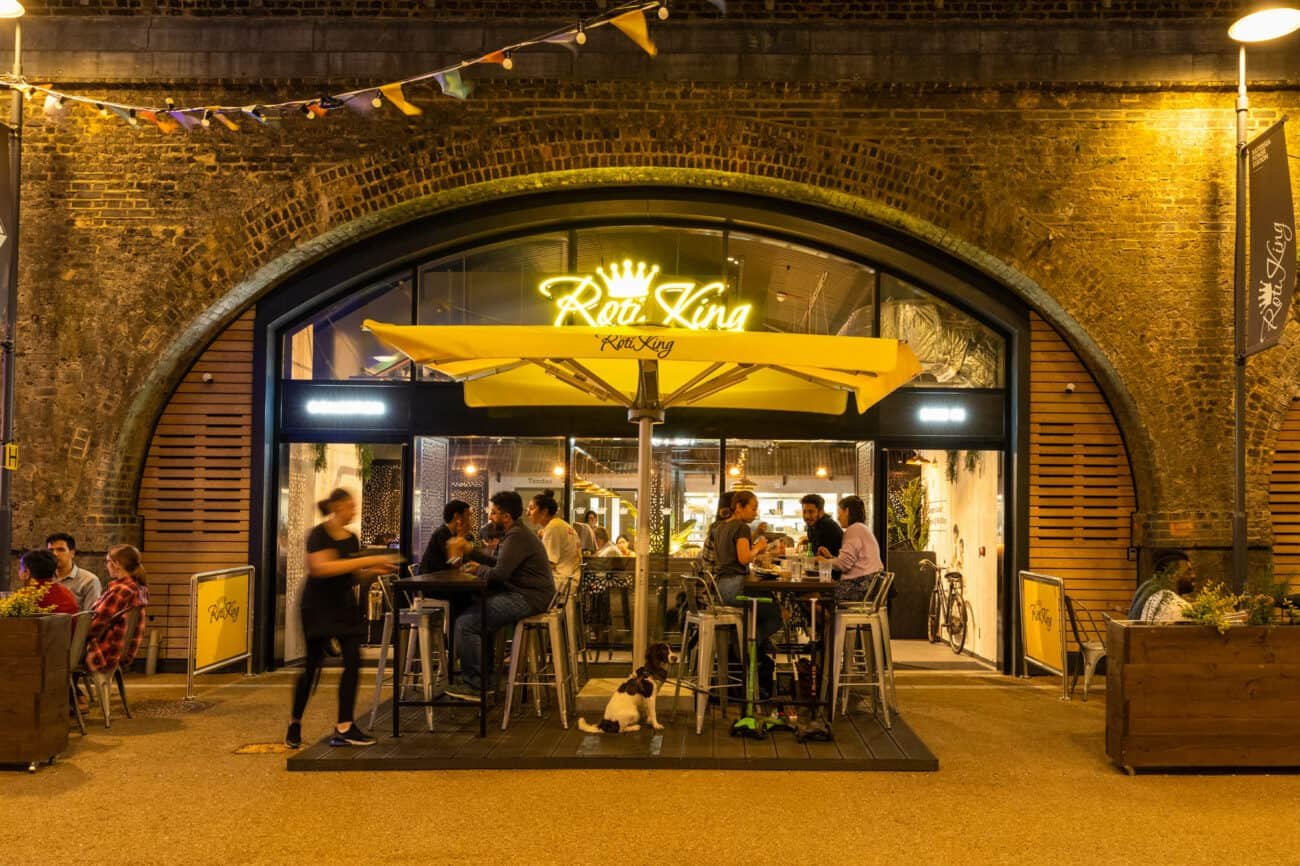
Roti, Reinvented for a New Setting
Battersea Power Station's transformation from derelict industrial landmark into a retail and dining destination has attracted operators across every price point, from neighbourhood cafes to formal restaurants. The decision to place a roti canai specialist inside its arched undercroft, along Arches Lane in the Nine Elms quarter, says something about how the development's curators have thought about casual dining: not as an afterthought to the fine-dining anchors, but as a distinct draw in its own right. Roti King Battersea sits at 16 Arches Lane, SW11 8AB, where the brickwork of the Victorian railway arches provides a physical container that is the inverse of the original Euston branch's low-ceilinged basement room. Here, the architecture does the heavy lifting before the food arrives.
The Physical Container and What It Says
London's most interesting casual dining rooms increasingly make deliberate use of found architecture. Converted railway arches, in particular, have shaped a recognisable dining typology across the city, curved ceilings, exposed brickwork, a sense of enclosure that is at once industrial and intimate. The Arches Lane setting slots Roti King into that lineage, while the Battersea Power Station context adds a layer of design ambition not typically associated with a sub-£15 roti counter. The visual contrast between the setting's grand heritage bones and the practical informality of a Malaysian flatbread operation is precisely the kind of tension that makes London's mid-tier dining scene worth paying attention to. Where London's Michelin-tier operators, venues like CORE by Clare Smyth, The Ledbury, and Dinner by Heston Blumenthal, invest heavily in custom interiors designed to signal the price point before the menu lands, Roti King does the opposite: the setting is inherited, the décor is spare, and the draw is almost entirely on the plate.
Roti Canai in the London Context
Malaysian food has occupied an underserved corner of London's casual dining offer for years. The city has a handful of credible Malay operators, but nothing approaching the density of Chinese, South Asian, or Middle Eastern representation. Roti canai, the laminated, pan-fried flatbread cooked on a tawa and typically served with dhal or curry for dipping, has never received the mainstream London moment that, say, Japanese katsu or Korean fried chicken has managed. Roti King's original Euston location, which opened near Warren Street and attracted queues that regularly extended onto the pavement, changed the terms of that conversation. It demonstrated that there was an audience willing to wait for well-made roti in a setting with almost no design investment, purely on the quality of the bread and its accompaniments. The Battersea branch extends that argument into a different demographic and a more design-conscious environment.
What the Battersea Setting Changes
Relocating a cult casual operator into a premium development always risks blunting the original proposition. The Euston branch's appeal was partly about its dissonance, serious flatbreads in a basement that looked like it was designed for a different purpose entirely. Battersea Power Station brings foot traffic from the residential towers above, the shopping levels adjacent, and day-trippers drawn to the development as a destination. That changes the customer mix, and it changes the operational demands on a format that works well when it is focused and fast. Whether the roti canai itself translates unchanged is the operative question, and it is one that the original location's reputation makes particularly pointed. Casual Malaysian food at this level of execution is rare enough in London that any deviation from the source would register quickly with the regulars who made the Euston branch what it is.
Positioning Relative to the Wider London Casual Scene
London's casual dining market has fragmented significantly over the past decade. The middle has largely disappeared: operators either invest in the kind of design, sourcing, and credential-building that pushes covers toward the £40-60 per head territory, or they compete on tightly focused menus and high throughput at under £20. Roti King belongs to the latter camp, which is a smaller category than the numbers might suggest. The food-hall model that Battersea Power Station partially employs has been a vehicle for exactly this kind of operator, giving single-focus kitchens access to high-footfall environments without the overhead of standalone restaurant sites. For comparison, the same dynamic is visible in Glasgow with venues like Corner Shop, and in cities where tight-format specialists have found homes in mixed-use developments, see also Franc in Canterbury and The Highland Laddie in Leeds for regional parallels. The contrast with formal London dining is sharp: Restaurant Gordon Ramsay and Sketch, The Lecture Room and Library operate at a price and formality level where the dining room architecture is an explicit part of the proposition. At Roti King, the architecture is borrowed from the development, and the proposition is the bread. Internationally, the tight-focus specialist format has strong precedents, Lazy Bear in San Francisco and Atomix in New York City represent the higher-end version of the same discipline-over-breadth philosophy, while Le Bernardin in New York City, Emeril's in New Orleans, and Alain Ducasse at Louis XV in Monte Carlo illustrate how far the formal end of the spectrum extends. Roti King occupies a deliberately different register from all of them, and that is the point.
Planning Your Visit
Roti King Battersea is located at 16 Arches Lane, Battersea Power Station, Nine Elms, London SW11 8AB. The Power Station development is accessible via Battersea Power Station Underground station on the Northern line, making it direct to reach from central London. The Arches Lane strip has attracted a cluster of food and drink operators, so it is worth treating the area as a short stay rather than a quick detour. Roti King Battersea is open daily from 12 to 10 PM. It is walk-in friendly and priced at about $20 per person.
Compact Comparison
Comparable venues nearby, for context on price, style, and recognition.
| Venue | Cuisine | Price |
|---|---|---|
| Roti King BatterseaThis venue — the venue you are viewing | Nine Elms, Malaysian Street Food | $$ |
| PP Cafe | Paddington, Pan Asian and Malaysian | $$ |
| Mele e Pere | Soho, Italian Trattoria | $$ |
| Lievito | Chelsea, Dining | Not listed |
| Myung Ga Korean Restaurant | Soho, Authentic Korean BBQ | $$ |
| Thai Tho Soho | Soho, Authentic Thai | $$ |
Continue exploring
More in London
Restaurants in London
Browse all →
Bars in London
Browse all →
Hotels in London
Browse all →



At a Glance
- Lively
- Trendy
- Cozy
- Casual Hangout
- After Work
- Group Dining
- Open Kitchen
- Byob
- Street Scene
Current opening hours
- Monday
- 12–10 PM
- Tuesday
- 12–10 PM
- Wednesday
- 12–10 PM
- Thursday
- 12–10 PM
- Friday
- 12–10 PM
- Saturday
- 12–10 PM
- Sunday
- 12–10 PM
Hours can change for holidays and private events. Last verified .