
Restaurant Baran-Rapan holds a 2-Star accreditation from the World of Fine Wine & London Awards, placing it among a small tier of recognised dining addresses on Russia's Black Sea coast. The restaurant operates from Teatral'naya Ulitsa in central Sochi, drawing on the region's notable produce geography, subtropical coast, mountain foothills, and the nearby wine country of Krasnodar Krai.
Pearl is the En Primeur Club membership app — saves, bookings, and concierge access live there. Same editors, same standards.
- Address
- Teatral'naya Ulitsa, 11, Sochi, Krasnodar Krai, Russia, 354000
- Phone
- +7 995 225-50-25
- Website
- baranrapan.ru
- Directions
- Get directions
 Saves & bookings on Pearl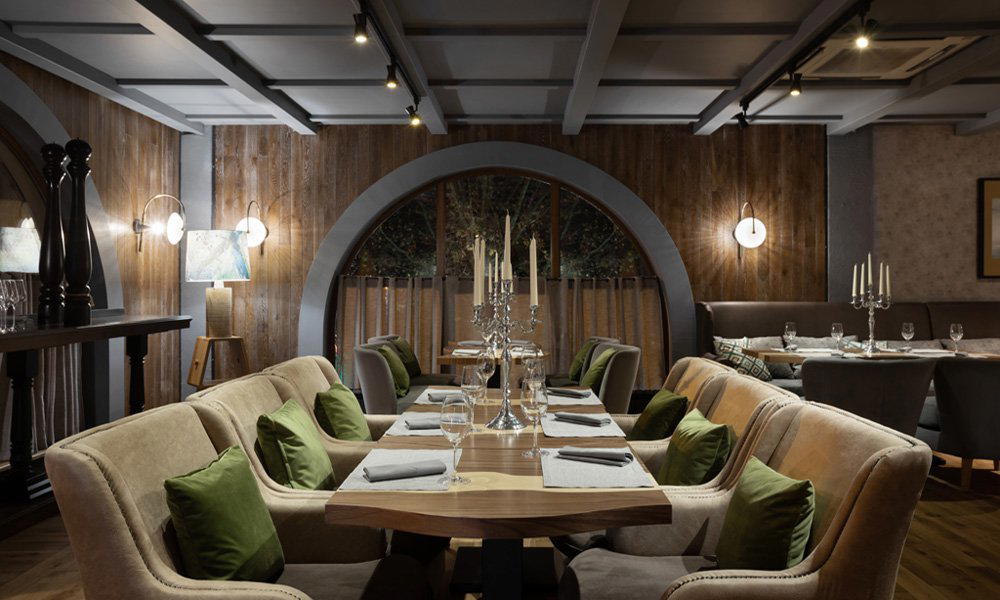
Where the Black Sea Coast Meets the Kitchen
Teatral'naya Ulitsa runs through the civic centre of Sochi with a particular kind of confident southernness: broad pavements, the smell of salt air carried in from the coast a few blocks away, and a general sense that the city takes its pleasures seriously. The street does not feel like a resort corridor. It feels like a functioning city that happens to sit on a subtropical shore, and Restaurant Baran-Rapan occupies a position on it that reflects exactly that tone. Before you consider what arrives on the plate, that physical grounding matters, because it tells you something about what kind of restaurant this is: a year-round address that earns its standing through consistency in Sochi.
Sochi's culinary development has always been shaped by geography before it was shaped by ambition. The Krasnodar region that surrounds it is one of Russia's most agriculturally active, subtropical fruit, stone fruits, hazelnuts, corn, honey, sheep, and Black Sea fish all move through the local supply chain with a proximity that few Russian cities can match. Where Moscow restaurants like Varvary have built reputations on sourcing Russian ingredients from a distance, Sochi restaurants have the advantage of production sitting immediately at their edge. That proximity, when a kitchen uses it deliberately, produces a different kind of cooking: shorter supply chains, less cold-storage compromise, and a menu logic that can shift with what's arriving rather than what was ordered three weeks ahead.
The Ingredient Geography That Drives Sochi Dining
Understanding why Baran-Rapan holds its accreditation requires understanding the produce context it operates within. The Krasnodar Krai is not simply Russia's agricultural south, it is one of the few zones in the country where a serious kitchen can source subtropical and temperate ingredients from the same regional belt. Feijoa, persimmon, cornelian cherry, and matsoni culture sit alongside the more obvious claims: fresh Black Sea fish, Caucasian herbs, and the lamb that gives the restaurant part of its name (baran means ram in Russian). The rapan, a Black Sea mollusc related to the whelk, completes the identity, pulling together mountain and coast as the two poles of a genuinely local sourcing philosophy.
This kind of dual-sourcing geography is rare on the European fine dining map. Restaurants in coastal cities further west often deal in either mountain produce or maritime produce, but rarely both with equal conviction. Sochi's position at the base of the Caucasus range, where the Greater Caucasus descends directly to the shoreline, creates a compressed geography that makes ingredient diversity not just possible but structurally embedded in what the region produces. The kitchen's engagement with that geography is what separates Sochi's more ambitious restaurants from seasonal resort operations, and it is the dimension along which Baran-Rapan has built its recognisable position.
A 2-Star Accreditation in Context
Baran-Rapan's World of Fine Wine and London Awards 2-Star accreditation is a meaningful credential within the international wine and fine dining recognition circuit. At the 2-star tier, the accreditation signals a kitchen operating with sufficient ambition and consistency to attract international adjudication, a relatively rare status for a Sochi address. Russia's recognised dining cluster has historically concentrated in Moscow and, to a lesser degree, St. Petersburg: Birch and Probka in St. Petersburg, or operations of the scale of Tsarskaya Okhota in Zhukovka, reflect how concentrated the country's high-end dining geography has been. That a restaurant in Sochi sits in this recognised tier says something about the city's dining profile.
On an international scale, a 2-star WFW accreditation places Baran-Rapan in a peer group that values wine programme integration and kitchen execution together rather than separately, a different emphasis from Michelin's chef-centric model, and one that rewards venues where the cellar and the kitchen are speaking the same sourcing and flavour language. Krasnodar Krai is now producing wines of genuine export-level quality; the region's proximity gives Sochi kitchens a wine-pairing advantage that few Russian restaurants outside Moscow can access as naturally. For comparison, internationally recognised restaurants where the wine programme is as weighted as the food, Le Bernardin in New York or Alain Ducasse at Louis XV in Monte Carlo, give a sense of the evaluative standard that informs WFW accreditations, even if the scale and culinary tradition differ considerably.
Sochi's Dining Scene and Where Baran-Rapan Sits Within It
Russia's serious dining scene has historically split between Moscow's technically ambitious modern-Russian operations and St. Petersburg's more European-leaning formats. Sochi has operated as a third node: smaller, more seasonally sensitive, and more directly connected to regional produce than either capital. The city's fine dining addresses tend to work harder on ingredient narrative precisely because the sourcing story is more immediate and more distinctive than anything a Moscow restaurant can claim about local production. SEASONS in Kaliningrad offers an interesting counterpoint from Russia's western exclave, where Baltic produce and European culinary proximity create a different regional identity.
Within Sochi itself, the dining tier that Baran-Rapan occupies is not large. The city has several well-regarded addresses, but internationally accredited kitchens remain a minority. That scarcity shapes the experience: there is no deep competitive set to benchmark against at close range, which places more responsibility on the kitchen to define its own standard rather than calibrate against neighbours. Whether that isolation sharpens or insulates depends on the year, and on how seriously the team tracks the wider current of modern Russian cooking. Particularly technically progressive benchmarks in that current, including operations with the format discipline of Alinea in Chicago or Lazy Bear in San Francisco, are not direct comparisons, but they illustrate how ingredient-narrative restaurants with strong regional identity are being evaluated globally.
Planning a Visit
Restaurant Baran-Rapan is located at Teatral'naya Ulitsa, 11 in central Sochi, within walking distance of the city's main civic and cultural institutions. Sochi is accessible by direct flights from Moscow and other Russian cities, and the central address means the restaurant is reachable from most of the city's hotel accommodation without significant travel time. Given the 2-star accreditation and Sochi's limited supply of internationally recognised dining addresses, booking ahead is the sensible approach, particularly during the summer coastal season and the winter ski-resort period, when the city operates at higher visitor volumes. Reservations are recommended.
For those planning broader itineraries around the visit, our full Sochi restaurants guide maps the city's dining options across price points and styles. Sochi's hotel and accommodation range is covered in our Sochi hotels guide, and the city's bar scene, increasingly serious in the resort-city upper tier, is detailed in our Sochi bars guide. The Krasnodar wine region that supplies many of the area's kitchens and cellars is worth exploring directly; our Sochi wineries guide covers what to visit in the surrounding area. Broader cultural and activity programming is in our Sochi experiences guide.
In Context: Similar Options
Comparable venues nearby, for context on price, style, and recognition.
| Venue | Cuisine | Price | Notes |
|---|---|---|---|
| Restaurant Baran-RapanThis venue — the venue you are viewing | Modern Black Sea Seafood & Caucasus Cuisine | $$$$ | Not listed |
| Birch | Modern Fusion Tasting Menu | $$$ | Tsentralny District |
| Confectionary Pushkin | French Patisserie & Confectionery | $$$ | Tverskoy District |
| Magnum Wine Bar | European Wine Bar Cuisine | $$$ | District Central (TsAO) |
| Kazbek | Authentic Georgian | $$ | Presnensky |
| Китайская грамота | Кантонская кухня | $$$ | Бульварное кольцо |
Recognition history
Dated appearances from independent guides and award organizations, with the underlying list record or original source where available.
Wine Spectator Best of Award of Excellence
Wine Spectator
World's Best Wine Lists Awards WBWL 2-Star
World's Best Wine Lists Awards
Continue exploring
More in Sochi
Restaurants in Sochi
Browse all →
At a Glance
- Elegant
- Sophisticated
- Romantic
- Cozy
- Date Night
- Business Dinner
- Special Occasion
- Celebration
- Open Kitchen
- Live Music
- Private Dining
- Extensive Wine List
- Sommelier Led
- Craft Cocktails
- Local Sourcing
- Farm To Table
Current opening hours
- Monday
- 12 PM–12 AM
- Tuesday
- 12 PM–12 AM
- Wednesday
- 12 PM–12 AM
- Thursday
- 12 PM–12 AM
- Friday
- 12 PM–12 AM
- Saturday
- 12 PM–12 AM
- Sunday
- 12 PM–12 AM
Hours can change for holidays and private events. Last verified .
Elegant and cozy with high ceilings, comfortable zoning, refined decor blending modernity and classic style, soft lighting, and live music that is perfectly accommodating without being distracting.