Qazaq Gourmet

La Liste Top Restaurants
Our verdict
Qazaq Gourmet occupies a serious position in Astana's fine-dining tier, holding La Liste recognition in both 2025 and 2026 with scores around 75-76 points. The kitchen works across Kazakh and European traditions, drawing on the steppe's larder to produce cooking that reads as both locally grounded and technically considered. On Prospekt Mangilik Yel, it is one of the city's clearest arguments for Kazakh cuisine at the formal end of the table.

Pearl is the En Primeur Club membership app — saves, bookings, and concierge access live there. Same editors, same standards.
- Address
- Prospekt Mangilik Yel. 29, Astana 020000, Kazakhstan
- Phone
- +7 708 988 8888
- Hours
- Daily 12–11 PM
- Website
- qazaqgourmet.kz
- Directions
- Get directions
- Booking
- Book on the venue's website
The menu
What to order
- Besh Parmak
- Bishbarmak
- Mutton and pumpkin dumplings
- Lamb with smoked aubergine
- Horsemeat specialities
- Fish Manti
Astana's Fine-Dining Tier and Where Kazakh Cuisine Fits
Central Asia's capital cities have spent the last decade building fine-dining infrastructure that did not exist in any coherent form before the 2010s. Astana is the most accelerated case: a planned city whose architectural ambition has pulled serious hospitality investment behind it. Within that context, the restaurants doing the most interesting work are those attempting to reconcile European technical frameworks with the actual larder of the Kazakh steppe — horse meat, fermented mare's milk, dried lamb, wheat from the northern grain belt, river fish from the Ishim and Ural systems. That reconciliation, when it works, produces cooking that cannot be replicated in Paris or Hong Kong, because the raw materials are specific to this geography.
Qazaq Gourmet, on Prospekt Mangilik Yel in the heart of the new city, operates at that intersection. La Liste, which compiles critical scores from restaurant guides across roughly 600 sources globally, awarded it 76 points in 2025 and 75 points in 2026 — a band that places it inside the top tier of recognised restaurants in Kazakhstan and gives it a credible peer position alongside the handful of Central Asian addresses that appear in international listings at all. For readers using, it sits at the serious end of the local range.
What Kazakh-European Cooking Actually Means on the Plate
The Kazakh-European category is not a compromise. It is a technical strategy: use European cooking methods, sauce-making, controlled aging, precision heat, structured plating, as tools to present ingredients whose identity is entirely Kazakhstani. The approach has parallels elsewhere. In the Basque Country, restaurants like Arzak in San Sebastián built global reputations by applying innovation to a hyper-regional larder. In coastal Spain, Aponiente in El Puerto de Santa María treats marine ingredients from a specific estuary as the entire creative premise. The logic is the same: sourcing specificity creates a dish that cannot be made anywhere else.
Kazakhstan's sourcing credentials are considerable if underreported. The country is among the world's largest wheat producers. Steppe-raised livestock, horses, sheep, cattle, graze on grasslands that cover roughly a third of the country's land area, producing meat with a flavour profile distinct from grain-fed equivalents. The Caspian and the river systems feeding into it supply sturgeon, asp, and carp. Salt from the Aral basin. Wild herbs and berries from the Tien Shan foothills to the south. A kitchen that takes these materials seriously has a larder with genuine depth. Qazaq Gourmet's positioning within the Kazakh-European framework suggests the kitchen is working with that depth rather than substituting imported ingredients for local ones.
The Address and the Setting
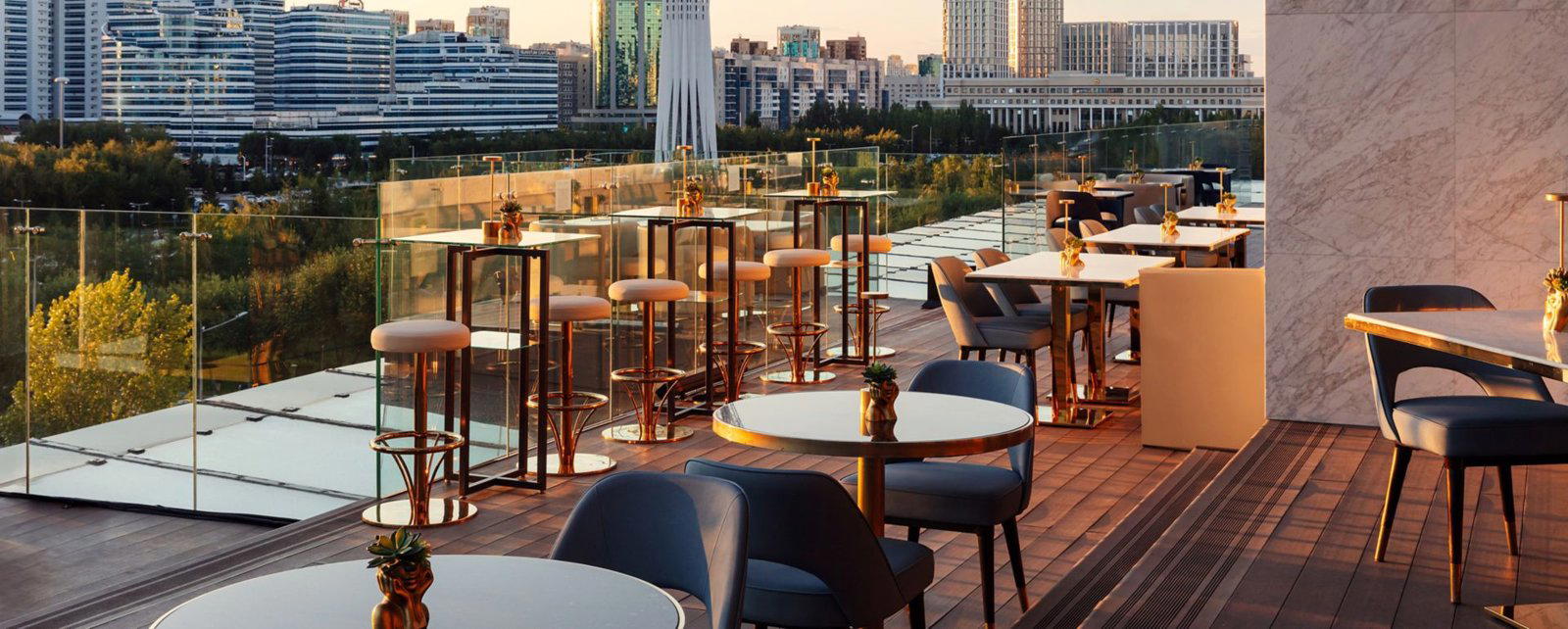
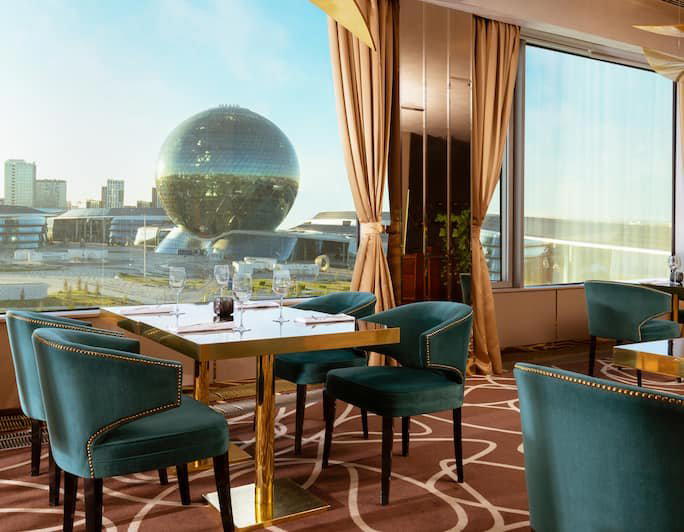
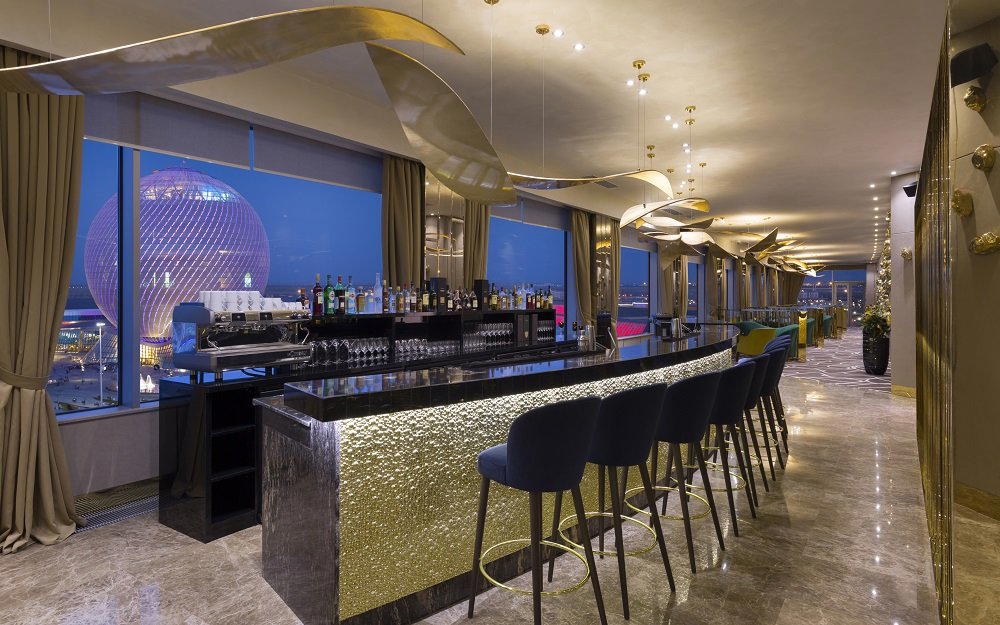
Prospekt Mangilik Yel, the Avenue of the Golden Path, is Astana's ceremonial spine, a broad boulevard lined with government buildings, financial institutions, and the newer hospitality infrastructure that has followed investment into the capital. The address places Qazaq Gourmet within the planned city's formal zone, the part of Astana that signals institutional ambition. Arriving from this direction, the expectation is for a restaurant that matches the register of its surroundings: considered, controlled, designed with intent. That framing is useful context before you sit down.
The city's broader hospitality scene is still consolidating. Astana is not yet on the international fine-dining circuit in the way that comparable capital cities in Asia or the Gulf are, which makes La Liste recognition particularly meaningful here. It signals that the kitchen is producing at a standard that translates to an international critical audience, not just a local one. For visitors building a wider Astana itinerary, bars guide, and experiences guide cover the surrounding options.
Kazakh Cuisine in the Broader Regional Context
Across Kazakhstan's two major cities, a small number of restaurants are attempting formal interpretations of Kazakh cooking. In Almaty, Qazaq Auyl operates within the traditional Kazakh framework, and Ogonek works the same Kazakh-European hyphenate that defines Qazaq Gourmet's category. The Astana-Almaty comparison is instructive: Almaty, the financial and cultural capital, has had longer to develop its restaurant infrastructure and a larger affluent resident base to support it. Astana's scene is newer and more government-driven, but the ambition is comparable. Qazaq Gourmet's La Liste appearance gives it a credential that very few Almaty restaurants hold, which shifts the competitive comparison in Astana's favour at the formal end.
For context on how La Liste's scoring bands translate internationally: 75-76 points places Qazaq Gourmet in a tier well below the 90+ scores held by addresses like Alléno Paris au Pavillon Ledoyen or Louis XV in Monte Carlo, but within a band that implies consistent, critically acknowledged quality. Restaurants like Le Bernardin in New York and Atomix operate at higher bands, providing useful calibration for where 75-76 points sits in the global range.
Planning Your Visit
The restaurant is at Prospekt Mangilik Yel 29, in central Astana, accessible from the main hotel corridor of the new city. Given the absence of published booking details in the available record, the most reliable approach is to contact the restaurant directly on arrival in Astana or through your hotel concierge, who will have current reservation and operating information. For visitors flying into Astana International Airport, the new city district where Qazaq Gourmet sits is roughly 15-20 minutes by road depending on traffic, placing it easily within reach before or after arrival. is a useful companion for those exploring Kazakhstani wine and spirits alongside the dining programme.
A note on timing: Astana's winters are severe, with temperatures regularly dropping below minus 20 Celsius between December and February. The city's restaurant culture tends to be year-round given that most of the dining infrastructure is indoors and climate-controlled, but visiting in the shoulder seasons of May or September gives a more navigable experience of the city overall.
What Qazaq Gourmet Represents
The broader point, which Qazaq Gourmet illustrates, is that Central Asian fine dining is no longer a theoretical category. A restaurant on the Kazakh steppe holding two consecutive years of La Liste recognition, working with ingredients that have no equivalent elsewhere, is making an argument about sourcing and identity that deserves to be taken seriously on its own terms, not as a curiosity or an emerging-market story, but as a kitchen doing considered work with a larder that most of the world has not yet learned to read. That is, at this moment, a more interesting position to be in than adding another European technique to already-familiar European ingredients. Comparable efforts in cuisine-forward restaurants like Lazy Bear in San Francisco, Atelier Moessmer in Brunico, or Dal Pescatore in Runate show how regional ingredient fidelity translates into sustained critical respect over time. The trajectory for Qazaq Gourmet, if the sourcing commitment holds, points in the same direction.
Frequently asked questions
What's Qazaq Gourmet's location?
Qazaq Gourmet is located at Prospekt Mangilik Yel. 29, Astana 020000, Kazakhstan, Astana.
Quick Comparison
| Venue | Cuisine | Price | Awards |
|---|---|---|---|
| Qazaq GourmetThis venue — the venue you are viewing | Modern Kazakh Fine Dining | $50–100 | La Liste Top Restaurants |
| Казах Аул - Qazaq Auyl | Kazakh Cuisine | Not listed | Not listed |
| Огонёк - Ogonek | Kazakh European | Not listed | Not listed |
Recognition history
Dated appearances from independent guides and award organizations, with the underlying list record or original source where available.
La Liste Top Restaurants
La Liste
Full recognition history (2 entries)
La Liste Top Restaurants
La Liste


Qazaq Gourmet
The wine
- Wine program
- Curated wine list
- Extensive wine list
- Sommelier-led
- Craft cocktails
Details
- Elegant
- Sophisticated
- Romantic
- Classic
- Date Night
- Business Dinner
- Group Dining
- Special Occasion
- Celebration
- Live Music
- Private Dining
- Open Kitchen
- Design Destination
- Extensive Wine List
- Craft Cocktails
- Sommelier Led
- Local Sourcing
- Tasting Menu
- A La Carte
- Set Menu
- Wine
- Cocktails
- Traditional Kazakh Beverages
- Vegetarian Friendly
- Gluten Free Options
Current opening hours
- Monday
- 12–11 PM
- Tuesday
- 12–11 PM
- Wednesday
- 12–11 PM
- Thursday
- 12–11 PM
- Friday
- 12–11 PM
- Saturday
- 12–11 PM
- Sunday
- 12–11 PM
Hours can change for holidays and private events. Last verified .
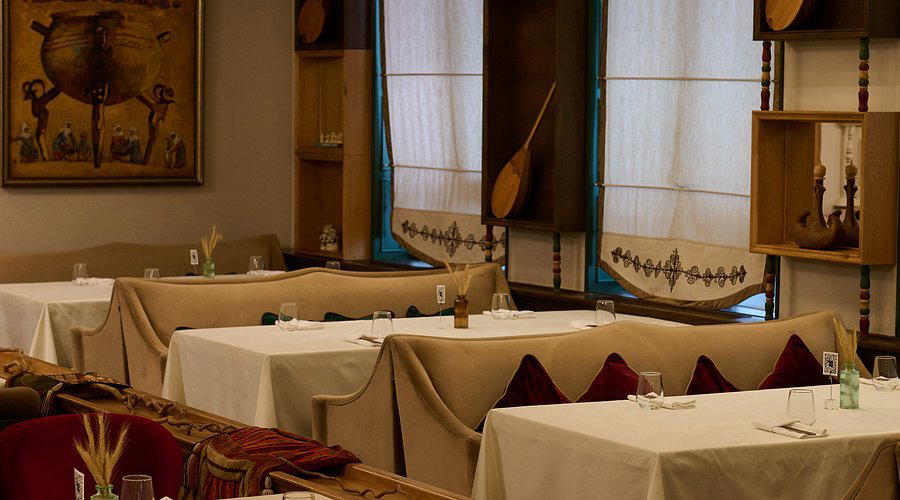
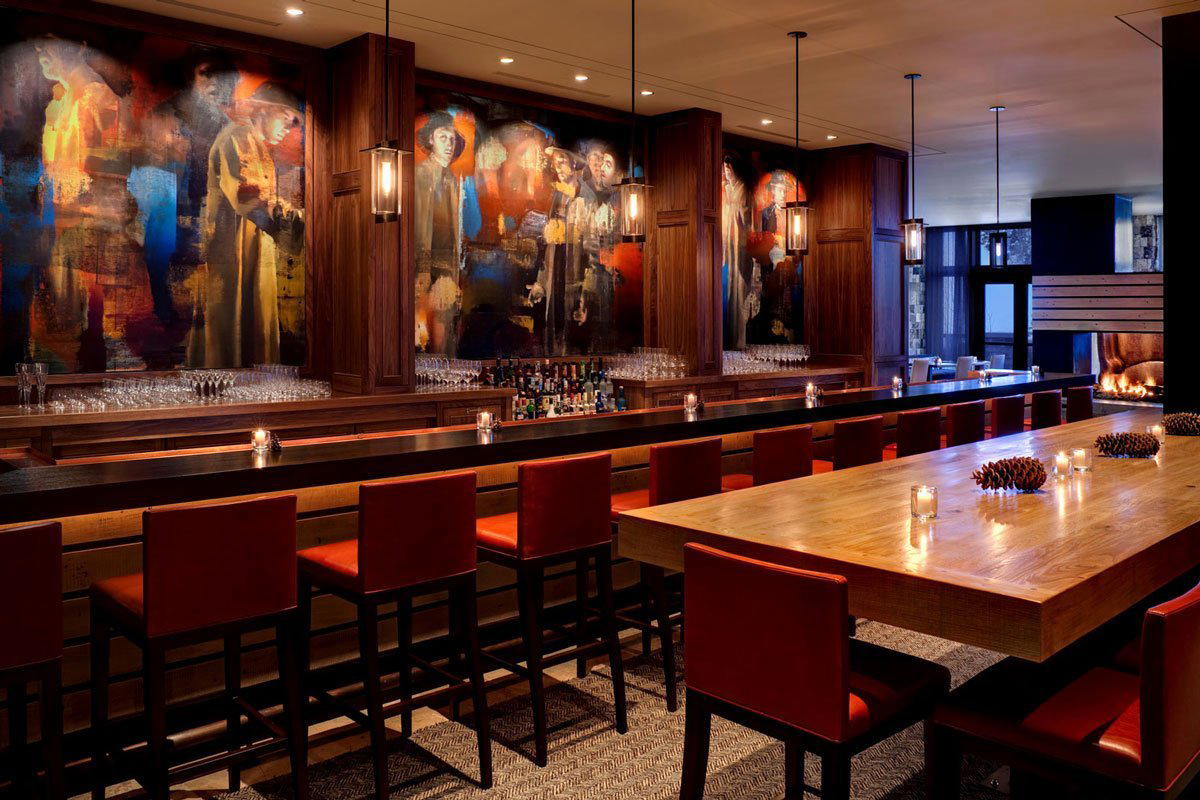
Magnificent scarlet and orange-hued dining room with domed ceiling, chandeliers, historic national costumes and artifacts; enhanced by live music performances on Kazakh national instruments.