
Michelin Plate
Our verdict
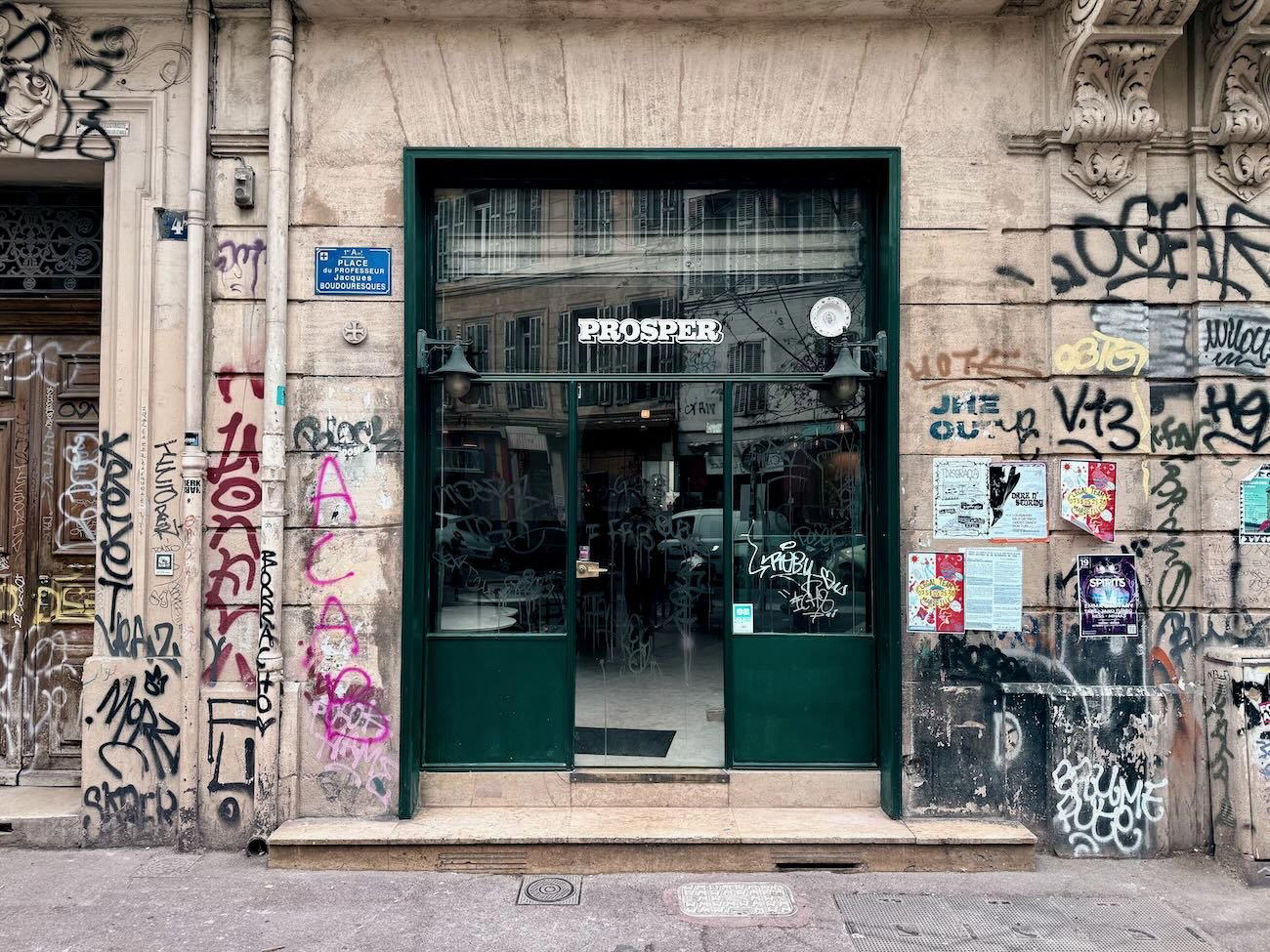
A former Marseille bar on a lively square near Cours Julien, Prosper has kept its white and bottle-green walls and exposed stonework while adding a kitchen run by a French-British duo trained at Frenchie in Paris and London. The cooking draws on Mediterranean tradition with a clear lean toward Spain: think skate wing terrine with pepper sauce, squid-ink rice with grilled octopus and aioli, and aubergine with smoked yoghurt and sumac flower. Booking is strongly advised, particularly in summer when two evening sittings operate.

Pearl is the En Primeur Club membership app — saves, bookings, and concierge access live there. Same editors, same standards.
The menu
What to order
- Spanish tortilla with green harissa
- Baked mussels with spiced crumble
- Cuttlefish crudo with XO sauce
- Breaded pork loin with glazed asparagus
A Square, a Terrace, and a Kitchen That Faces South
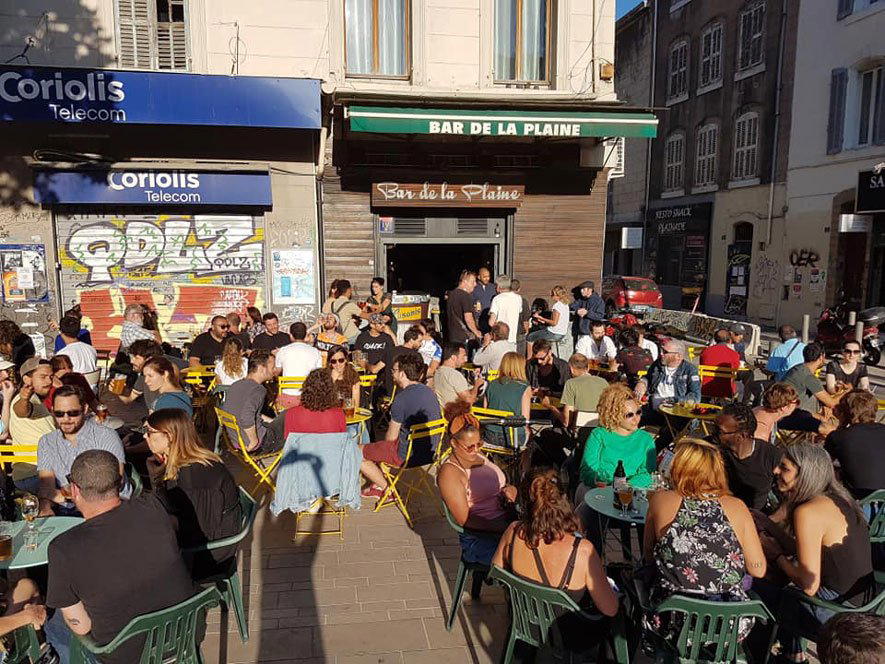
Cours Julien sits at the centre of Marseille's most densely creative neighbourhood — street art on every shutter, record shops beside natural wine bars, a square that fills with locals from noon to midnight. The streets feeding off it carry the same energy at lower volume, and it's on one of these, rue des Trois-Rois, that Prosper occupies the ground floor of a building that has clearly been a bar for a long time. The bottle-green and white walls, exposed stonework, and terrace opening onto the square haven't been stripped out and replaced with something more photogenic. They've been kept, because they're the point.
This matters in a city like Marseille, where the distinction between a restaurant that belongs to a neighbourhood and one that has simply located itself there tends to be legible within minutes of arriving. Prosper belongs. The room reads as a place that was already occupied by a specific kind of sociability before the current kitchen took over, and the cooking has been calibrated to match that register rather than override it.
Where Mediterranean Cooking Looks Toward the Other Shore
The broader Mediterranean culinary tradition has always been a conversation between coastlines rather than a single fixed identity. Marseille, sitting at its northern edge, has historically absorbed influences from North Africa, Italy, the Levant, and the Iberian peninsula, and the city's leading kitchens tend to treat that plurality as material rather than confusion. What distinguishes Prosper within this context is the clarity of its directional preference: the menu reads with a strong lean toward Spain, not as fusion but as a focused interpretation of what Mediterranean cooking can do when it follows one line of influence with discipline.
The team at the helm trained at Frenchie, the Paris and London operation built around precise bistro cooking with international reference points, and that training is evident in how the dishes are constructed. A skate wing terrine arrives with pepper sauce; aubergine comes with smoked yoghurt, caponata, plum, and sumac flower; squid-ink rice is paired with grilled octopus and aioli. These are not timid compositions. The flavour combinations are bold and, by the kitchen's own description, fiery. Sumac flower and smoked yoghurt signal a palate that has absorbed southern Mediterranean pantry logic. The aioli alongside squid ink is straightforwardly Catalan in its reference. What ties these dishes together is a confidence that comes from commitment to the tradition rather than from the kind of eclectic assembly that so often passes for Mediterranean cooking in lesser hands.
Marseille's fine dining tier, represented by houses like AM par Alexandre Mazzia and Le Petit Nice, operates at the highest level of formal French technique applied to southern ingredients. Une Table, au Sud occupies a similarly structured register. Prosper is not competing in that tier. It sits closer to the neighbourhood bistro model, where the ambition is expressed through what's on the plate rather than through the formality of the room or the ceremony of service. That positioning is a deliberate choice, not a limitation, and it places Prosper in a different but equally specific competitive set alongside neighbours like Alivetu and Auffo, where the question is how much kitchen ambition can be loaded into an accessible format.
The Frenchie Lineage and What It Means Here
The Frenchie training reference is worth holding for a moment, not as biography but as a marker of culinary position. Frenchie in Paris established a template that a significant number of mid-generation French cooks have taken outward: precise technique applied to ingredient-led, informally served food, with an international palate that doesn't apologise for its influences. Chefs who came through that kitchen and moved elsewhere have generally carried that disposition into their own projects, adapting it to local materials and contexts rather than reproducing it wholesale. In Marseille, with its Mediterranean raw material and its particular resistance to culinary pretension, that disposition finds a natural home. The cooking at Prosper, as described, reflects exactly this kind of translation: serious technique in an unstuffy room, with a flavour language that leans into the geography of the city's coastline.
For context on what this lineage has produced across France's broader fine dining circuit, it's worth noting that the country's formal restaurant tier runs from multi-generational institutions like Auberge de l'Ill and Troisgros through contemporary creative houses like Mirazur in Menton and Flocons de Sel in Megève, and extends internationally to operations like Alléno Paris au Pavillon Ledoyen, Le Bernardin in New York, and Emeril's in New Orleans. Prosper operates in an entirely different register, but the Frenchie connection places it in a lineage that has been proven at multiple levels. That lineage matters for understanding why the food here is put together the way it is.
Planning a Visit
Prosper is at 2 rue des Trois-Rois, a short walk from Cours Julien in the 6th arrondissement. The terrace opens onto a square that carries foot traffic through the day and evening, making it a reasonable option for aperitif-hour arrival ahead of dinner. In summer, two sittings operate in the evening, which means the kitchen is running at capacity; booking well in advance is strongly recommended for either sitting, and walk-ins during high season carry meaningful risk of not being seated. The format and the neighbourhood make this a more fitting choice for dinner than a formal lunch, though the room's character would translate across both services.
For a fuller picture of what Marseille offers across price tiers and formats, see our full Marseille restaurants guide, as well as our Marseille hotels guide, bars guide, wineries guide, and experiences guide.
Frequently asked questions
Is Prosper Michelin-listed?
Prosper has received recognition including: Not far from Cours Julien, this old Marseille bar, spruced up but pleasingly unfussy, has retained its heart and soul: white and bottle-green walls, exposed stonework, and a terrace on a lively square. At the helm is a French-British duo wh….
How do I find Prosper?
Prosper is located at 2 rue des Trois-Rois, Marseille.
What do people recommend at Prosper?
The squid-ink rice with grilled octopus and aioli is the most talked-about dish, drawing on a Catalan reference that defines the kitchen's Spanish-inflected direction. The skate wing terrine with pepper sauce and the aubergine with smoked yoghurt, caponata, plum, and sumac flower have also appeared on the dinner menu, showing the range the kitchen is working within.
Do they take walk-ins at Prosper?
In summer, Prosper runs two evening sittings and tends to fill both. The venue itself recommends booking in advance, and given the terrace on a lively square near Cours Julien, demand holds consistently through peak season. Walk-ins are a risk worth managing with a reservation.
What's the signature at Prosper?
The squid-ink rice with grilled octopus and aioli is the clearest statement of what the kitchen is doing: Mediterranean cooking that looks toward Spain rather than defaulting to Provençal convention. The French-British duo at the helm trained at Frenchie in Paris and London, and that grounding in precise, produce-led cooking shows in how the Spanish influences are handled — bold but structured.
Budget Reality Check
Comparable venues nearby, for context on price, style, and recognition.
| Venue | Cuisine | Price | Awards | Notes |
|---|---|---|---|---|
| ProsperThis venue — the venue you are viewing | Modern Mediterranean Bistro | $30–50 | Michelin Plate | Not listed |
| Les Trois Forts | Modern Provençal Mediterranean | $50–100 | Michelin Plate | Le Pharo, Modern Provençal Mediterranean |
| Peron | Refined Mediterranean Seafood | $50–100 | Michelin Plate | Endoume, Refined Mediterranean Seafood |
| La Pagaille | Modern Mediterranean Tapas | $30–50 | Not listed | Hotel De Ville, Modern Mediterranean Tapas |
| Mijoba | Modern Mediterranean with Andean Fusion | $50–100 | Michelin Plate | Vauban, Modern Mediterranean with Andean Fusion |
| Alivetu | Modern Mediterranean Bistronomique | $30–50 | Michelin Plate | Saint Victor, Modern Mediterranean Bistronomique |
Recognition history
Dated appearances from independent guides and award organizations, with the underlying list record or original source where available.
Michelin Plate
Michelin · 2026 Michelin Plate
Full recognition history (2 entries)
Michelin Bib Gourmand
Michelin
Continue exploring
More in Marseille
Restaurants in Marseille
All restaurants in Marseille →
Bars in Marseille
All bars in Marseille →
Prosper
The wine
- Wine program
- Curated wine list
- Extensive wine list
- Natural wine
Details
- Trendy
- Modern
- Lively
- Bohemian
- Casual Hangout
- Group Dining
- After Work
- Open Kitchen
- Terrace
- Natural Wine
- Extensive Wine List
- Natural Wine
- Local Sourcing
- Biodynamic
- A La Carte
- Small Plates
- Natural Wine
- Biodynamic Wine
- Mezcal
- Rum
- Vegetarian Friendly
Current opening hours
- Monday
- 7–11 PM
- Tuesday
- 7–11 PM
- Wednesday
- 7–11 PM
- Thursday
- 7–11 PM
- Friday
- 7–11 PM
- Saturday
- Closed
- Sunday
- Closed
Hours can change for holidays and private events. Last verified .
Bright and joyful with two-toned walls, open kitchen, and shady terrace; casual and lively atmosphere reflecting local culture.