Pierozek

A Michelin Bib Gourmand recipient on Greenpoint's historically Polish Manhattan Avenue, Pierozek serves pierogi, borscht, golabki, and kielbasa from a compact, neighbourhood-rooted menu. Bolesławiec pottery lines the service station, Polish liquors anchor the drinks list, and the price point sits firmly at the accessible end of Brooklyn's dining spectrum. At $$, it prices well below New York's celebrated tasting-menu circuit.
Pearl is the En Primeur Club membership app — saves, bookings, and concierge access live there. Same editors, same standards.
- Address
- 592 Manhattan Ave, Brooklyn, NY 11222
- Phone
- (718) 576-3866
- Website
- pierozekbrooklyn.com
- Directions
- Get directions
 Saves & bookings on Pearl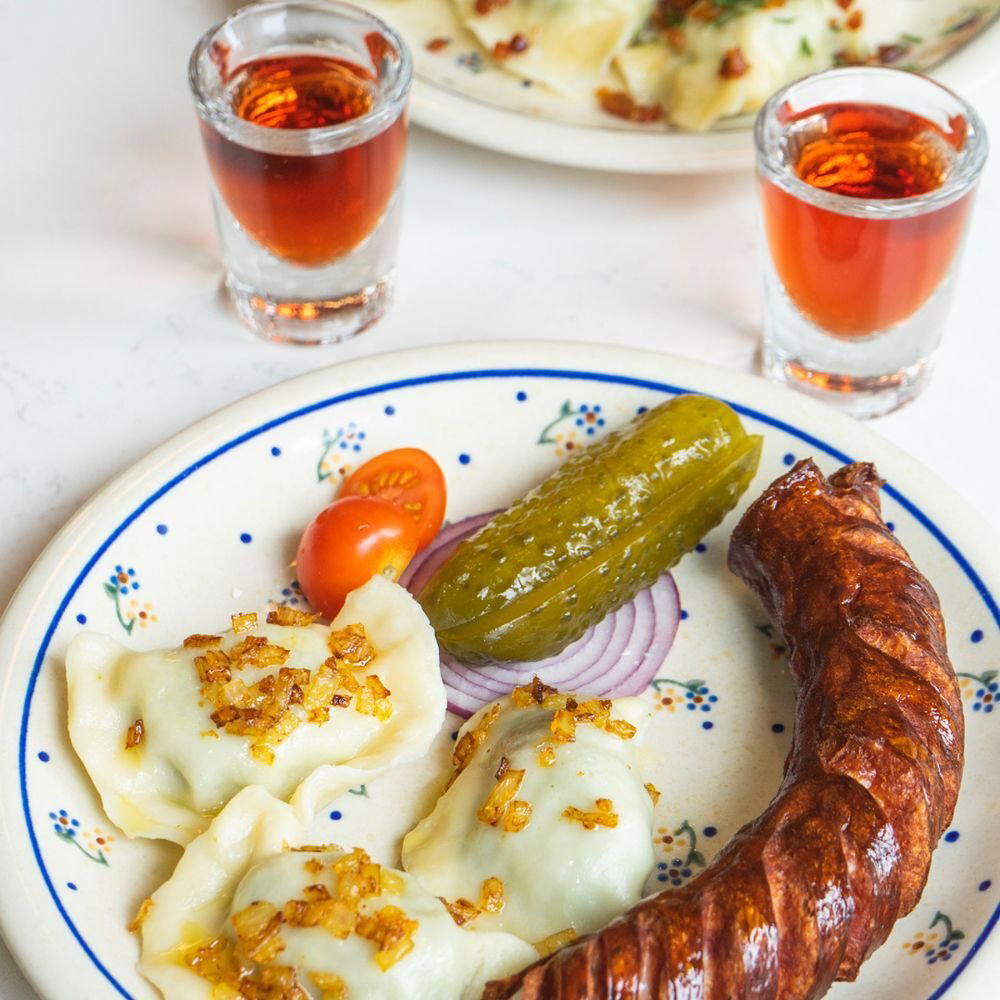
Greenpoint's Polish Table and What It Represents
Brooklyn's Greenpoint neighbourhood has maintained among the more durable Eastern European dining identities in New York City. Manhattan Avenue, its commercial spine, has carried Polish delis, bakeries, and sit-down restaurants through decades of demographic change that reshaped most of the borough around it. That continuity matters for understanding what Pierozek does and where it sits: this is not a revival concept or a fashionable reinterpretation of Central European cooking. It operates inside a living community tradition, on a block where Polish remains a spoken and eaten language.
The Michelin Bib Gourmand, awarded in 2024, places Pierozek in a specific tier of New York recognition: cooking that inspires inspectors to recommend it on value and quality grounds, rather than ambition or spectacle. Across the city, that distinction separates places like Pierozek from the upper reaches of the tasting-menu circuit occupied by Le Bernardin, Atomix, Eleven Madison Park, Masa, and Per Se. The Bib Gourmand is a different kind of endorsement, one that validates the neighbourhood-scale, daily-use restaurant rather than the occasion-driven destination. At a $$ price point, Pierozek prices squarely within that mandate.
The Menu: Pierogi as the Centre of Gravity
Polish cooking in New York has a habit of being reduced to a single dish in the popular imagination, and at Pierozek that dish is pierogi, though the kitchen earns the focus. The fillings here move across a wider register than the standard potato-and-cheese baseline: jalapeño, mashed potato, and bacon in one version; raspberry and sweet cheese in another, intended as a dessert counterpart rather than an afterthought. The latter works well alongside a pour from the restaurant's concise selection of Polish liquors, where the pairing logic follows the same sweet-against-spirit instinct that drives slivovitz and fruit dumplings across Central European traditions.
Beyond the dumplings, the menu covers ground that many casual Polish restaurants in American cities skip. Borscht here is described as hearty, which in Polish cooking typically signals a clear or semi-clear broth built on fermented beet liquid rather than the thicker, creamier versions that circulate in Ukrainian-American diners. Golabki, the cabbage-rolled pork and rice parcel finished with tomato-basil sauce, represents a home-cooking staple that rarely survives translation to restaurant menus without losing something in portion or seasoning. The kielbasa is presented as a standalone item, the grilled or smoked sausage assessed on its own terms, though the kitchen pairs it with whole grain mustard that sharpens the fat and smoke.
One detail that anchors the room's identity: the service station displays Bolesławiec pottery, the blue-and-white stoneware produced in southwestern Poland for centuries, and the kitchen uses the same ceramic tradition as its primary serving vessel. This is not decorative sourcing. Bolesławiec pieces carry functional weight in Polish domestic life and their presence here signals an understanding of material culture that most restaurant concepts approaching a cuisine from the outside would not reach.
Daytime versus Evening: How the Hours Shape the Experience
Casual Polish restaurants on Manhattan Avenue historically function as lunchtime anchors for the neighbourhood's working population before shifting toward a slower, more social evening pace. The distinction matters for how a visitor should approach Pierozek. During the day, the menu's borscht, pierogi, and kielbasa read as practical midday eating, filling and priced to support multiple visits a week rather than a single celebratory occasion. The setting, Bolesławiec pottery included, reinforces that register: this is a room that takes the daily meal seriously.
In the evening, the Polish liquor selection becomes the shaping element. A concise spirits list built around Polish vodkas and flavoured liquors shifts the atmosphere toward something more social, where the raspberry pierogi with a shot functions as a closing ritual rather than a practical course. The value proposition holds in both daylight and after dark, but the evening visit rewards lingering in a way that the lunch hour may not, depending on service volume.
Pierozek in the Broader Polish Restaurant Conversation
New York's Greenpoint occupies a specific place in the transatlantic map of Polish cooking. Internationally, Polish cuisine is generating more serious editorial attention than at any point in recent memory, with venues like Matka in Paris and Restauracja Solmarina in Wiślinka representing different points on the spectrum from diaspora-accessible to regionally rooted. Greenpoint sits on the diaspora end of that axis, with Pierozek drawing on community continuity rather than avant-garde reinterpretation.
That positioning is neither a limitation nor a compromise. The Bib Gourmand is earned through consistency, flavour, and value, not through conceptual novelty. Compared with the ambition-forward end of American restaurant culture represented by venues like Alinea in Chicago, Lazy Bear in San Francisco, The French Laundry in Napa, Single Thread Farm in Healdsburg, Providence in Los Angeles, or Emeril's in New Orleans, Pierozek operates on a fundamentally different axis. The measure here is whether the golabki tastes the way it should, whether the borscht carries the fermented depth the dish requires, whether the pierogi dough holds its shape and texture through service. Those are the standards the kitchen is held to, and the Michelin recognition suggests they are being met.
Planning Your Visit
Pierozek sits at 592 Manhattan Ave in Greenpoint, Brooklyn, on the corridor where Polish commercial life has concentrated for generations. The G train stops at Greenpoint Avenue and Nassau Avenue, both within walking distance of that stretch of Manhattan Ave. The $$ price point means a full meal, including pierogi, a main, and a Polish liquor, lands well below the average cost of a comparable sit-down in Manhattan's mid-range tier. Pierozek is open Mon: 12-10 PM; Tue: 12-10 PM; Wed: 12-10 PM; Thu: 12-10 PM; Fri: 12-10 PM; Sat: 12-10 PM; Sun: 12-8 PM. Walk-in service fits the restaurant's casual format.
Peers You’d Cross-Shop
Comparable venues nearby, for context on price, style, and recognition.
| Venue | Cuisine | Price | Notes |
|---|---|---|---|
| PierozekThis venue — the venue you are viewing | Authentic Polish Pierogi | $$ | Not listed |
| Chama Mama | Authentic Georgian | $$ | Chelsea-Hudson Yards |
| Bohemian Spirit | Traditional Czech | $$ | Upper East Side-Lenox Hill-Roosevelt Island |
| Sagara | Sri Lankan | $$ | Tompkinsville-Stapleton-Clifton-Fox Hills |
| 8282 | Modern Korean Anju & Banju | $$ | Lower East Side |
| Yemenat | Yemeni | Not listed | Bay Ridge |
Recognition history
Dated appearances from independent guides and award organizations, with the underlying list record or original source where available.
Michelin Bib Gourmand
Michelin
Michelin Bib Gourmand
Michelin
Continue exploring
More in New York City
Restaurants in New York City
Browse all →
Bars in New York City
Browse all →
Hotels in New York City
Browse all →





At a Glance
- Cozy
- Classic
- Intimate
- Casual Hangout
- Family
- Group Dining
- Open Kitchen
- Craft Cocktails
Current opening hours
- Monday
- 12–10 PM
- Tuesday
- 12–10 PM
- Wednesday
- 12–10 PM
- Thursday
- 12–10 PM
- Friday
- 12–10 PM
- Saturday
- 12–10 PM
- Sunday
- 12–8 PM
Hours can change for holidays and private events. Last verified .
Warm and heartwarming with playful Polish touches like Bolesławiec pottery plates and pierogi-shaped pillows, creating a cozy family-like atmosphere.