.png)
Set within the Petrányi Pince vineyard on a hillside above Lake Balaton, Petrányi Csopak serves traditional Hungarian home cooking in a period house with countryside views. The menu runs through soups, stews, and ragouts drawn from regional household recipes, placing it firmly in the mid-range tier of Csopak's small but growing dining scene. Priced at €€, it pairs naturally with a visit to the surrounding wine country.
 Discover on Pearl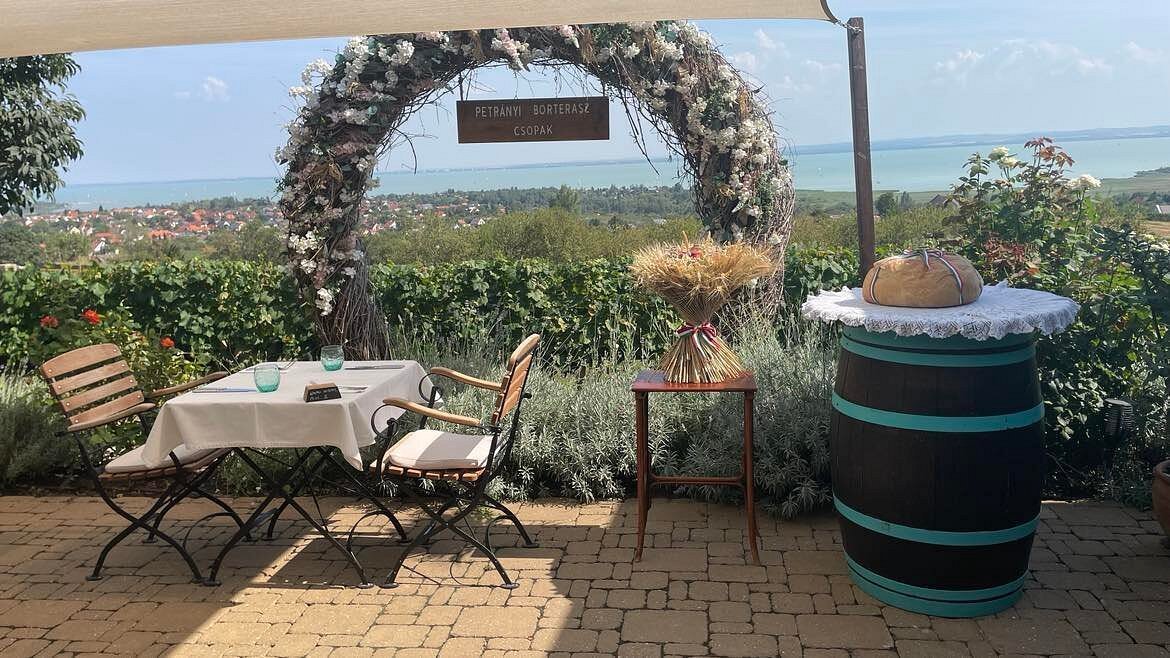
Hillside Hungary: The Case for Cooking From Memory
There is a particular category of Hungarian restaurant that resists modernisation on principle. Not out of stubbornness, but because the food it serves belongs to a domestic tradition so deeply embedded in regional identity that any attempt to refine it would miss the point entirely. Petrányi Csopak, positioned on the slopes above Lake Balaton within the Petrányi Pince vineyard, operates squarely within that tradition. The approach here is guided by the kind of cooking that Hungarian households have practised for generations: soups built on long-simmered bones, stews that thicken over hours, ragouts that carry the flavour of rendered fat and sweet paprika. These are not dishes designed to impress a chef's table; they are dishes designed to feed people well.
The setting reinforces that domestic register. A period house on a sloping hillside, with vineyard rows outside and views that reach across open countryside toward Lake Balaton in the middle distance, creates the specific atmosphere of a Hungarian country estate where eating and wine production exist on the same land. That continuity between landscape and table is not incidental to the experience at Petrányi Csopak; it is the experience.
The shortlist, unlocked.
Hard-to-book tables, cellar releases, and concierge-planned trips.
Get Exclusive Access →Traditional Hungarian Cooking and What It Actually Means
Hungarian cuisine's international reputation rests on a handful of dishes, but the tradition it draws from is considerably wider. The cooking that spread from rural households across the Pannonian basin over centuries was built around preserved meats, dairy-enriched sauces, freshwater fish from Lake Balaton and its tributaries, and vegetables that could be dried, pickled, or stored through winter. Paprika, introduced from the Ottoman period, became the defining spice not because it was fashionable but because it worked with fat, with flour, with the slow cooking that the cuisine depended on.
The menu at Petrányi Csopak reads as an honest inventory of that tradition. Soups, stews, and ragouts appear as the structural backbone, with the salmon trout with leek, potato, béchamel, and lemon representing a specifically Balaton-inflected approach to freshwater fish cookery. The béchamel here connects to a Central European tradition that runs through Austrian and Hungarian bourgeois cooking from the nineteenth century onward; the lemon cuts the richness in a way that keeps the dish from feeling heavy despite its construction. It is the kind of dish that has a dozen family-recipe variants in villages around the lake.
What distinguishes this tier of Hungarian restaurant from the urban modernisers is the refusal to treat traditional recipes as raw material for reinterpretation. Restaurants such as Stand in Budapest and Pajta in Őriszentpéter work with Hungarian ingredients and technique but push them through a contemporary lens. Petrányi Csopak does something different: it asks what the original version tasted like and cooks that instead. That is a genuinely more conservative position, and in a wine region where visitors often arrive specifically to engage with agricultural heritage, it connects to a coherent sense of place.
Csopak's Dining Tier and Where Petrányi Sits
Csopak is a small settlement on the northern shore of Lake Balaton with a reputation built more on its Olaszrizling and Furmint production than on its restaurant scene. The dining options are limited by the town's scale, which makes positioning within that small set relatively clear. At the mid-range €€ tier, Petrányi Csopak sits alongside Víg Molnár Csárda, another address in Csopak working within the traditional Hungarian register. For something more contemporary, Csopaki Resti by Laurel offers modern cuisine at a different price point and with a different culinary ambition.
The broader regional context places Csopak within a circuit of Hungarian destinations where food and wine operate together. Addresses like A Konyhám Stúdió 365 in Fonyód on the southern shore or Platán Gourmet in Tata represent different expressions of Hungarian regional cooking within an hour or two of Csopak. Further afield, 42 Restaurant in Esztergom and 67 Sigma in Székesfehérvár operate in a more contemporary register. For those building a wider picture of Hungarian dining, Alkimista Kulináris Műhely in Szeged, Andrassy Restaurant in Tarcal, and Anyukám Mondta in Encs each offer distinct regional perspectives worth considering.
For comparison outside Hungary, the €€ traditional cuisine tier has parallels in places like Café Sjiek in Maastricht and Bistro in Noordeloos, where regional cooking rooted in domestic tradition occupies a similar price and positioning bracket.
The Vineyard Setting as Context, Not Decoration
The physical placement of Petrányi Csopak within the Petrányi Pince vineyard matters in a way that goes beyond scenic appeal. The northern shore of Lake Balaton has produced wine since Roman times, and the hillside terroir of Csopak in particular yields some of Hungary's most characterful Olaszrizling. Eating a traditional Hungarian meal at a table from which you can see the vines that produce the wine you are drinking connects the two elements of the region's agricultural identity in a direct and legible way. That is a different proposition from a restaurant that simply stocks local bottles: here, the food and the wine come from the same piece of land.
For visitors arriving to explore the wine region, the address is Csopak, Homokbánya u. 31, 8229 Hungary. The hillside location means the restaurant sits above the main lakeshore road, accessible by car. Given the vineyard setting and the domestic cooking style, the atmosphere is more appropriate for a leisurely afternoon or evening than a quick stop. Whether a reservation is needed will depend on the season: the Lake Balaton region draws significant summer traffic, and hillside restaurants with views tend to fill at weekends between June and August. Visiting outside peak summer or arriving mid-week provides more flexibility. The €€ price point sits in the mid-range for Hungarian regional dining, in line with the traditional cuisine tier rather than the €€€ and above addresses found in Budapest's dining scene. For a full picture of what Csopak offers, see our full Csopak restaurants guide, as well as guides to hotels, bars, wineries, and experiences in the area.
The shortlist, unlocked.
Hard-to-book tables, cellar releases, and concierge-planned trips.
Get Exclusive Access →Frequently Asked Questions
Cost Snapshot
A fast peer set for context, pulled from similar venues in our database.
| Venue | Price | Awards | Notes |
|---|---|---|---|
| Petrányi Csopak | If you’re looking to immerse yourself in a traditional Hungarian experience, the… | This venue | |
| Babel | €€€€ | Michelin 1 Star | €€€€ · Modern Cuisine, €€€€ |
| Borkonyha Winekitchen | €€€ | Michelin 1 Star | €€€ · Modern Cuisine, €€€ |
| Rumour by Rácz Jenő | €€€€ | €€€€ · Creative, €€€€ | |
| Stand25 Bisztró | €€ | €€ · Traditional Cuisine, €€ | |
| Bilanx | €€ | €€€ · Contemporary, €€ |
Need a table?
Our members enjoy priority alerts and concierge-led booking support for the world's most difficult tables.
Get Exclusive AccessThe shortlist, unlocked.
Hard-to-book tables, cellar releases, and concierge-planned trips.
Get Exclusive Access →