Palomar





Michelin Bib Gourmand · Wine Spectator Award of Excellence · We're Smart World 2 Radishes
Our verdict
Holding a Michelin Bib Gourmand since 2024 and ranked among Europe's top casual dining destinations by Opinionated About Dining, Palomar has been translating the flavours of modern Jerusalem for Soho since the mid-2010s. The zinc counter facing an open kitchen remains the place to sit, where fire-cooked meats, kubaneh bread, and vegetable-forward plates anchor a menu rooted in Levantine, North African, and Iberian crosscurrents. At the ££ price point, it represents one of central London's most credentialled Middle Eastern tables.

Pearl is the En Primeur Club membership app — saves, bookings, and concierge access live there. Same editors, same standards.
- Address
- 34 Rupert St, London W1D 6DN, United Kingdom
- Phone
- +44 20 7439 8777
- Hours
- Mon 5–10 p.m.Tue–Wed 12–2:30 p.m., 5–10 p.m.Thu–Sat 12–2:30 p.m., 5–10:30 p.m.Sun 12–2:30 p.m., 5–9 p.m.
- Website
- thepalomar.co.uk
- Directions
- Get directions
- Booking
- Book on SevenRooms
The menu
What to order
- Kubaneh bread
- Chicken Labanieh
- Tarka octopus
- Lamb rump
- Josperised aubergine
- Baklava ice cream sandwich
Where Jerusalem Meets Soho: The Cultural Roots of Modern Israeli Cooking
Modern Israeli cuisine is, at its core, a cuisine of convergence. The cooking that emerged from Tel Aviv and Jerusalem over the past three decades draws simultaneously on Sephardic Jewish traditions carried from Spain and Portugal, Mizrahi influences from Iran, Iraq, and Yemen, North African spice logic, and the Levantine pantry shared across Syria, Lebanon, and Palestine. The result is a cooking style defined less by a single flavour profile than by a method of layering: fire, acid, fresh herb, and ferment applied to vegetables, legumes, and meat in combinations that resist easy categorisation under any single regional banner.
When Palomar opened on Rupert Street in the mid-2010s, it arrived as part of a small first wave of London restaurants taking that multi-layered tradition seriously rather than flattening it into falafel-and-hummus shorthand. The timing mattered. London's Soho and surrounding theatreland had absorbed decades of generic Middle Eastern menus, and the counter-service, fire-forward, sharing-plate format Palomar introduced represented a genuine shift in how that cuisine was being presented to a British audience.
A Decade of Recognition: What the Awards Signal
Palomar holds a Michelin Bib Gourmand as of 2025, a designation the guide reserves for restaurants offering what it describes as good cooking at moderate prices. That framing is relevant here: at the ££ price point, Palomar sits several tiers below the city's Michelin-starred fine dining rooms. Compare it to CORE by Clare Smyth, Restaurant Gordon Ramsay, Sketch, The Lecture Room and Library, or The Ledbury, and the gap in both price and format is substantial. The Bib Gourmand signals something different: that the kitchen is cooking with enough skill and consistency to earn inspector attention without the tasting-menu infrastructure or fine-dining pricing that typically accompanies Michelin recognition.
The Opinionated About Dining listing adds a second data point. OAD's Casual in Europe list, where Palomar ranked 341st in 2024 after appearing as recommended in 2023, is driven by votes from a community of experienced diners rather than anonymous inspectors. The combination of both recognitions across multiple consecutive years indicates consistency rather than a single strong performance in an award cycle.
At Palomar's price point, that volume of strong public feedback is a meaningful signal.
The Counter, the Fire, and the Format
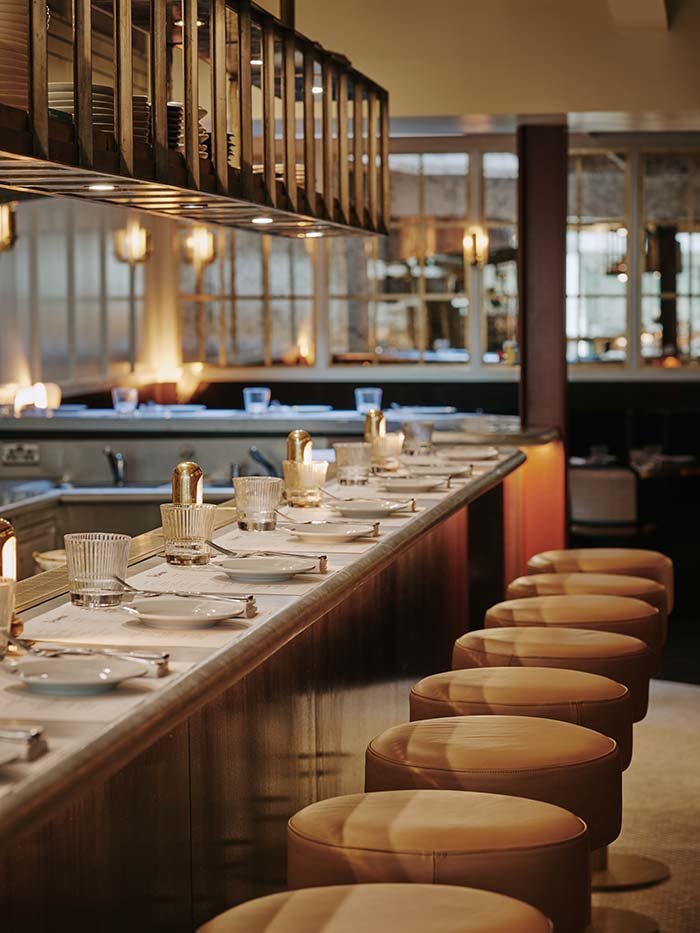
The spatial logic of Palomar's dining room encodes a specific set of priorities. The zinc kitchen counter running through to a wood-panelled dining room is not incidental design; it is the room's argument. Counter seating facing an open kitchen places the cooking performance at the centre of the experience, collapsing the distance between the kitchen and the guest in a way that conventional table service does not.
Subsequent refurbishment extended the eating counter for groups of four and introduced velvet-lined booths for smaller parties alongside larger tables for up to ten. But the counter retains its primacy. The open-kitchen format creates a visual menu: watching the assembly of dishes in real time is, practically speaking, a more reliable guide to ordering than any written menu, and the informality it enables sits at the heart of what distinguishes this style of Israeli restaurant from the more structured formats that regional fine dining tends toward.
The atmosphere that results, described consistently across reviews as high-energy and loud, is not incidental to the food. Israeli dining culture in its contemporary Tel Aviv or Jerusalem expression tends toward the communal and the convivial. The noise level and pace at Palomar are features of a particular hospitality philosophy, not departures from one.
Reading the Menu Through a Cultural Lens
The menu's architecture reflects the layered origins of modern Israeli cooking. Kubaneh, a Yemeni Jewish enriched bread traditionally baked overnight for Shabbat morning, appears here as a pull-apart centrepiece served with tomato and tahini. Its function on the menu is both cultural reference and practical conduit: the bread absorbs the cooking juices from surrounding dishes in a way that signals the kitchen's understanding of how the components relate.
Baba ganoush and other dip-based preparations connect to the broader Levantine tradition shared across the eastern Mediterranean. The presence of freekeh, a fire-roasted green wheat used across Syria, Lebanon, and Egypt, in a risotto format with kale and dukkah reflects the hybridisation that defines the cuisine: a North African and Middle Eastern grain cooked in a European technique, seasoned with an Egyptian-origin spice blend.
Fish preparations with Israeli interpretations of kimchi and lamb dishes with confit garlic yoghurt both demonstrate the cross-cultural fluency the menu operates with. None of these are fusion gestures in the commercial sense; they reflect the actual layered history of Jewish diaspora cooking moving across continents and absorbing and adapting along the way.
For context on how Israeli and Middle Eastern cooking is being interpreted elsewhere at the serious end of the spectrum, Bavel in Los Angeles and Laser Wolf in New York City represent the American counterparts to what Palomar established in London. Closer in spirit and geography is Honey & Co, which occupies a similar London niche with a different price point and a quieter room.
The sibling restaurant, the Barbary in Covent Garden, extends the same Palomar formula with a North African emphasis. The two venues, along with several restaurants in London that have adopted the open-kitchen sharing-plate format since Palomar opened, form a cohort that has materially shifted how modern Middle Eastern cooking is understood by London audiences.
Planning Your Visit
| Detail | Palomar | Comparable Peer |
|---|---|---|
| Price tier | ££ (moderate) | The Ledbury ££££ |
| Cuisine | Israeli, Middle Eastern | Honey & Co (Israeli) |
| Awards | Michelin Bib Gourmand 2024–2025; OAD Casual Europe #341 (2024) | CORE by Clare Smyth (Michelin starred) |
| Lunch service | Tue–Sun from 12pm | Varies by venue |
| Dinner service | Mon–Sun from 5pm (closes 9–10:30pm by day) | Varies by venue |
| Location | 34 Rupert St, Soho W1D 6DN | Various London postcodes |
Palomar is closed for lunch on Mondays but runs a full dinner service from 5pm. Thursday through Saturday dinner extends to 10:30pm. Sunday dinner closes at 9pm. The Rupert Street address places it within walking distance of the West End theatre cluster, making pre- or post-theatre timing viable on most evenings.
For a broader picture of where Palomar sits in the London dining scene, see our full London restaurants guide. For hotels, bars, and experiences in the same city, see our London hotels guide, our London bars guide, and our London experiences guide. If you are also considering destinations beyond the capital, The Fat Duck in Bray, L'Enclume in Cartmel, Moor Hall in Aughton, Gidleigh Park in Chagford, Hand and Flowers in Marlow, and Le Manoir aux Quat' Saisons in Great Milton represent the range of serious tables within reach of London. An overview of London wineries is available for those extending their itinerary further.
What to Order at Palomar
at Palomar?
The kubaneh bread is the one dish that anchors the meal regardless of what else you order. The Michelin inspectors and OAD community alike have noted the quality of the fire-cooked preparations, and the lamb dishes with their accompanying sauces have consistently drawn attention in review coverage. The menu's vegetable dishes, including the baba ganoush and aubergine preparations, offer some of the most direct expressions of the Levantine pantry the kitchen draws on. On the drinks side, the Lebanese house Cinsault rosé from Massaya Winery is worth noting as a food-compatible option. The cocktail list, particularly the Bumblebee combining gin, honey, ginger, and lemon, has also been specifically called out in critical coverage as a strength of the programme.
Frequently asked questions
Is Palomar more mid-range or high-end?
Pricing at Palomar is listed as ££.
Where is Palomar in London?
Palomar is located at 34 Rupert St, London W1D 6DN, United Kingdom, London.
What awards or recognition does Palomar have?
Palomar has received recognition including: The flavours of Jerusalem have found a home in the heart of London’s theatreland, thanks to this stylish and deservedly popular restaurant. A zinc kitchen counter runs back to an intimate, wood-panelled dining room, which is filled with an ….
Side-by-Side Snapshot
| Venue | Cuisine | Price | Awards | Notes |
|---|---|---|---|---|
| PalomarThis venue — the venue you are viewing | Modern Jerusalem Grill | $150–200 | Michelin Bib Gourmand · Wine Spectator Award of Excellence | Not listed |
| The Ledbury | Modern British Fine Dining | $300–500 | 3 Michelin Stars · World's 50 Best #42 | Modern European, Modern Cuisine |
| Sketch, The Lecture Room and Library | Modern French Fine Dining | $200–300 | 3 Michelin Stars · World's 50 Best #18 | Modern French |
| CORE by Clare Smyth | Modern British Fine Dining | $150–200 | 3 Michelin Stars · World's 50 Best #97 | Modern British |
| Restaurant Gordon Ramsay | French Fine Dining | $200–300 | 3 Michelin Stars · World's 50 Best #13 | Contemporary European, French |
| Dinner by Heston Blumenthal | Historic British Fine Dining | $200–300 | 2 Michelin Stars · World's 50 Best #45 | Modern British, Traditional British |
Recognition history
Dated appearances from independent guides and award organizations, with the underlying list record or original source where available.
Michelin Bib Gourmand
Michelin
Opinionated About Dining Casual in Europe Recommended
Opinionated About Dining
The Good Food Guide GFG Good
The Good Food Guide
We're Smart World 2 Radishes
We're Smart World
Wine Spectator Award of Excellence
Wine Spectator
Full recognition history (9 entries)
Michelin Bib Gourmand
Michelin
Michelin Bib Gourmand
Michelin
Opinionated About Dining Casual in Europe Ranked #341
Opinionated About Dining
Opinionated About Dining Casual in Europe Recommended
Opinionated About Dining
Continue exploring
More in London
Restaurants in London
Browse all →
Bars in London
Browse all →
Hotels in London
Browse all →




Details
- Lively
- Energetic
- Trendy
- Intimate
- Date Night
- Group Dining
- Celebration
- Special Occasion
- Open Kitchen
- Chefs Counter
- Craft Cocktails
- Local Sourcing
- Street Scene
- Small Plates
- A La Carte
- Counter Dining
- Craft Cocktails
- Wine
- Vegetarian Friendly
- Gluten Free Options
- Allergy Accommodating
Current opening hours
- Monday
- 5–10 p.m.
- Tuesday
- 12–2:30 p.m., 5–10 p.m.
- Wednesday
- 12–2:30 p.m., 5–10 p.m.
- Thursday
- 12–2:30 p.m., 5–10:30 p.m.
- Friday
- 12–2:30 p.m., 5–10:30 p.m.
- Saturday
- 12–2:30 p.m., 5–10:30 p.m.
- Sunday
- 12–2:30 p.m., 5–9 p.m.
Hours can change for holidays and private events. Last verified .
Brightly lit, high-energy atmosphere with loud music and yelling from the kitchen; described as nightclub-like with a busy, lively vibe despite cramped seating.