New World Mall
Our verdict
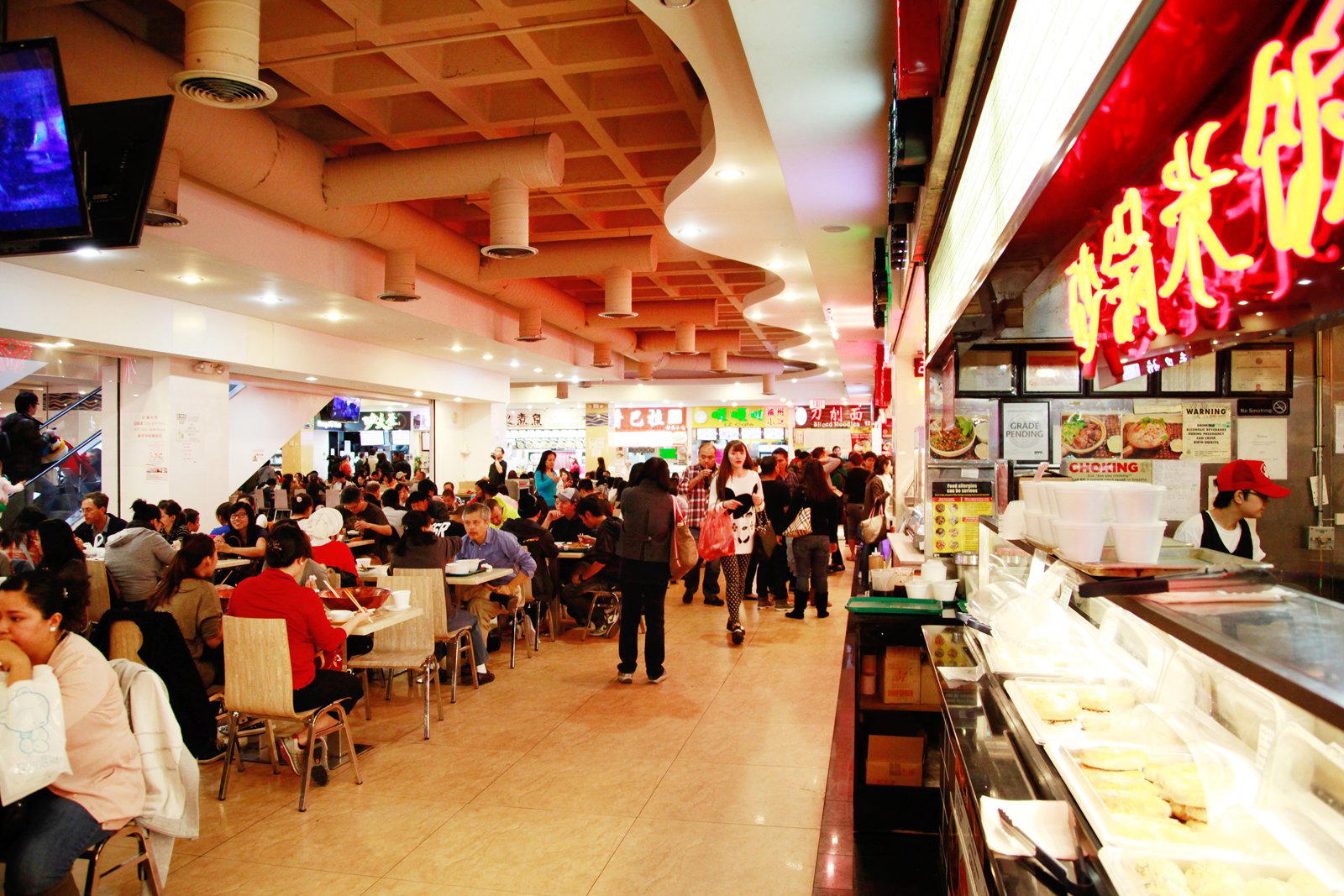
New World Mall in Flushing, Queens, draws crowds from across the New York metropolitan area for one of the city's most concentrated collections of regional Chinese food stalls. Located at 136-20 Roosevelt Ave, the food court basement operates as an informal community hub where Cantonese, Shanghainese, and Sichuan vendors share close quarters. It occupies a different register than Manhattan's fine-dining corridor, but no less seriously in terms of culinary range.

Pearl is the En Primeur Club membership app, where members save venues, book tables and use the concierge.
The menu
What to order
- Lamb Knife-Cut Noodles
- Pan-Fried Pork Buns
- Salt and Pepper Chicken
- Hong Kong Style Egg Tart
- Beef Pulled Noodle
What Flushing's Food Court Tells You About New York Dining
Step down into the basement level of New World Mall on Roosevelt Avenue and the city's fine-dining conversation, the tasting menus, the sommelier selections, the sixty-day advance reservations, recedes entirely. What replaces it is something older and, in many ways, more demanding: a food court where stall operators have been competing for the same regulars for years, and where quality is enforced not by critics but by daily foot traffic. Flushing has long operated as one of the most self-sufficient culinary ecosystems in the New York metropolitan area, and New World Mall sits at the center of that ecosystem's most concentrated expression.
The broader context matters here. Manhattan's premium dining tier, venues like Le Bernardin, Eleven Madison Park, and Masa, competes internationally on reputation, price, and critical recognition. The Flushing food court operates by entirely different rules: proximity to a community, speed of service, regional specificity, and the compounding loyalty of repeat customers who know exactly which stall makes the version of a dish they grew up eating. Both tiers are serious. They simply have different metrics.
The Occasion Case for Flushing
Milestone meals don't always require white tablecloths. A significant portion of the celebrations that happen at New World Mall are family occasions, Lunar New Year gatherings, post-graduation lunches, weekend dim sum rituals that have repeated for a decade across three generations. The food court format, which might initially read as casual or incidental, actually accommodates large groups more gracefully than most Manhattan restaurants. Tables can be combined, dishes arrive in waves rather than orchestrated courses, and the communal nature of Chinese dining traditions maps directly onto the environment.
This is worth stating plainly: for certain occasions, particularly those involving extended families with members spanning different age groups and dietary habits, a well-stocked food court in Flushing solves problems that a single-concept tasting menu cannot. The range of regional Chinese cooking available under one roof means that grandparents, children, and adventurous eaters in their thirties can all find something that suits them without compromise. Compare that flexibility to the fixed-format menus at Per Se or Atomix, where the kitchen, not the table, sets the pace and direction of the meal.
Regional Range and What It Signals
The food court model in Flushing developed alongside successive waves of immigration from mainland China, Hong Kong, and Taiwan from the 1980s onward. New World Mall, which opened in the 2010s, represents the more recent, larger-scale iteration of a format that older Flushing markets had already proved viable. The mall's food court draws vendors across a wide regional spectrum: Cantonese roast meats, Shanghainese soup dumplings, Sichuan cold noodles, Fujianese fish balls, Taiwanese bubble tea, and Northeastern Chinese lamb skewers occupy adjacent stalls in a way that would be geographically impossible in China itself.
That compression is the editorial point. New York's Chinese diaspora community is large enough and diverse enough to sustain authentic regional specificity at scale, something that distinguishes New York's Flushing from Chinese food courts in smaller American cities, where the market demands a more generalized, pan-Chinese approach. For the diner planning a special occasion meal built around discovery rather than ceremony, Flushing offers a depth of regional variation that very few dining destinations in the United States can match. Places like Blue Hill at Stone Barns in Tarrytown or Single Thread Farm in Healdsburg build their reputations on sourcing depth and seasonal specificity; Flushing builds its on community depth and regional specificity. The principle is the same.
How This Compares Across American Cities
New York's Chinese food court scene in Flushing has counterparts, notably in Los Angeles's San Gabriel Valley and Houston's Chinatown, but few match the density and transit accessibility of the Roosevelt Avenue corridor. Getting to Flushing from Midtown Manhattan takes roughly 30 to 40 minutes on the 7 train, which runs directly to the Main Street-Flushing station, a few blocks from the mall. That accessibility is meaningful for occasion planning: a group coming from different parts of the city can coordinate on the subway rather than renting multiple cars or managing parking.
For comparison, venues like Providence in Los Angeles or Addison in San Diego require car access as a baseline assumption. Lazy Bear in San Francisco, Smyth in Chicago, and Frasca Food and Wine in Boulder each serve a particular kind of occasion diner, one who has pre-committed to a specific format and price point. New World Mall serves a different one: the group that wants maximum flexibility, regional breadth, and the option to order four dishes or fourteen depending on who shows up. Even relative to international reference points like Dal Pescatore in Runate or Atelier Moessmer Norbert Niederkofler in Brunico, the Flushing food court represents a structurally different but equally intentional dining proposition.
Planning a Visit
Weekend afternoons draw the largest crowds, particularly on Saturdays between noon and 3pm, when the food court functions as a community gathering point as much as a dining destination. Weekday lunches offer shorter waits and the same vendor selection. There is no reservation system at individual stalls, seating is first-come, first-served, and tables turn quickly given the format. Groups larger than six may find it useful to arrive slightly off-peak or to split into smaller units while one person holds a table.
The mall is accessible via the 7 train to Main Street-Flushing, with the entrance on Roosevelt Avenue. For occasion diners accustomed to the formality of Manhattan's fine-dining corridor, the absence of booking infrastructure is the main adjustment. Everything else, the quality ceiling, the regional breadth, the potential for a genuinely memorable shared meal, is already in place. For more on where New World Mall fits within the broader New York dining picture, see our full New York City restaurants guide. Comparable occasion formats in other cities include Emeril's in New Orleans and The Inn at Little Washington, both of which take a different approach to the same question of what makes a meal feel like an event.
Quick reference: New World Mall food court, 136-20 Roosevelt Ave, Flushing, NY 11354. Accessible via the 7 train to Main Street-Flushing. No reservations. Walk-in only.
Frequently asked questions
How do I find New World Mall?
New World Mall is located at 136-20 Roosevelt Ave, Flushing, NY 11354, New York City.
Is New World Mall worth visiting from Manhattan for a group meal?
For groups seeking genuine Chinese regional breadth in a communal setting, the trip from Manhattan, roughly 30 to 40 minutes on the 7 train to Flushing-Main Street, puts 136-20 Roosevelt Avenue within practical range. The no-reservation format works in a group's favor at off-peak hours, when multiple seats are easier to consolidate. Few comparable concentrations of regional Chinese cooking exist within New York City limits.
What do regulars order at New World Mall?
Regulars at the Roosevelt Avenue food court prioritize dishes made to order rather than pre-cooked batch items: freshly folded dumplings, hand-pulled noodles, and preparations that depend on live technique. The logic is practical, stalls that require active preparation tend to turn over fresh product faster, which is especially relevant during the Saturday and Sunday peak hours when foot traffic is highest.
How hard is it to get a table at New World Mall?
There are no reservations and no waitlist. On Saturday and Sunday between noon and 3pm, the basement food court at 136-20 Roosevelt Avenue fills quickly, and finding a free seat requires patience or timing your arrival before the midday rush. Weekday visits are considerably more manageable.
What's New World Mall best at?
The food court's clearest credential is regional concentration: it brings together cooking traditions from mainland China, Hong Kong, and Taiwan in a single basement space, a range that developed alongside successive immigration waves from the 1980s onward. Few comparable food courts in American cities match that breadth in a single address, with the closest counterparts found in Los Angeles's San Gabriel Valley and Houston's Chinatown.
Is New World Mall good for vegetarians?
Vegetarian options exist across multiple stalls given the span of Chinese regional cuisines represented at the Flushing food court, but availability varies by vendor and is not uniform. Arriving with flexibility rather than a fixed target dish is the more reliable approach.
Cost and Credentials
Comparable venues nearby, for context on price, style, and recognition.
| Venue | Cuisine | Price | Notes |
|---|---|---|---|
| New World MallThis venue (the venue you are viewing) | Authentic Asian Food Court - Chinese, Taiwanese, Sichuan, Korean, Vietnamese | $10–20 | Not listed |
| Xi'an Famous Foods 西安名吃 | Upper East Side 78th&2nd | Authentic Xi'an Chinese Noodles | $10–20 | Upper East Side-Lenox Hill-Roosevelt Island, Authentic Xi'an Chinese Noodles |
| Hop Lee | Traditional Cantonese Chinese | $20–30 | Chinatown, Traditional Cantonese Chinese |
| Nom Wah Tea Parlor | Hong Kong-Style Dim Sum | $20–30 | Chinatown-Two Bridges, Hong Kong-Style Dim Sum |
| Joe's Steam Rice Roll | Cantonese Steamed Rice Rolls | $10–20 | Upper West Side (Central), Cantonese Steamed Rice Rolls |
| Evergreen On 38 | Shanghainese & Szechuan with Dim Sum | Not listed | Midtown-Times Square, Shanghainese & Szechuan with Dim Sum |
Continue exploring
More in New York City
Restaurants in New York City
All restaurants in New York City →
Bars in New York City
All bars in New York City →




Details
- Lively
- Energetic
- Group Dining
- Casual Hangout
- Family
- Open Kitchen
- A La Carte
- Counter Dining
- Family Style
- Vegetarian Friendly
Somewhat drab but dizzying space with bright signs, cluttered walls, and the aroma of chili oil; chaotic and energetic atmosphere that feels authentically lived-in.