

1 Michelin Star
Our verdict
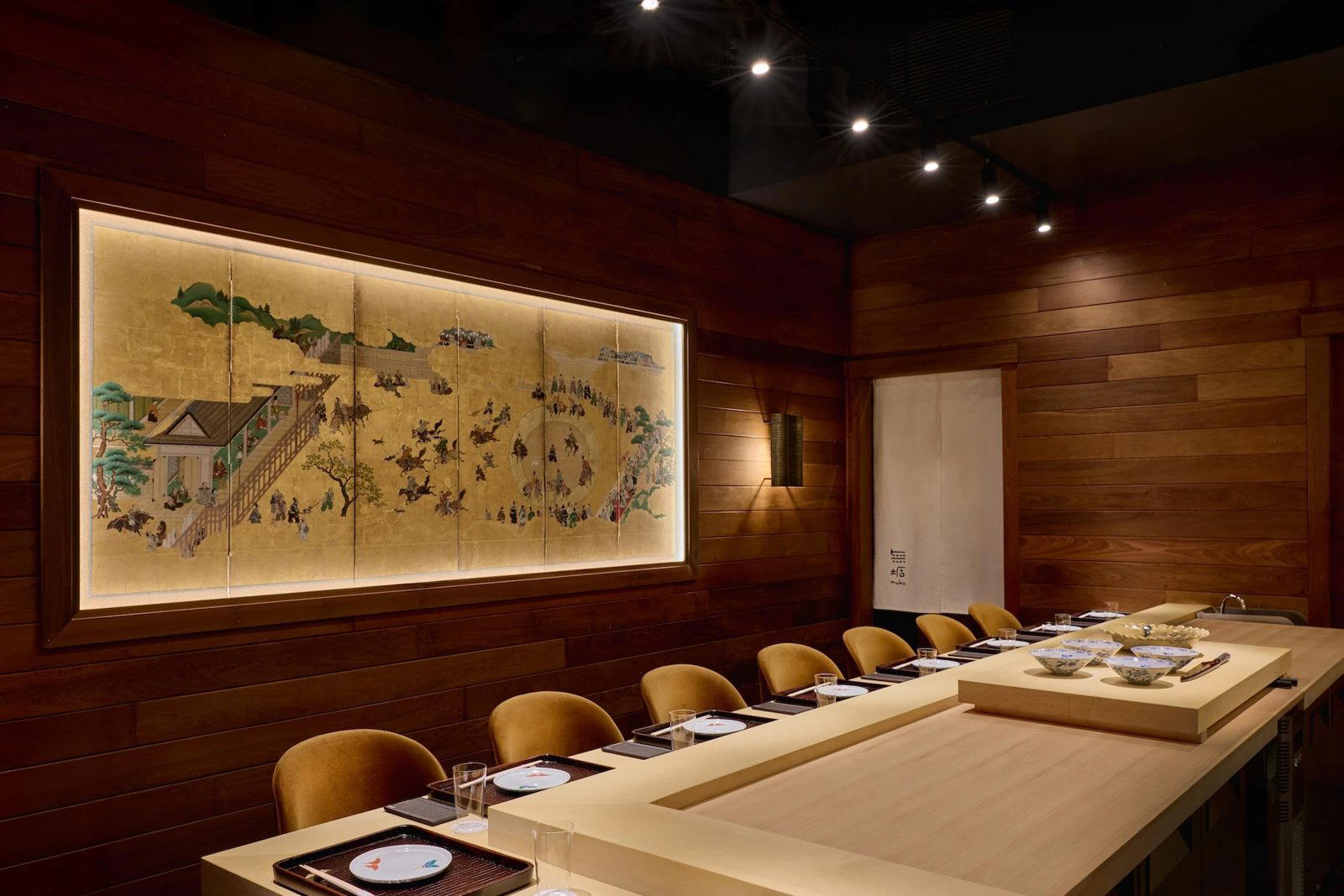
Muku is a kaiseki-inspired counter in TriBeCa holding around ten seats, where the menu is structured around goho, the Japanese rule of five cooking techniques. Seasonality drives every course, from wagyu shabu shabu to housemade soba noodles milled from the chef's hometown buckwheat. Michelin recognition confirms its position inside New York's most demanding tier of Japanese fine dining.

Pearl is the En Primeur Club membership app, where members save venues, book tables and use the concierge.
The menu
What to order
- Handmade soba
- Foie gras chawanmushi
- Hairy crab
Where TriBeCa Meets Japanese Precision
The kaiseki tradition that migrated from Kyoto's tea ceremony culture to New York's fine-dining circuit has, over the past decade, fractured into two distinct camps: the grand, hotel-backed expressions with century-deep Japanese provenance, and the smaller, chef-driven counters that absorb that discipline and apply it with a degree of personal and locational specificity. Muku, occupying a penthouse address on Greenwich Street in TriBeCa, sits firmly in the second category. The counter holds roughly ten seats, a format that Japanese fine dining has long favoured as the condition under which precision at every course becomes operationally possible. At this scale, the room is not incidental to the food; it is the mechanism by which the food gets delivered the way it needs to be.
TriBeCa has historically provided cover for exactly this kind of quiet ambition. The neighbourhood lacks the Midtown foot traffic that sustains the city's large-format dining flagships, Le Bernardin, Per Se, Eleven Madison Park, and as a result, a penthouse counter of ten seats is viable here in a way it might not be elsewhere. The address signals something before a single dish arrives: this is a destination, not a walk-in.
The Architecture of Five
Muku's organizing principle is goho, the Japanese rule of five, which assigns five distinct cooking techniques to the structure of a meal: raw, grilled, simmered, steamed, and fried. This is not a stylistic flourish. Goho is a framework with deep roots in Japanese culinary philosophy, predating the modern kaiseki form, and using it as a menu architecture is a commitment to showing range as part of the concept rather than as an incidental property. It places Muku in a tradition that treats technique itself as content, a different proposition from the European tasting-menu model where a chef's palate or a single product category drives the sequence.
Across the American fine-dining scene, menus that reach for Japanese structural frameworks tend to present them in one of two ways: as an aesthetic filter over otherwise Western-trained technique, or as a genuine operating system. The Michelin guide's recognition of Muku is relevant here, because it indicates the latter, that the kitchen's command of those five techniques reads as coherent and accomplished rather than borrowed. That recognition also places Muku in a specific peer tier: New York has a handful of Japanese-tradition counters with Michelin standing, including Masa, which prices at the very best of the market, and the city's growing cohort of modern Korean tasting rooms such as Atomix, which operate along structurally analogous lines. Muku's counter format and seasonal emphasis make it legible against all of these references.
Seasonality as Method, Not Marketing
In kaiseki cooking, seasonality is not an ingredient-sourcing preference but an organising discipline: the calendar dictates the menu, and the menu reflects specific seasonal moments with precision. This is why kaiseki counters are among the most demanding formats for a kitchen team to sustain. The menu cannot be amortised across a year; it must be rebuilt, course by course, as produce windows open and close. The result, when the system is working, is a kind of temporal specificity, dishes that are possible only now, in this week's market, at this point in the season.
At Muku, that discipline is visible in the sourcing. Soba noodles made from buckwheat milled from the chef's hometown are the kind of detail that signals supply-chain depth rather than convenience. Shabu shabu using Japanese wagyu, structured around a broth described in Michelin's own notes as deeply flavoured, sits within the simmered category of the goho framework, where temperature, time, and liquid composition define the outcome more than the protein alone. The dessert course, diced crown melon with sake lees ice cream and honeydew soda foam, served alongside smoked green tea, places Japan's most freighted luxury fruit at the conclusion of a meal that has earned it through structural rigour.
The Room and the Service Dynamic
The ten-seat counter format fundamentally changes what front-of-house can do. At this scale, the division between kitchen team, sommelier, and service staff collapses into something closer to a single rehearsed ensemble. The guest at a counter of this size receives not a scripted rotation of staff but a sustained read from a team that has tracked the meal from the first course. In the kaiseki tradition, this is the expected condition: service is meant to anticipate rather than respond, and a small counter is the only format in which that anticipation is operationally achievable night after night.
This team-as-ensemble model distinguishes Muku from the larger-footprint Japanese dining experiences operating in New York, and brings it closer, in operational philosophy if not in cuisine, to comparison counters elsewhere in the country: Single Thread Farm in Healdsburg, where agriculture and kitchen and dining room function as a continuous system, or Lazy Bear in San Francisco, where counter proximity and team coordination define the format. Internationally, the dynamic finds parallels at properties like 8 1/2 Otto e Mezzo Bombana in Hong Kong, where the space constrains the operation into a tighter, more focused form. The point is not that these places are interchangeable, but that the small counter as a concept generates a predictable set of service conditions, and Muku is, by most indications, delivering on those conditions.
Where Muku Sits in New York's Japanese Fine-Dining Tier
New York's Japanese fine-dining scene has matured considerably since the early 2000s, when a small number of omakase and kaiseki counters operated in relative isolation. The city now supports a layered market: entry-level omakase at fifty to eighty dollars, mid-tier counters with seasonal menus and light Michelin attention, and a top tier where per-person spend crosses several hundred dollars and reservations run months out. Masa anchors the extreme upper bracket. Muku, with its Michelin standing and ten-seat structure, operates in the market layer just below that extreme, pricing against format peers rather than against the broader restaurant market. For readers already familiar with the category, this is the tier where the work is often most interesting, because the ambitions are large and the safety net of institutional scale is absent.
For a broader sense of how New York's restaurant scene maps across cuisines and price points, our full New York City restaurants guide covers the full range. If you are planning around a longer stay, our New York City hotels guide, bars guide, wineries guide, and experiences guide provide the wider editorial context.
For those building a cross-country itinerary around fine dining at this level, comparable ambition in different forms can be found at Alinea in Chicago, Providence in Los Angeles, The French Laundry in Napa, Emeril's in New Orleans, and at the European reference point for multi-generational fine dining, Alain Ducasse at Louis XV in Monte Carlo.
Planning Your Visit
Muku is located at 412 Greenwich Street, Penthouse B, in TriBeCa. The counter holds around ten seats, which means availability is genuinely constrained and advance planning is necessary. Given the Michelin recognition and the format, this is not a same-week reservation for most dates.
Quick reference: 412 Greenwich St, Penthouse B, TriBeCa, New York. Ten-seat counter. Michelin-recognised. Advance reservation required.
Frequently asked questions
What do regulars order at Muku?
The menu at Muku is structured around goho, five cooking techniques applied across a kaiseki-inspired sequence, so there is no single dish to order independently. Returning guests tend to anchor their expectations around the soba noodles, made from buckwheat sourced from the chef's hometown, and the wagyu shabu shabu, which Michelin's notes describe as built around a deeply flavoured broth. The dessert course, pairing crown melon with sake lees ice cream and smoked green tea, has drawn specific mention in Michelin's coverage and represents the meal's conclusion. Because seasonality governs the menu, what appears on any given visit will shift; the cuisine and structural framework remain constant while the specific dishes do not.
Do I need a reservation for Muku?
At a ten-seat counter with Michelin recognition in New York, a city where comparable formats such as Masa operate on allocation lists months in advance, booking ahead is not optional in practice. The smaller the counter and the stronger the awards standing, the longer the lead time required. If you are planning around a specific date, contact the venue well in advance. Walk-in availability at this format tier in New York is effectively zero on desirable dates.
What It’s Closest To
| Venue | Cuisine | Price | Awards | Notes |
|---|---|---|---|---|
| MukuThis venue (the venue you are viewing) | Modern Kaiseki | $200–300 | 1 Michelin Star | Not listed |
| Le Bernardin | French Seafood Fine Dining | $300–500 | 3 Michelin Stars · World's 50 Best #13 | French, Seafood |
| Atomix | Modern Korean Tasting Menu | $300–500 | 2 Michelin Stars · World's 50 Best #7 | Modern Korean, Korean |
| Masa | Seasonal Hokkaido Tempura Omakase | $150–200 | Tabelog 100 #34 | Sushi, Japanese |
| Per Se | French Fine Dining Tasting Menu | $300–500 | 3 Michelin Stars · World's 50 Best #40 | French, Contemporary |
| Eleven Madison Park | Contemporary Plant-Based Fine Dining | $300–500 | 3 Michelin Stars · World's 50 Best #4 | French, Vegan |
Recognition history
Dated appearances from independent guides and award organizations, with the underlying list record or original source where available.
Michelin 1 Star
Michelin
Opinionated About Dining Top Restaurants in North America Recommended
Opinionated About Dining
Muku
Featured Guides
Continue exploring
More in New York City
Restaurants in New York City
All restaurants in New York City →
Bars in New York City
All bars in New York City →




Details
- Intimate
- Elegant
- Serene
- Sophisticated
- Minimalist
- Date Night
- Special Occasion
- Chefs Counter
- Sake Program
- Local Sourcing
- Tasting Menu
- Sake Program
Current opening hours
- Monday
- Closed
- Tuesday
- 5:30–11:30 PM
- Wednesday
- 5:30–11:30 PM
- Thursday
- 5:30–11:30 PM
- Friday
- 5:30–11:30 PM
- Saturday
- 5:30–11:30 PM
- Sunday
- Closed
Hours can change for holidays and private events. Hours as of .
Refined, tranquil, and warmly hospitable with tsuchikabe walls, a handsome 10-seat counter, serene mountain inn-like atmosphere, and elegant presentation that feels like dining in Japan.