Our verdict
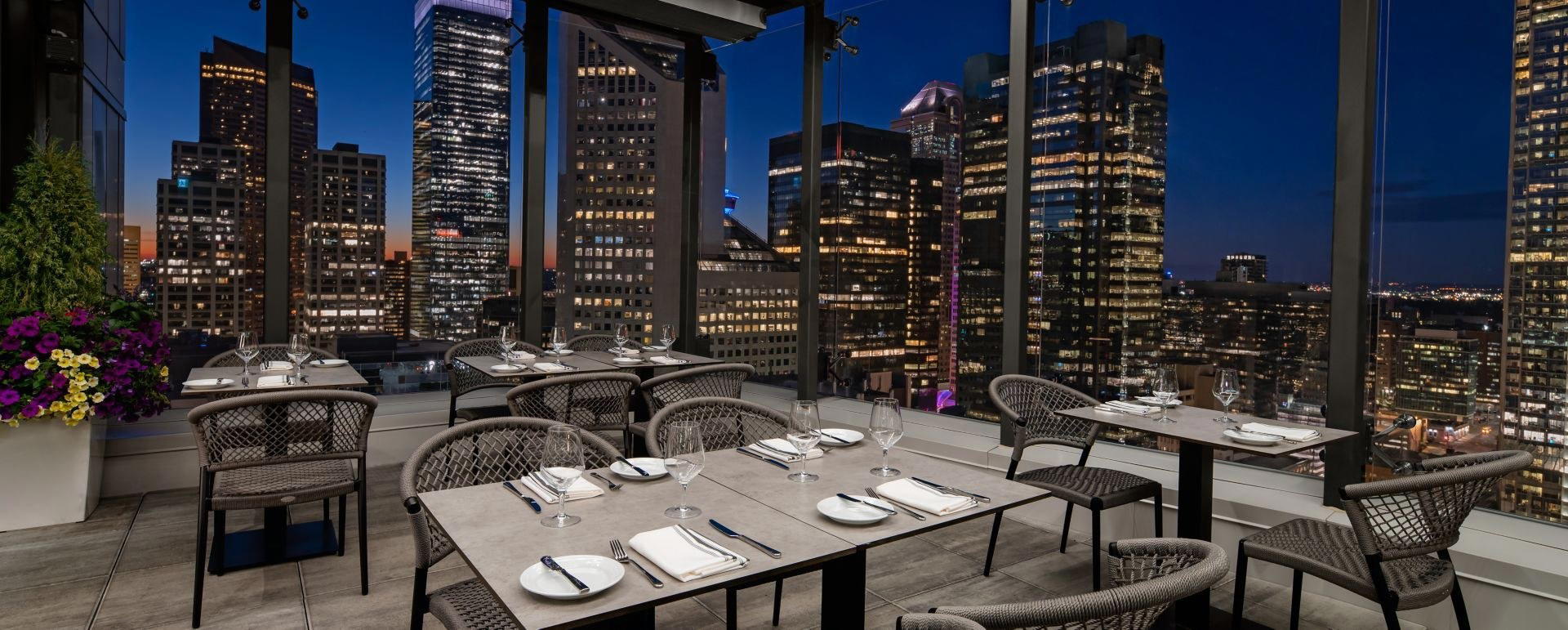
Mercato West operates in Calgary's southwest, where the city's appetite for market-style dining meets a growing interest in locally sourced ingredients handled with technical precision. The address places it inside a commercial corridor that has quietly drawn serious food operators away from the downtown core, making it a useful marker for understanding where Calgary's dining energy is shifting.

Pearl is the En Primeur Club membership app — saves, bookings, and concierge access live there. Same editors, same standards.
Where Calgary's Southwest Dining Scene Is Heading
Calgary's restaurant geography has been redrawn over the past decade. The downtown core, long the gravitational centre for serious dining, now competes with commercial nodes in the southwest and northwest quadrants, where newer operators have found lower overhead and a residential catchment with disposable income and genuine food curiosity. The corridor along 85th Street SW represents one of these emerging clusters: not a traditional dining neighbourhood in the European sense, but a mixed-use zone where market-format and casual-premium operators have taken root alongside the usual suburban retail. Mercato West sits inside that pattern, and understanding it requires understanding the shift first.
The market-hall model — a format borrowed from European and North American urban precedents, where multiple food concepts share a single roof or retail shell — has gained ground in Canadian cities over the past fifteen years. Calgary's dining scene has absorbed this format selectively, and the southwest has been a more receptive host than the downtown, where real estate pressure tends to compress formats toward either fast-casual or high-ticket tasting menus with little room for the middle register. Mercato West occupies that middle register, which in Calgary's current market is neither obvious nor easily sustained.
Local Ingredients, Imported Frameworks
The more interesting editorial question for any Calgary restaurant in this category is how it positions itself relative to the Alberta larder. The province's ranching heritage gives any serious kitchen access to beef that competes on quality with anything raised in the American Midwest, and the agricultural corridor running north and south of Calgary produces grains, pulses, and seasonal produce that a technically trained kitchen can do real work with. The gap, historically, has been on the technique side: Alberta cooking culture leaned toward hearty and familiar long after coastal cities had absorbed French brigade discipline, Japanese knife culture, and the fermentation-forward instincts of Scandinavian-influenced New Nordic cooking.
That gap has been closing. The generation of cooks now running Calgary kitchens trained in Vancouver, Toronto, and increasingly abroad, bringing back frameworks, precise sauce work, house-cured programs, fermentation protocols, and applying them to ingredients that their coastal peers would have to import. The result, at its finest, is a cuisine that reads as confidently Canadian without performing either nationalism or nostalgia. Peers in this conversation include Alloy, which has long operated at the intersection of classical technique and local sourcing, and newer arrivals like Aloha Modern Kitchen, which applies Pacific-influenced methods to Alberta produce. Mercato West enters this conversation through a market-format lens, where the sourcing story is often more visible to the diner than in a conventional restaurant setting.
Nationally, this approach has its most developed expression in Quebec, where Tanière³ in Quebec City and Narval in Rimouski have demonstrated how deeply a kitchen can engage with regional ingredients when the sourcing infrastructure and culinary ambition align. Ontario has its own version of this conversation at places like Eigensinn Farm in Singhampton and Restaurant Pearl Morissette in Lincoln, where the farm-to-table relationship is literal rather than rhetorical. Calgary's contribution to this national pattern is still forming, and market-format operators like Mercato West are part of that formation.
The Southwest Commercial Corridor in Context
The 85th Street SW address places Mercato West in a zone that functions differently from Calgary's established dining precincts. Inglewood, Kensington, and the 17th Avenue strip each carry their own dining identity, built over decades of incremental operator investment. The southwest commercial corridors are newer, more car-dependent, and oriented toward a residential base rather than a walk-in urban crowd. This shapes what works: formats that reward a deliberate visit rather than a spontaneous drop-in, and price points that reflect suburban overhead rather than downtown real estate. It also means that operators in this zone compete less directly with each other and more with the gravitational pull of established precincts closer to the city centre.
For the diner, the practical implication is planning. A visit to Mercato West is not a detour from another Southwest errand so much as a destination decision, which is worth factoring into how you approach the booking. Pairing it with a broader southwest afternoon, or combining it with other operators in the corridor, makes geographic sense in a way that a standalone trip from the northeast might not. Alforno Eau Claire and Annabelle's Kitchen Downtown serve a different quadrant of the city, but they illustrate the same pattern: Calgary's serious food operators are now distributed across the urban fabric rather than concentrated in one or two precincts.
Calgary in the Canadian Fine-Dining Conversation
It is worth situating Calgary's dining ambitions within the broader Canadian context, because the city is often read as a secondary market relative to Toronto, Vancouver, and Montreal. That reading is increasingly outdated. The restaurant infrastructure that supports serious cooking, skilled cooks, knowledgeable front-of-house staff, an audience willing to pay for precision, has matured significantly over the past decade. Alo in Toronto and AnnaLena in Vancouver represent the benchmark tier in their respective cities, and Calgary's gap to that benchmark has narrowed. The market-format model, which Mercato West represents, is one of several formats driving that convergence: it lowers the barrier to entry for skilled operators and creates visible sourcing stories that build audience trust over time.
Other reference points in the national conversation include Jérôme Ferrer's Europea in Montreal, where classical French training anchors a locally inflected menu, and Aux Anciens Canadiens in Quebec, which demonstrates how deep a cuisine can run when it commits fully to regional tradition. Calgary's version of this commitment is still being written, and operators in the southwest corridor are among those writing it. For visitors approaching Calgary from an international frame, the useful comparisons are less with New York references like Le Bernardin or Atomix and more with the mid-tier Canadian operators who have built credible, ingredient-forward programs without the institutional support of a major coastal food media establishment.
Planning a Visit
The 85 St SW address is most accessible by car, consistent with the suburban commercial format of the surrounding area. Public transit options exist but require connections that add meaningful time from the city centre, so most visitors arriving from downtown or the northeast will find driving the practical default. Given the market-format nature of the space, timing around peak weekend hours is worth considering: market-format venues in Canadian cities tend to concentrate their highest traffic in the late morning through early afternoon window on Saturdays and Sundays, and the experience at off-peak times is meaningfully different. For diners who want to engage with the sourcing story at a pace that allows conversation and selection, a weekday visit or an early weekend arrival tends to reward more than arriving mid-Saturday.
For further orientation across Calgary's dining scene, including coverage of established operators and newer entrants across all city precincts, A Certain Flair Catering at Lougheed House offers a different register of Calgary hospitality, while our full Calgary restaurants guide maps the broader picture across neighbourhoods and price tiers. Barra Fion in Burlington and The Pine in Creemore provide comparative reference points for how mid-sized Canadian cities are handling the local-ingredients-global-technique question outside the major metros.
Frequently asked questions
Where is Mercato West in Calgary?
Mercato West is located at 873 85 St SW #5000, Calgary, AB T3H 0K6, Canada, Calgary.
Is Mercato West a good option for a business dinner in Calgary's southwest?
Located at 873 85 St SW in a suburban commercial format, Mercato West is positioned to serve Calgary's growing west-side professional and residential population. The address suits guests arriving by car, which is consistent with the corridor's infrastructure. For a business dinner, confirming current private or semi-private seating arrangements directly with the venue is the practical first step.
What's the must-try dish at Mercato West?
Given its position in Calgary's southwest dining corridor at 85 St SW, the kitchen's approach to Alberta-sourced ingredients is worth probing when you visit. Ask staff directly about current seasonal focus, as that will tell you more about the kitchen's priorities than any fixed recommendation.
How far ahead should I plan for Mercato West?
Booking lead times for Mercato West have not been formally documented in available dining guides. Restaurants in Calgary's southwest commercial zone at 85 St SW tend to draw a loyal local crowd, particularly on weekends, so contacting the venue directly before your intended date is advisable. Prime Friday and Saturday sittings in this category typically warrant at least a week's notice.
What do critics highlight about Mercato West?
Formal critical coverage of Mercato West in named publications has not been indexed publicly to date. Within Calgary's dining conversation, the southwest corridor represented by addresses like 85 St SW is increasingly discussed as a counterpoint to the downtown-centric restaurant map that defined the city a decade ago. Mercato West's position in that shift is the more relevant editorial frame than any individual review.
Credentials Lens
| Venue | Cuisine | Price | Awards | Notes |
|---|---|---|---|---|
| Mercato WestThis venue — the venue you are viewing | Rustic Italian | Not listed | Not listed | Not listed |
| Pigeonhole | Modern Canadian Small Plates | $50–100 | Not listed | New Canadian |
| Ten Foot Henry | Modern Vegetable-Forward Fusion | $50–100 | Not listed | New Canadian |
| The River Café | Seasonal Canadian Fine Dining | $50–100 | La Liste Top Restaurants · Wine Spectator Best of Award of Excellence | Tuscan |
| EIGHT | Modern Canadian Tasting Menu | $300–500 | World's 50 Best #2 · Canada's 100 Best Restaurants #9 | Not listed |
| Pizza Culture | Authentic Neapolitan Pizza | $20–30 | 50 Top Pizza World #80 | Not listed |