Ma•dé
.png)
A Michelin Plate-recognised South East Asian address on Spring Street in SoHo, Ma•dé operates at a price tier well below New York's starred omakase counters yet draws consistent critical attention for its approach to regional Southeast Asian cooking. With a 4.4 Google rating across 158 reviews, it holds a firm position among the neighbourhood's more considered mid-range options. Booking ahead is advisable.
 Discover on Pearl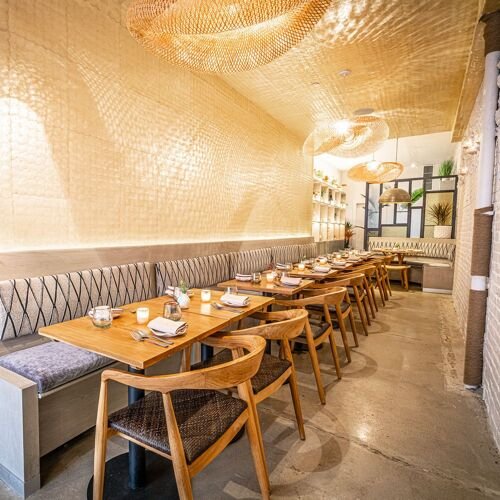
SoHo's Southeast Asian Counter in Context
The Southeast Asian dining category in New York has never been monolithic. At one end sit the Chinatown and Flushing canteens where regional fidelity and price accessibility define the offer. At the other end, a smaller cohort of chef-driven rooms applies classical technique to the flavour profiles of Thailand, Vietnam, Indonesia, and Malaysia, pricing against mid-to-upper-market American and European contemporaries rather than neighbourhood takeout. Ma•dé, on Spring Street in SoHo, occupies that second tier. Its 2025 Michelin Plate recognition places it inside a specific quality threshold: kitchens the Guide considers worthy of attention without yet awarding a star. In New York's increasingly crowded Southeast Asian fine-casual space, that credential carries weight.
The address itself signals something. SoHo's restaurant ecosystem has shifted over the past decade from fashion-adjacent casual dining toward more serious, chef-focused rooms. The neighbourhood now runs a credible range from approachable Italian to Japanese omakase, and an ambitious Southeast Asian room fits that evolution. Ma•dé's Spring Street location puts it within walking distance of Nolita and the lower edge of the Village, drawing a clientele that moves across the city's mid-range and upper-mid dining circuit. For context on how the broader New York dining scene is structured, see our full New York City restaurants guide.
How the Meal Moves
Southeast Asian cooking, at its most structured, operates as a progression of contrasting registers: something bright and acidic to open, followed by richer, aromatic middle courses built on layered spice pastes, then a close that is simultaneously sweet and herbal. When a kitchen applies that logic with discipline, the meal reads as a coherent arc rather than a collection of dishes. This is the framework through which Ma•dé's approach makes the most sense.
The $$$ price range positions it below the $$$$ tier occupied by New York's fully starred rooms. Comparative reference points in that upper bracket include Atomix, which applies similar multi-course discipline to Korean cooking at a considerably higher price point, and Eleven Madison Park, where the tasting format has become its own genre. Ma•dé operates with fewer structural constraints than either: the Southeast Asian format allows more lateral movement across regional traditions within a single sitting, and the price tier permits a less ceremonial pace.
The opening register in Southeast Asian tasting formats typically works with raw or lightly cured proteins, citrus-based dressings, and fresh herbs that function as palate primers rather than statements. The kitchen's ability to calibrate acidity and heat in these early courses sets the terms for what follows. Middle courses in this tradition carry the deepest complexity, where the slow-cooked curries, braised proteins, and fermented condiments that define the region's pantry do the structural work. The close, whether a dessert rooted in coconut milk and palm sugar or something that cuts across expectations, functions as resolution rather than afterthought.
At Ma•dé's price point within SoHo, the comparison set is not the starred French rooms on the west side. The relevant peer group is the smaller collection of non-European mid-range rooms that have secured Michelin recognition in recent cycles: kitchens doing serious regional cooking without the formal architecture of a full tasting counter. That peer group is growing in New York, particularly in the Korean, Japanese, and now Southeast Asian categories.
The SoHo Position and What It Implies for the Diner
A restaurant operating at the $$$ tier with a Michelin Plate in SoHo is pricing against a neighbourhood average that skews toward casual Italian and American rooms. The implication for the diner is that Ma•dé is neither a budget option nor an occasion-dining splurge in the mould of Le Bernardin, Per Se, or Masa. It occupies the productive middle ground where serious cooking is accessible without the ritual of a full-dress, multi-hundred-dollar commitment.
For travellers building a New York itinerary around diverse dining, that positioning matters. A meal at Ma•dé can sit alongside a night at a $$$$ starred room without redundancy, because the register and cuisine tradition are entirely different. Southeast Asian cooking at this level offers a counterweight to the French and Japanese formats that dominate New York's upper tiers. Internationally, the Southeast Asian fine-dining category has produced notable work at rooms like Farang in Stockholm and Chuan Kitchen in Pak Kret, each of which contextualises regional tradition differently depending on local audience. New York's version of the format, of which Ma•dé is a current example, tends to address an audience already familiar with the source cuisines and expecting precision rather than introduction.
The Google rating of 4.4 across 158 reviews is a useful data point. At this volume of reviews, the score reflects a settled consensus rather than early-adopter enthusiasm. A 4.4 at 158 reviews is more reliable than a 4.8 at 23, and it signals consistent execution rather than occasional brilliance.
Domestically, the closest analogues in ambition and format at this price tier sit in other major American dining cities. Lazy Bear in San Francisco and Alinea in Chicago operate at higher price points with more theatrical formats; Providence in Los Angeles and The French Laundry in Napa anchor the West Coast fine-dining circuit. Ma•dé's contribution to the New York version of this conversation is a Southeast Asian frame applied with enough seriousness to earn Michelin's attention, at a price that keeps it in weekly rotation rather than annual occasion territory. Emeril's in New Orleans and Single Thread Farm in Healdsburg represent other regional expressions of chef-driven American dining that reward similar levels of attention to sourcing and sequence.
Planning Your Visit
Ma•dé is located at 22 Spring Street in SoHo, Manhattan. Price tier: $$$ (mid-to-upper mid-range; below the $$$$ bracket of New York's starred tasting menus). Recognition: Michelin Plate 2025, Google rating 4.4 (158 reviews). Booking: Specific booking method not confirmed; given the Michelin recognition and neighbourhood demand, advance reservation is advisable. Hours: Not confirmed at time of publication; verify directly before visiting. Nearby: The Spring Street address places it within easy reach of Nolita, Little Italy, and the broader SoHo gallery and shopping circuit, making it a practical anchor for an afternoon-into-evening itinerary.
For wider New York planning, EP Club maintains guides across categories: hotels, bars, wineries, and experiences.
Frequently Asked Questions
How It Stacks Up
A quick context table based on similar venues in our dataset.
| Venue | Cuisine | Price | Awards | Notes |
|---|---|---|---|---|
| Ma•dé | South East Asian | $$$ | Michelin Plate (2025) | This venue |
| Le Bernardin | French, Seafood | $$$$ | Michelin 3 Star | French, Seafood, $$$$ |
| Atomix | Modern Korean, Korean | $$$$ | Michelin 2 Star | Modern Korean, Korean, $$$$ |
| Masa | Sushi, Japanese | $$$$ | Michelin 3 Star | Sushi, Japanese, $$$$ |
| Per Se | French, Contemporary | $$$$ | Michelin 3 Star | French, Contemporary, $$$$ |
| Eleven Madison Park | French, Vegan | $$$$ | Michelin 3 Star | French, Vegan, $$$$ |
Need a table?
Our members enjoy priority alerts and concierge-led booking support for the world's most difficult tables.
Get Exclusive Access