In Kashgar's Old Town, where the Silk Road's agricultural legacy is still edible, Local Old Town Home offers a grounding point for Uyghur home cooking rooted in the region's distinct ingredient traditions. The setting draws from the residential architecture of the historic quarter, and the food reflects what the surrounding bazaars and farms have produced for centuries. For travelers moving through Xinjiang, it functions as a reliable reference for the cuisine in its least mediated form.

Pearl is the En Primeur Club membership app — saves, bookings, and concierge access live there. Same editors, same standards.
Where the Silk Road Still Shows Up on the Table
Local Old Town Home is a restaurant in Kashgar serving traditional Uyghur home cooking at a casual, walk-in-friendly price tier of about $10 per person. Kashgar sits at the western edge of China, closer to Baghdad than to Beijing, and the city's food has always reflected that geography more than any political cartography. The Old Town district, a dense grid of rammed-earth architecture that has been continuously inhabited for over two millennia, remains one of the few places in China where Central Asian culinary traditions survive in their least diluted form. Lamb from the high Pamir pastures, hand-milled wheat from the Tarim Basin, and cumin grown at altitude rather than imported from elsewhere: these are the raw materials that have defined Uyghur cooking here for centuries, and they remain the defining logic of what Local Old Town Home puts on the table.
That ingredient geography matters more than it might seem. Kashgar sits at the convergence of trade routes that once moved spices, dried fruits, and livestock between the Mediterranean, Persia, India, and China. What remained behind, absorbed into local kitchens rather than traded onward, is a pantry that doesn't map neatly onto any single culinary tradition. The lamb here carries a different flavor profile than the animals raised on lower, warmer plains; the altitude and the wild herbs of the Pamir contribute something to the meat that no marinade can replicate. A kitchen that sources locally in Kashgar is, by default, working with ingredients that carry genuine provenance.
The Old Town as a Dining Environment
Approaching the Old Town from the main bazaar, the streets narrow and the noise of the city drops away. The residential lanes are shaded by timber overhangs, and the smell of bread baking in tandoor ovens registers before any signage does. Local Old Town Home operates within this residential fabric rather than apart from it, which places it in a small category of Kashgar dining that prioritizes immersion in the historic quarter over the accessibility of the newer city districts.
For travelers already covering the Old Town on foot, the venue works as a natural continuation of that experience. Kashgar's tourism infrastructure has developed unevenly; the newer parts of the city have absorbed most of the hotel investment and chain-restaurant activity, while the Old Town has remained more self-contained. Eating here situates the meal within the neighborhood's actual daily life rather than in a version of it produced for visitors. That distinction, in a city where the gap between authentic and reconstructed experience can be significant, carries practical weight.
Ingredient Sourcing as Culinary Argument
Uyghur cooking is built around a relatively concentrated set of core ingredients: hand-pulled noodles from local wheat, lamb prepared in multiple formats, flatbreads from the tandoor, and a spice palette that leans on cumin, black pepper, and dried chili rather than the broader spectrum used in Sichuan or Cantonese cooking. The restraint is structural, not accidental. When the raw materials are this specific to place, elaboration tends to obscure rather than enhance.
The regional comparison is worth making. Across China, premium restaurants in cities like Beijing and Shanghai have invested heavily in sourcing narratives, flying in single-origin ingredients and positioning provenance as a mark of quality. At venues like Xin Rong Ji (Xinyuan South Road) in Beijing or 102 House in Shanghai, the sourcing story is consciously constructed as a differentiator. In Kashgar, that relationship between place and ingredient is simply the baseline. There is no supply chain to construct because the supply chain is the local market, and that market has been operating continuously since the city functioned as a Silk Road waystation.
This is the culinary context that separates Old Town Kashgar from the experiential dining formats common in China's eastern cities. At Chef Tam's Seasons in Macau or Ru Yuan in Hangzhou, the frame is aspirational, drawing on classical traditions and presenting them in formats designed for a contemporary audience. Kashgar's home-style kitchens operate on a different premise: the tradition hasn't required preservation because it hasn't been interrupted. The food at a place like Local Old Town Home draws its authority from continuity rather than recovery.
Placing Kashgar in China's Dining Map
For travelers building an itinerary across China's dining geography, Kashgar represents a genuinely distinct node. The dominant fine-dining conversation in China runs through Cantonese technique, Sichuan heat, and the Shanghai-Beijing corridor of contemporary Chinese cuisine. Venues like Imperial Treasure Fine Chinese Cuisine in Guangzhou, Dai Yuet Heen in Nanjing, and Dingshan·Jiangyan (Xiangcheng) in Suzhou each represent that mainland fine-dining current in their respective cities. Kashgar sits entirely outside that conversation, not as a lesser version of it, but as a parallel track rooted in Central Asian rather than Han Chinese culinary logic.
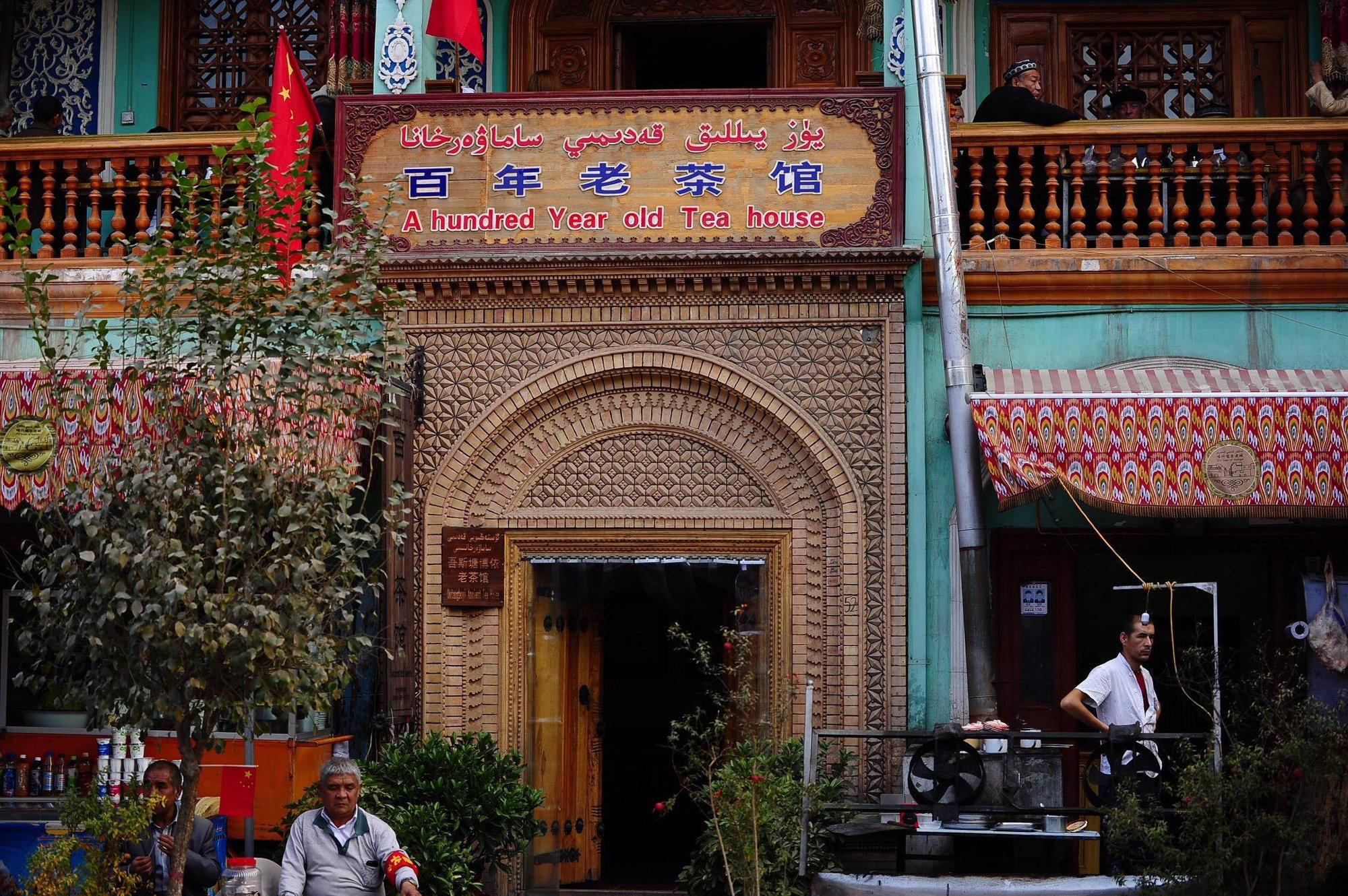
The Old Town itself is walkable, and the main bazaar area provides the geographic anchor for most visitor movement. A Hundred Year Old Tea House nearby offers a useful complement for understanding the social rituals that frame Kashgar's food culture, and
Against that range, Kashgar reads as the furthest outlier, and the restaurant sits at the center of that distinction.
Planning Your Visit
Kashgar's Old Town restaurants typically operate without formal reservation systems, and the home-style format here means that turning up without advance arrangements is the norm rather than the exception. Visiting in the late afternoon through early evening aligns with the neighborhood's natural rhythm and avoids the midday heat that empties the lanes during summer months. Xinjiang observes its own informal time offset from Beijing's official standard, so meal times run later than eastern China equivalents; factoring this in prevents arriving either too early or too late for active service. Flexibility on timing matters more than advance planning, and the experience of walking the surrounding streets before eating adds context.
At-a-Glance Comparison
Comparable venues nearby, for context on price, style, and recognition.
| Venue | Cuisine | Price | Notes |
|---|---|---|---|
| Local Old Town HomeThis venue — the venue you are viewing | Traditional Uyghur Home Cooking | $ | Not listed |
| Meifu Dapanji (美福大盤雞) | Xinjiang Dapanji | $ | Kashgar Old City |
| Altun Orda | Uyghur Cuisine | $$ | Renmin Xi Lu |
| A Hundred Year Old Tea House | Traditional Uyghur Teahouse | $$ | Kashgar Old City |
| 利宏桂林米粉 Li Hong Guilin Rice Noodle | Guilin Rice Noodles | $ | 白沙镇 |
| 余家庄生态鱼 | Chongqing Ecological Fish | $ | Miaoya Township |
At a Glance
- Rustic
- Cozy
- Historic
- Casual Hangout
- Family
- Historic Building
- Street Scene
Cozy and rustic with traditional Uyghur architecture, evoking local family atmosphere amid the historic old city.