

Macarfi 8 Food Rating
Our verdict
One of Madrid's oldest continuously operating restaurants, Lhardy on Carrera de San Jerónimo has anchored the city's traditional dining scene since the nineteenth century. Ranked #144 in Opinionated About Dining's Casual Europe list for 2025, it draws a mix of regulars and first-timers to its Spanish kitchen under chef Ricardo Quintana. Sunday hours run until 4 pm only, so plan accordingly.

Pearl is the En Primeur Club membership app, where members save venues, book tables and use the concierge.
The menu
What to order
- Cocido madrileño
- Callos a la madrileña
- Kidneys in sherry
A Street That Still Takes Lunch Seriously
Carrera de San Jerónimo is one of those Madrid streets where the weight of institutional life is still legible in the architecture. Parliament sits at one end, the old literary cafés have given way to wine bars and hotel lobbies, but Lhardy's shopfront at number eight has remained more or less unchanged in character for longer than most of its neighbours have existed. Walking past, you register it the way you register a well-worn landmark: something about the proportion of the windows and the quietness of the signage signals that this place is not competing for your attention, and never has been.
That restraint is itself a position. Madrid's high-end dining conversation in 2025 runs through tasting-menu addresses like Botín Restaurante and the progressive kitchens clustered around the northern barrios, but the city also holds a parallel track of traditional Spanish restaurants where the format has barely changed across generations. Lhardy occupies an unusually senior position in that track. It is the kind of room where the cooking is inseparable from the building, and the building is inseparable from a particular version of Madrid that predates the capital's current gastronomic celebrity.
The Wine Argument for a Room Like This
Spain's wine culture rewards exactly the kind of patience that a room like Lhardy embodies. Fino and manzanilla, the driest expressions of Sherry, are made for this register of dining: saline, reductive, cold from the fridge, and structurally suited to the stocks, cured products, and braised preparations that define traditional Castilian cooking. A serious Spanish wine education runs through these pairings long before it reaches the showcase bottles of Rioja Reserva or Priorat.
What matters at a restaurant with Lhardy's longevity and institutional character is not the wine list as a document of ambition but as a map of the kitchen's logic. Older Riojas, the kind with bottle age rather than oak-driven extraction, work against slow-cooked dishes in the way that fashionable labels often cannot. The same is true of Galician whites built on Albariño or Treixadura when the kitchen is working with salt cod or shellfish preparations: the acidity functions, the weight matches. Traditional Spanish restaurants of this standing tend to carry wines that reflect this knowledge even when they do not narrate it explicitly.
Spain's sommelier culture has a somewhat different orientation than France's, and is better for it in certain respects. The emphasis falls on regional pairing logic rather than vertical prestige, which makes rooms like this one an instructive counterpoint to the showier end of the city's dining offer. For the travelling drinker building a practical understanding of Spanish wine alongside Spanish food, the case for this category of restaurant is structural, not sentimental.
Where Lhardy Sits in the Madrid Dining Picture
Opinionated About Dining, whose Casual Europe rankings carry significant weight among food-focused travellers and industry professionals, placed Lhardy at #144 in its 2025 European Casual list, up from #183 in 2024 and following a Highly Recommended designation in 2023. That upward trajectory across three consecutive years is the kind of signal that separates a restaurant holding its ground from one that has begun attracting renewed critical attention.
The Madrid restaurant field at the serious end is not short of ambition. Desencaja and Cuenllas represent different contemporary approaches, while the creative tasting-menu tier produces some of Europe's most discussed cooking. But the comparison set that actually frames Lhardy's significance is not the modernist kitchens. It is the question of what traditional Spanish cooking looks like when it is taken seriously at an institutional level over a very long time. In that context, the relevant peers are the handful of Madrid addresses, like Casa Revuelta and El Fogón de Trifón, that anchor traditional format rather than renovate it.
Spanish cuisine's international standing in 2025 is built substantially on its avant-garde tier. El Celler de Can Roca in Girona, Arzak in San Sebastián, Disfrutar in Barcelona, Quique Dacosta in Dénia, and Azurmendi in Larrabetzu are the addresses that generate the most international press. The country's influence has also travelled: ZURRIOLA in Tokyo and Arco by Paco Pérez in Gdańsk demonstrate how far Spanish cooking technique has dispersed globally. But the traditional registers, the cocidos, the braised meats, the long-standing regional preparations, form the substrate from which all of that innovation grew. Lhardy is one of the places where that substrate is still intact and still cooking.
Chef Ricardo Quintana leads the kitchen at a restaurant whose identity long predates any single chef's tenure. That is not a demotion; it is the structural reality of restaurants that function as institutions. The cooking exists within a tradition that imposes its own discipline, and the relevant question for the kitchen is always fidelity and execution rather than authorial expression. That discipline, applied consistently, is what produces the kind of durable critical recognition Lhardy has accumulated across the OAD rankings.
Eating Here: What the Format Asks of You
Lhardy opens at 1 pm daily from Monday through Saturday, closing at midnight, which maps directly onto Madrid's lunch and dinner rhythm. Lunch in this city has not surrendered its primacy to dinner the way it has in northern European capitals, and a room like this one is better understood at 2 pm than at 9 pm. Sunday service runs from 1 pm to 4 pm only, which means Sunday dinner is not an option. For visitors planning around the weekend, this is the detail that most often catches people out.
The location on Carrera de San Jerónimo places it inside walking distance of the Prado, the Thyssen-Bornemisza, and the Retiro park, which means it sits within the natural circuit of a culturally focused Madrid day. For bar and drink recommendations in the same area, see our full Madrid bars guide. For hotels in the Centro neighbourhood and beyond, our full Madrid hotels guide covers the current options across price tiers. The wider Madrid restaurant picture, including the creative and contemporary tier, is mapped in our full Madrid restaurants guide. Wine-focused visitors can also browse our Madrid wineries guide and our Madrid experiences guide for context beyond the table.
Know Before You Go
- Address: Cra de S. Jerónimo, 8, Centro, 28014 Madrid, Spain
- Chef: Ricardo Quintana
- Cuisine: Spanish (traditional)
- Hours: Monday to Saturday, 1 pm–12 am; Sunday, 1–4 pm
- Awards: Opinionated About Dining Casual Europe #144 (2025); #183 (2024); Highly Recommended (2023)
- Note: Sunday dinner is not available; plan your visit around the 1–4 pm Sunday window or book a weekday lunch
What People Recommend at Lhardy
Given that Lhardy's kitchen operates within a traditional Spanish framework under chef Ricardo Quintana, documented recommendations from visitors and critics consistently focus on the classical preparations that have defined the restaurant across its long tenure: slow-cooked Castilian dishes, house stocks used as a base for richly built mains, and the kind of cocido madrileño that requires both time and technique to produce correctly. The most common advice from those familiar with the room is to arrive at lunch, take time with the full service, and treat the wine list as a working document rather than a showcase, letting the kitchen's logic guide the pairing choices. For the broader context of what Madrid's traditional dining addresses offer, our full Madrid restaurants guide places Lhardy within the wider field. Similarly, Aponiente in El Puerto de Santa María offers a useful point of contrast: both restaurants are deeply rooted in Spanish culinary tradition, but Aponiente works at the opposite end of the formality and innovation axis, making the comparison instructive for anyone building a more complete picture of what the country's food culture holds.
Peers Worth Knowing
A quick peer list to put this venue’s basics in context.
| Venue | Cuisine | Price | Awards | Notes |
|---|---|---|---|---|
| LhardyThis venue (the venue you are viewing) | Classic Spanish Haute Cuisine | $50–100 | Macarfi 8 Food Rating | Not listed |
| DiverXO | Avant-Garde Spanish Tasting Menu | $300–500 | 3 Michelin Stars · World's 50 Best #4 | Progressive - Asian, Creative |
| Deessa | Modern Valencian Fine Dining | $150–200 | 2 Michelin Stars · La Liste Top Restaurants | Modern Spanish, Creative |
| Smoked Room | Modern Japanese Fire Omakase | $200–300 | 2 Michelin Stars · La Liste Top Restaurants | Progressive Asador, Contemporary |
| Coque | Modern Spanish Fine Dining | $300–500 | 2 Michelin Stars · La Liste Top Restaurants | Spanish, Creative |
| Paco Roncero | Avant-Garde Spanish Fine Dining | $150–200 | 2 Michelin Stars · La Liste Top Restaurants | Creative |
Recognition history
Dated appearances from independent guides and award organizations, with the underlying list record or original source where available.
Macarfi 8 Food Rating
Macarfi
Opinionated About Dining Casual in Europe Recommended
Opinionated About Dining
Full recognition history (5 entries)
Opinionated About Dining Casual in Europe Ranked #144
Opinionated About Dining
Opinionated About Dining Casual in Europe Ranked #183
Opinionated About Dining
Opinionated About Dining Casual in Europe Highly Recommended
Opinionated About Dining
Continue exploring
More in Madrid
Restaurants in Madrid
All restaurants in Madrid →
Bars in Madrid
All bars in Madrid →


Details
- Classic
- Elegant
- Historic
- Well Known
- Sophisticated
- Special Occasion
- Business Dinner
- Historic Building
- Private Dining
- A La Carte
Current opening hours
- Monday
- 1 PM–12 AM
- Tuesday
- 1 PM–12 AM
- Wednesday
- 1 PM–12 AM
- Thursday
- 1 PM–12 AM
- Friday
- 1 PM–12 AM
- Saturday
- 1 PM–12 AM
- Sunday
- 1–5 PM
Hours can change for holidays and private events. Hours as of .
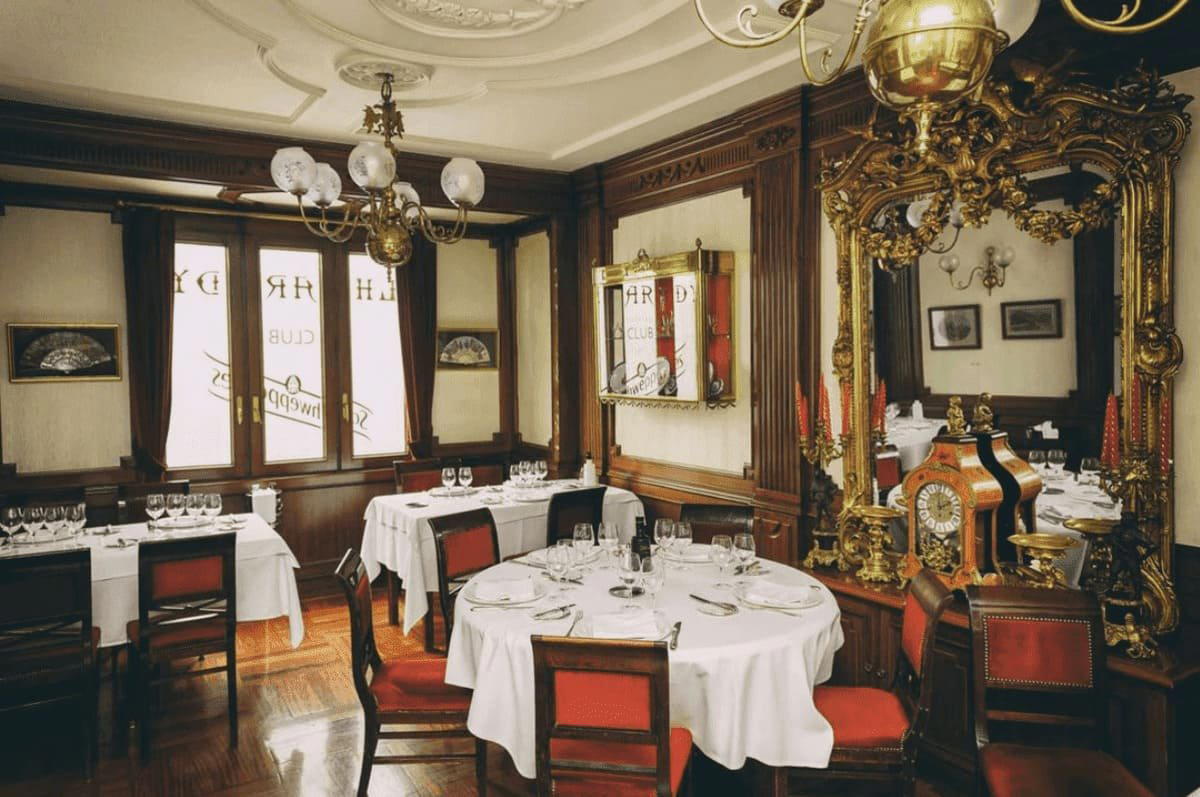
Elegant and historic with chandeliers, red velvet, dark wood paneling, gilded fixtures, and an atmosphere evoking romanticism and aristocracy.