
Michelin Plate
Our verdict
L'Aubergade holds a 2025 Michelin Plate in the small commune of Dury, south of Amiens, where Éric Boutté builds a menu from seasonal Picardy ingredients. The interior pairs waide blue pigment with raw concrete in a deliberate nod to the region's industrial and agricultural heritage. Pricing sits at the accessible end of the €€€ tier, making it one of the more honest value propositions in northern France's recognised dining circuit.

Pearl is the En Primeur Club membership app, where members save venues, book tables and use the concierge.
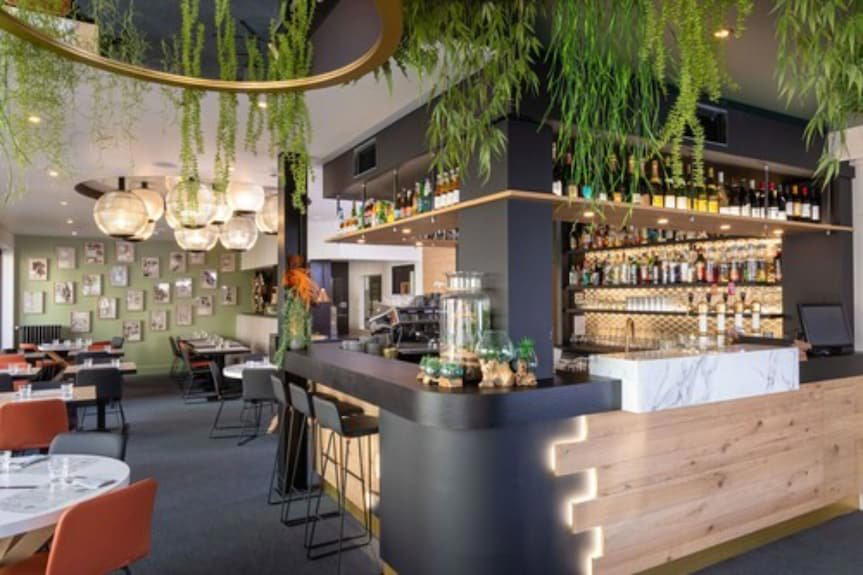
A Room That Tells You Where You Are
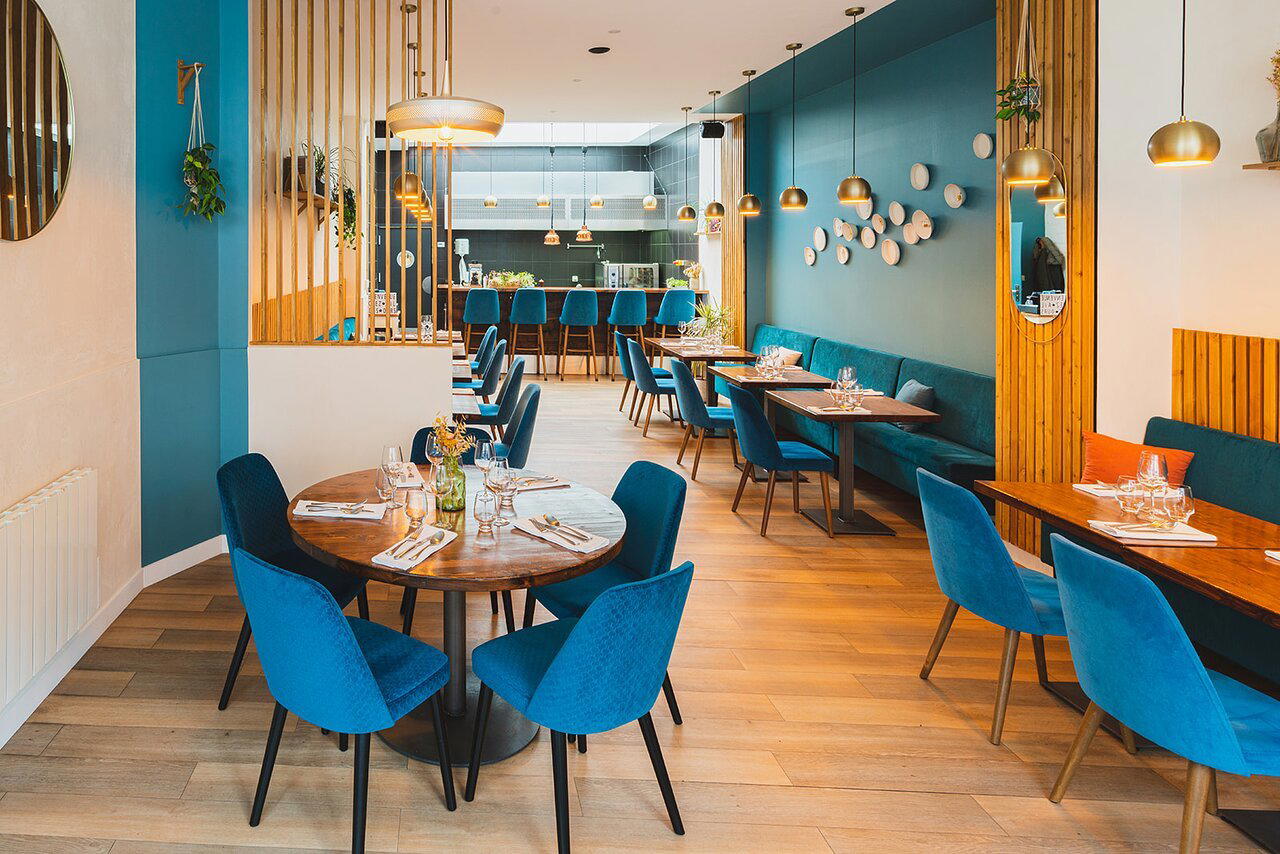
Dury sits just off the N1 south of Amiens, close enough to the A16 motorway to catch travellers moving between Paris and Calais, but with none of the transient anonymity that roadside dining in northern France often implies. The interior of L'Aubergade announces its regional allegiances immediately: waide blue walls set against untreated concrete. Waide is the pigment extracted from the woad plant, historically cultivated across Picardy from the Middle Ages, and its presence here is not decorative whimsy. It is a direct material link to the agricultural economy that shaped this corner of northern France for centuries, before the dye trade collapsed under competition from indigo imports. Arriving for dinner, you understand quickly that the room is making an argument about place before the menu has said a word.
That decision to root the visual environment in local pigment and raw industrial material puts L'Aubergade in a specific subcategory of French regional dining: establishments where provenance is embedded in the architecture, not just narrated on the menu. For a broader picture of where this sits within Dury's dining options, see our full Dury restaurants guide. Nearby, La Bonne Auberge occupies a different register in the local circuit, making the two worth considering as a pair when planning a visit to the area.
What the Kitchen Prioritises
The menu at L'Aubergade works from the Picardy larder outward. Cabbage, stuffed leaf by leaf in a labour-intensive process, has become the restaurant's signature, which tells you something about the kitchen's priorities: this is not a dish that photographs well or travels well on social media. It requires patience to prepare and attention to eat. That choice of emblem says more about the cooking philosophy than any stated manifesto would.
The approach connects to a broader movement in northern French cooking that has been building quietly for two decades. Chefs across Hauts-de-France have increasingly turned to the region's agricultural output, chicory, endive, leeks, root vegetables, freshwater fish from the Somme, as the primary creative material, rather than importing prestige ingredients from further south. At L'Aubergade, confit of rabbit leg arrives alongside a medley of parsnips, a combination that reads as straightforwardly local in the leading sense: both ingredients are at home in Picardy's colder climate, and the confit technique extends shelf-life while deepening flavour, a practical and aesthetic decision simultaneously.
Where the menu reaches toward the coast, it does so with similar intelligence. Marinated scallops on a butternut puree, paired with smoked herring roe, brings together two products that are geographically close, the Channel coast is within two hours, but rarely placed in conversation. The smoked herring roe functions as a seasoning that concentrates brine and smoke without obscuring the scallop, a compositional choice that rewards attention. Michelin's 2025 Plate recognition acknowledges exactly this kind of consistent, considered cooking: not the theatrical ambition that earns stars, but the reliability and regional coherence that the Plate designation is designed to signal.
How This Fits the Regional Dining Map
Northern France occupies an unusual position in the country's dining hierarchy. The grand address restaurants that shape France's international reputation, from Alléno Paris au Pavillon Ledoyen to Mirazur in Menton, cluster in Paris and along the Mediterranean and Alpine corridors. The Picardy region rarely appears on the same mental map as Flocons de Sel in Megève, Bras in Laguiole, or Auberge de l'Ill in Illhaeusern, all of which carry the weight of long institutional reputations. That gap is partly geographic prejudice and partly the result of decades of industrial decline in the north that made the region a less attractive destination for gastronomy tourism.
What has changed is the commitment among a generation of northern French chefs to treat local produce as a serious creative constraint rather than a limitation to be overcome. The approach has parallels elsewhere in France: Michel Bras's decades-long excavation of the Aubrac plateau's flora and fauna at Bras in Laguiole established a template for hyper-regional cooking that subsequent generations adapted. In the northeast, Au Crocodile in Strasbourg and Assiette Champenoise in Reims demonstrate how regional identity can anchor Michelin-recognised cooking without the pull of a coastal or mountain terroir. L'Aubergade operates at a different tier from those starred houses, but the underlying argument, that northern France's agricultural specificity deserves kitchen-level attention, is the same.
For reference, the starred houses that define the further reaches of French gastronomy, including Troisgros in Ouches, Paul Bocuse in Collonges-au-Mont-d'Or, and AM par Alexandre Mazzia in Marseille, represent a different conversation entirely. Equally, modern cuisine practitioners operating at the international level, such as Frantzén in Stockholm and FZN by Björn Frantzén in Dubai, show how the same seasonal-local framework scales across contexts and price points. L'Aubergade sits firmly in the regional, accessible end of that spectrum, which is where it intends to be.
Planning a Visit
L'Aubergade is located at 78 Route Nationale, Dury (80480), a few kilometres south of Amiens city centre. The €€€ pricing positions it as one of the more approachable options in its Michelin-recognised tier, the 2025 Plate reflects consistent quality rather than special-occasion pricing. For visitors approaching from Amiens itself, or using the city as a base, our full Dury hotels guide covers accommodation options nearby. Those building a broader itinerary around the area can also consult our Dury bars guide, our Dury wineries guide, and our Dury experiences guide for additional planning context. Booking details, hours, and current availability are best confirmed directly with the restaurant, as these are subject to seasonal variation.
Frequently asked questions
Is L'Aubergade award-winning?
L'Aubergade has received recognition including: Michelin Plate (2025); This establishment, run by Éric Boutté, rolls out classically themed cuisine with a modern twist that is in tune with the seasons and of local inspiration and origin. Among its emblematic dishes, you will find cabbage….
What do people recommend at L'Aubergade?
Michelin's own citation singles out the cabbage stuffed leaf by leaf as the house signature, a labour-intensive preparation that defines the kitchen's classical sensibility. Confit of rabbit leg with parsnip and marinated scallops on butternut purée with smoked herring roe also appear in the official 2025 Michelin Plate listing as representative dishes.
What's the pricing like at L'Aubergade?
Pricing at L'Aubergade is listed as €€€.
Where do I go for L'Aubergade?
L'Aubergade is located at 78 Rte nationale, 80480 Dury, France, Dury.
Do they take walk-ins at L'Aubergade?
Walk-in availability is unconfirmed, and a 2025 Michelin Plate recognition typically generates consistent demand, particularly for a €€€ address in a region where this tier of dining is less dense than in Paris or Lyon. Booking ahead via phone or the restaurant directly is the more reliable approach.
Quick Comparison
| Venue | Cuisine | Price | Awards | Notes |
|---|---|---|---|---|
| L'AubergadeThis venue (the venue you are viewing) | Modern French Fine Dining | $50–100 | Michelin Plate | Not listed |
| Alléno Paris au Pavillon Ledoyen | Modern French Fine Dining | $150–200 | 3 Michelin Stars · World's 50 Best #79 | Creative |
| Kei | Contemporary French, Modern Cuisine | Not listed | Michelin 3 Star | Not listed |
| L'Ambroisie | Classic French Haute Cuisine | $300–500 | 2 Michelin Stars · World's 50 Best #23 | French, Classic Cuisine |
| Le Cinq - Four Seasons Hôtel George V | Modern French Fine Dining | $300–500 | 3 Michelin Stars · World's 50 Best #24 | French, Modern Cuisine |
| Plénitude | Modern French Sauce-Led Fine Dining | $300–500 | 3 Michelin Stars · World's 50 Best #14 | Contemporary French |
Recognition history
Dated appearances from independent guides and award organizations, with the underlying list record or original source where available.
Michelin Plate
Michelin
Full recognition history (2 entries)
Michelin Plate
Michelin
Continue exploring
More in Dury
Restaurants in Dury
All restaurants in Dury →
Wineries in Dury
Browse all →
Details
- Elegant
- Cozy
- Sophisticated
- Date Night
- Special Occasion
- Celebration
- Standalone
- Extensive Wine List
- Local Sourcing
- A La Carte
- Prix Fixe
Current opening hours
- Monday
- Closed
- Tuesday
- 12–1:30 PM, 7:30–9 PM
- Wednesday
- 12–1:30 PM, 7:30–9 PM
- Thursday
- 12–1:30 PM, 7:30–9 PM
- Friday
- 12–1:30 PM, 7:30–9 PM
- Saturday
- 12–1:30 PM, 7:30–9 PM
- Sunday
- Closed
Hours can change for holidays and private events. Hours as of .
Spacious, bright rooms with warm colors, sober tasteful decoration, and a glass roof offering sky views.