
Tabelog 100 #96
Our verdict
Larousse places Asakusa’s yoshoku tradition in a quieter, more adult register than the neighbourhood’s snack counters and quick-service classics. The restaurant’s Tabelog 100 Yoshoku EAST 2025 selection, Russian inflection, wine-bar footing, and mid-range Tokyo pricing make it a useful address for travellers who want old-school Western-Japanese cooking without sliding into theme-park nostalgia.

Pearl is the En Primeur Club membership app, where members save venues, book tables and use the concierge.
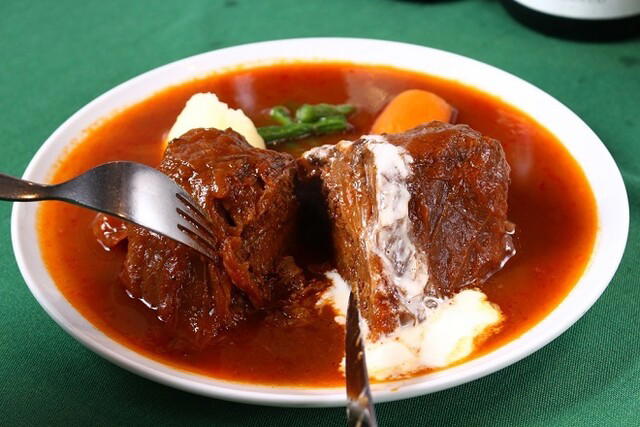
The menu
What to order
- Cabbage roll
- Borscht
- Piroshki
- Beef stroganoff
Tokyo feels theatrical before dinner: temple crowds somewhere in the day, shopping lanes, taxis, and the pull of something fried, sweet, or grilled. Larousse belongs to the Tokyo that appears after the day-trip rush thins and older dining habits return: not a quick stop, but Japanese-style Western cooking with a Russian accent and enough wine-bar identity to move beyond nostalgia.
Yoshoku is often misread outside Japan as generic Western food. In Tokyo it is more exact: an urban cuisine shaped by adaptation, hotel dining, department-store restaurants, kissaten culture, and family-run specialists that made Western-leaning forms feel native without pretending to be European. Tokyo is one of the clearest places to read that history because its dining culture never depended only on luxury signals; old coffee rooms, drinking dens, sweet shops, and Western-Japanese restaurants can share the same day’s itinerary.
Tokyo yoshoku with a Russian accent, not retro cosplay
The useful distinction at Larousse is category discipline. Its public classification spans yoshoku, Russian, and wine bar, placing it outside the standard Tokyo Western-style template without turning it into international fine dining. In Tokyo, where restaurants often trade on age, signage, and neighbourhood memory, the point is narrower: Japanese diners have long domesticated foreign formats, and Russian cooking enters that story through a hearty register that sits comfortably beside yoshoku’s sauce-led repertoire.
The 2025 Tabelog Hyakumeiten recognition gives Larousse a credible contemporary signal in a category visitors can struggle to parse. Michelin stars are not the only language of this tier; peer recognition and local diner confidence matter more. A Tabelog score of 3.57 should be read in Japanese context, where mid-three scores can indicate serious local support. In a city obsessed with omakase counters and tasting-menu precision, yoshoku rewards patience with sauce work, consistency, and making Western forms feel unmistakably Japanese.
Comparison within Tokyo clarifies the choice. Royal Coffee Ten Honten represents the kissaten side of the city, Asakusa Sanboa a compact drinking-and-dining register, Tonkatsu Yutaka the specialist cutlet tradition, Yoshikami Asakusa ten a more familiar yoshoku address, and Gyoza no Ousama the casual dumpling lane. Larousse sits above the quick, inexpensive end and below Tokyo’s formal luxury dining rooms: a grown-up yoshoku meal, not a snack stop, yet not dinner as ceremony.
For readers mapping Tokyo by genre rather than neighbourhood, Western-Japanese cooking is not a side note to sushi, ramen, or kaiseki. It is one of Tokyo’s great urban cuisines, born from translation rather than preservation. The same itinerary can include seafood-focused casual dining, contemporary city formats, and charcoal-led Japanese cooking elsewhere in Tokyo. Yoshoku belongs in that conversation because it shows how Tokyo eats when not performing tradition for visitors.
What the category tells you before the menu does
The format signals a slower meal than much of Tokyo’s daytime eating. Larousse’s categories point to a small-restaurant sensibility, while the wine-bar classification is telling: yoshoku sits between family dining and adult drinking, and the better versions know a sauce-heavy Western-Japanese meal can work with a glass poured for conversation rather than pairing orthodoxy.
Larousse belongs to the continuum in which Tokyo’s Western dining habits became more confident and less imitative. The point is not nostalgia so much as endurance in a city with abundant foot traffic but loyalty earned over repeat meals. Long-lived Tokyo restaurants know their lane and need not chase every dining fashion. Yoshoku suffers when too polished; its strength is calibration: rich but not clumsy, familiar but not generic, Western in outline and Japanese in appetite.
Travellers should read Larousse through its public categories and recognition rather than through luxury shorthand. The combination of yoshoku, Russian cooking, and wine bar suggests a composed meal with a social function beyond tourism. This is Tokyo as a lived dining city, not only a sightseeing circuit, and the restaurant’s appeal comes from the way it makes adapted forms feel settled rather than staged.
The broader Tokyo plan matters. A yoshoku dinner suits days spent reading older commercial rhythms rather than chasing only high-rise luxury. Do not treat older Tokyo dining as a daytime add-on; the city becomes clearer when dinner is part of the plan.
How to place it in a Japan dining itinerary
Larousse fits travellers who have booked the sushi counter, ramen queue, and kaiseki splurge, then realise those meals do not fully explain Tokyo. Yoshoku fills that gap. It shows how the city metabolised foreign influence into something local, how older restaurants remain relevant without becoming museum pieces, and how price, comfort, and craft can meet without luxury theatre.
Its value is comparative beyond Tokyo. Japan’s dining culture is regional, and travellers moving from the capital to other parts of the country will see different adaptations in casual meals, cafe formats, small contemporary rooms, and international cooking. Curry specialists, coffee rooms, and hybrid city restaurants make the same point from other angles: imported forms become Japanese through repetition, locality, and use.
Even outside Japan, the category travels in fragments, with sake bars, casual counters, and everyday Japanese formats translated for other cities. Larousse works in the opposite direction: foreign influence absorbed so completely into Tokyo dining that the better question is not how European or Russian it feels, but how clearly it expresses the city’s appetite for adaptation.
A Lean Comparison
Comparable venues for orientation by cuisine and category.
| Venue | Cuisine | Price | Awards | Notes |
|---|---|---|---|---|
| LarousseThis venue (the venue you are viewing) | Traditional Russian cuisine & wine bar | $50–100 | Tabelog 100 #96 | Not listed |
| BAR Shusendo | Classic Japanese cocktail & whisky bar | $30–50 | Tabelog 100 #34 | Chūō, Classic Japanese cocktail & whisky bar |
| TwentyEight Konraddo toukyou | Hotel bar & lounge with afternoon tea | $50–100 | Tabelog 100 #39 | Minato, Hotel bar & lounge with afternoon tea |
| Ishi no Hana | Craft cocktail bar | $30–50 | Tatler Listed in Best Bars Asia-Pacific · Tabelog 100 #19 | Shibuya, Craft cocktail bar |
| mixology heritage | Classic Cocktail Bar | $50–100 | Not listed | Chiyoda, Classic Cocktail Bar |
| Bar ODIN | Cocktail & Whisky Bar | $50–100 | Tabelog 100 #83 | Shibuya, Cocktail & Whisky Bar |
Recognition history
Dated appearances from independent guides and award organizations, with the underlying list record or original source where available.
Tabelog 100 #96 · No. 96
Tabelog · Tabelog 100 - Yoshoku - EAST - 2025
Continue exploring
More in Tokyo
Restaurants in Tokyo
All restaurants in Tokyo →

Bars in Tokyo
All bars in Tokyo →



Details
- Classic
- Cozy
- Romantic
- Intimate
- Celebration
- Special Occasion
- Date Night
- Group Dining
- Family
- Casual Hangout
- Private Event
- Wine Cellar
- Historic Building
- Standalone
- Extensive Wine List
- A La Carte
- Set Menu
- Wine
- Whisky
- Sparkling Wine
Current opening hours
- Monday
- 11:30 AM–10:30 PM
- Tuesday
- Closed
- Wednesday
- 11:30 AM–10:30 PM
- Thursday
- 11:30 AM–10:30 PM
- Friday
- 11:30 AM–10:30 PM
- Saturday
- 11:30 AM–10:30 PM
- Sunday
- 11:30 AM–10:30 PM
Hours can change for holidays and private events. Hours as of .
A long‑established, calm and inviting dining room with a classic, slightly old‑fashioned feel, focused on warm hospitality and creating memorable birthday, anniversary, and family occasions rather than a trendy atmosphere.