Tabelog 100
Our verdict
LADRIO is a Jinbocho kissaten, bar, and cafe selected for Tabelog’s Kissaten 100 in 2021 and 2022. It suits travelers interested in Tokyo’s older cafe culture: counter seats, table seating, no private rooms, no smoking, and a low-spend format that sits close to the neighborhood’s bookshop-and-coffee rhythm.

Pearl is the En Primeur Club membership app — saves, bookings, and concierge access live there. Same editors, same standards.
The menu
What to order
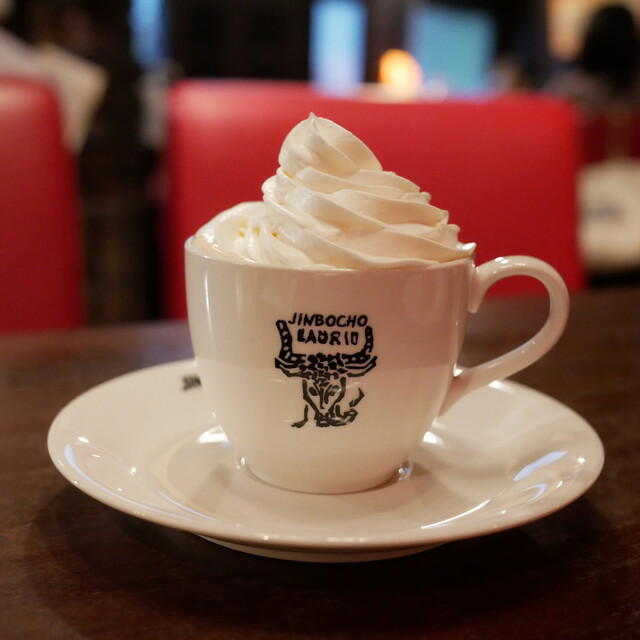
- Vienna coffee with whipped cream
- Napolitan pasta
Tokyo’s old cafe culture is built on thresholds: basement stairs, narrow lanes, used-book shelves, and rooms where conversation sits below the music. LADRIO belongs to that Tokyo grammar. Its public listing places it in the kissa, bar, and cafe category, a detail that matters because kissaten are not simply coffee shops. They are rooms with rules, pacing, and memory, often more useful for reading a city than another polished dining room.
Tokyo has spent the past decade exporting precision dining to visitors: sushi counters, tempura rooms, French-Japanese tasting menus, and bar programs with elaborate technique. The kissaten runs on another timescale. It values continuity over novelty, a steady seat over a staged reveal, and a price band that keeps it in daily-life territory rather than special-occasion dining. LADRIO’s selection for Tabelog’s Kissaten 100 in 2022 places it inside a curated national conversation about Japanese cafe culture, not merely a casual cafe category.
Tokyo's cafe bars preserve a slower Tokyo
Tokyo remains one of the clearest cities where books, universities, publishing houses, curry counters, and coffee rooms can still reinforce one another. It has long rewarded places that absorb solitary readers, office workers, students, and small groups without changing personality by the hour. That makes the kissaten format durable here: a middle ground between restaurant and bar, with coffee-shop bones and evening usefulness.
LADRIO’s category mix, kissa, bar, and cafe, fits that older hybrid model. Its public positioning pushes the room beyond a simple daytime coffee stop without turning it into a pure destination bar. In Tokyo terms, that matters. The city often divides sharply between specialist counters and broad-use neighborhood rooms; its older cafe culture has kept more of the latter than many polished dining districts. Compared with old-school references such as Milonga Nuova and Tea House TAKANO, LADRIO sits in the same approachable conversation, while Kanda Brazil occupies another modest cafe lane. Those comparisons show how Tokyo’s cafe scene works: range exists, but the center remains modest, bookish, and resistant to luxury inflation.
The format also explains why this is not competing with Tokyo’s reservation-led restaurants. A traveler using Our full Tokyo restaurants guide will find rooms built around chef counters, set menus, or destination dining. A kissaten asks for another read. It is better judged by whether the room can hold an afternoon, a conversation, or a drink after browsing shelves, not by whether it performs novelty on demand.
The evolution is in the category, not in a reinvention pitch
Many Tokyo venues modernize by narrowing: fewer seats, tighter menus, stronger reservation control, higher average spend. The kissaten tradition has moved the other way by surviving as a flexible civic room. LADRIO’s current identity reflects that evolution. Its 2022 recognition came through a kissaten list, while its operating category includes bar and cafe use. The signal is clear: the appeal is not a chef-driven narrative or new concept, but a mature format adapting to how Tokyo uses all-day rooms.
That separates it from trend-facing cafes where visual concept carries much of the first impression. It also separates the room from food-specific casual addresses where the decision is anchored more directly to what will be eaten. LADRIO is a format choice first: cafe bar, older Tokyo atmosphere, and a rhythm that belongs to the city rather than to a single menu item.
The room’s category reinforces that reading. Kissa, bar, and cafe together suggest solitary use, pairs, and small groups without forcing one dining mode. The proposition is not luxury service or a tightly scripted meal. It is a flexible cafe-bar setting, useful because it can carry different parts of a Tokyo day while still feeling rooted in an older style of hospitality.
The useful comparison is not only within cafes. Tokyo’s hospitality map stretches from hotel dining and design bars to specialist experiences, and the traveler’s choice depends on tempo. For a broader city plan, Our full Tokyo hotels guide, Our full Tokyo bars guide, Our full Tokyo wineries guide, and Our full Tokyo experiences guide frame the other lanes. LADRIO occupies the lower-key cafe-bar lane, where Tokyo’s cultural texture shows through use rather than spectacle.
How to place it in a Tokyo eating day
This address works around a city plan rather than dominating an itinerary. Tokyo rewards browsing, and the cafe-bar format suits a pause between bookshops, galleries, curry, and train transfers. The low spend makes it easy to pair with a meal elsewhere, including unnamed casual dining or another Tokyo curry stop such as Sumatra Curry Kyoei Do when the day is built around an old curry-and-coffee circuit.
Travelers extending the same editorial lens across Japan will find related questions in other cities: how much of a place is about the plate, and how much is about the social room around it. That question links cafe culture in Tokyo to other dining rooms in Osaka, Kyoto, Kumamoto, Kawasaki, Sapporo, and Kamakura. Outside Japan, the comparison shifts again as Japanese formats travel, while Tokyo shows how they behave at home.
The editorial case for LADRIO is precise: it is a recognized kissaten in a city where the category still makes cultural sense. It will not satisfy a traveler looking for Tokyo’s high-theater dining, but it gives context those rooms often cannot. In a city increasingly read through reservations and rankings, the enduring cafe bar remains a useful corrective.
Frequently asked questions
Is LADRIO child-friendly?
Check the venue's official channels for the latest details. LADRIO is listed in Tokyo in the kissa, bar, and cafe categories.
Is LADRIO better for a quiet night or a lively one?
It is best understood as a Tokyo kissaten-bar rather than a high-volume nightlife room. Its appeal is the slower cafe-bar format and the older rhythm of Japanese cafe culture.
What price level is LADRIO?
Pricing at LADRIO is listed as JPY 1,000 - JPY 1,999.
What are LADRIO's hours?
Check LADRIO's official channels for current hours before visiting.
A Pricing-First Comparison
Comparable venues for context, by category and price tier.
| Venue | Cuisine | Price | Awards | Notes |
|---|---|---|---|---|
| LADRIOThis venue (the venue you are viewing) | Classic Japanese kissaten café | $10–20 | Tabelog 100 | Not listed |
| La Precieuse Kioicho ten | Cake Shop / Café | Not listed | Tabelog 100 #12 | Chiyoda, Cake Shop / Café |
| TOLO COFFEE AND BAKERY | Not listed | $10–20 | Tabelog 100 #78 | Setagaya, Bakery café with pasta and coffee |
| AANGAN | Authentic Nepali Ethnic Cuisine | $10–20 | Tabelog 100 #75 | Shinjuku, Authentic Nepali Ethnic Cuisine |
| Spice Bar Nekoroku | Spice Bar / Asian-Ethnic Fusion | $20–30 | Tabelog 100 #68 | Sumida, Spice Bar / Asian-Ethnic Fusion |
| Theobroma Shibuya honten | Artisanal chocolatier & patisserie café | $10–20 | Tabelog 100 #34 | Shibuya, Artisanal chocolatier & patisserie café |
Recognition history
Dated appearances from independent guides and award organizations, with the underlying list record or original source where available.
Tabelog 100
Tabelog · Tabelog 100 - Kissaten - 2026
Full recognition history (2 entries)
Tabelog 100 #72 · No. 72
Tabelog · Tabelog 100 - Kissaten - 2022