Kuro Eatery
Kuro Eatery brings a minimalist Mediterranean sensibility to London's crowded mid-tier dining scene, where restraint in presentation often signals more confidence in the kitchen than elaborate plating. The Mediterranean-influenced menu positions the restaurant within a growing cohort of London addresses that treat the sea's larder, fish, shellfish, coastal vegetables, as the primary argument. For diners calibrating between the city's formal tasting-menu circuit and its more casual neighbourhood options, Kuro occupies a considered middle ground.
Pearl is the En Primeur Club membership app — saves, bookings, and concierge access live there. Same editors, same standards.
- Address
- London, United Kingdom
- Directions
- Get directions
 Saves & bookings on Pearl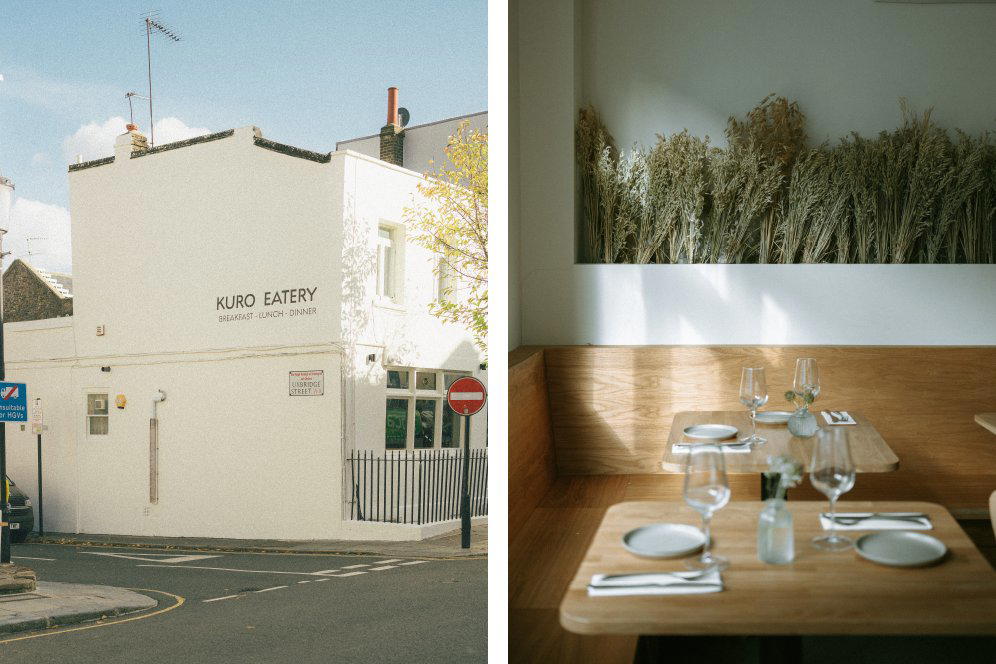
Where Mediterranean Minimalism Meets London's Dining Moment
Kuro Eatery is a restaurant in London serving Modern Italian dishes at around $50 per person. There is a particular kind of restaurant that announces itself quietly. No theatrical entrance sequence, no amuse-bouche trolley wheeled ceremonially to the table. Kuro Eatery belongs to that category, a London address working within the Mediterranean-influenced, minimalist register that has gained traction across the city as a counterpoint to the formal tasting-menu circuit. The room, from what its positioning suggests, communicates through subtraction: clean lines, considered materials, the kind of environment that asks you to focus on what arrives on the plate rather than the spectacle around it.
London's dining scene has been sorting itself into clearer tiers over the past decade. At the leading, places like CORE by Clare Smyth and Restaurant Gordon Ramsay operate at the ££££ level with multi-course formats, Michelin credentials, and booking windows that stretch months ahead. Below that tier, the competition is fiercer and the distinctions matter more. Kuro's Mediterranean-influenced, minimalist identity places it in a cohort that competes not on ceremony but on the quality of its sourcing and the precision of its restraint, a harder argument to sustain, and a more interesting one to follow.
The Mediterranean's Case for Fish and Shellfish
The Mediterranean basin has one of the oldest continuous seafood cultures in the world. From the Ligurian coast to the Levant, the relationship between fishing communities and the table was never decorative, it was economic, seasonal, and deeply practical. What that tradition produced, over centuries, was a set of techniques and combinations that treated fish not as a luxury protein but as the default one: grilled whole, dressed simply, served at the temperature of the kitchen rather than manipulated into architectural precision.
That tradition is what gives Mediterranean-influenced menus in London their strongest editorial argument. In a city where the high-end seafood conversation is dominated by formats like that at Le Bernardin in New York City, where fish is handled with almost surgical precision and the menu reads as a technical document, the Mediterranean approach offers something philosophically different. The fish is the point, not the technique applied to it. Seasonality drives the selection rather than a fixed signature list.
For Kuro Eatery, operating within this tradition in London means engaging with a city that now has genuine options across this register. The better addresses in this cohort track what is arriving at Billingsgate or sourced from day-boat fisheries around the British coast, marrying those inputs to Aegean and North African flavor references. Spring brings sea bream and razor clams; autumn shifts toward mussels, octopus, and the richer preparations that suit lower temperatures. A minimalist kitchen in this tradition doesn't simplify because it lacks ambition, it simplifies because it has enough confidence to let the ingredient make the case.
Positioning Within London's Mediterranean Tier
London's Mediterranean-influenced restaurant category has expanded considerably since the early 2010s, when a handful of addresses essentially defined the format. The market has since produced a range of interpretations: some skew Levantine, others anchor in southern French or Italian coastal cooking, and a smaller number operate in the genuinely cross-Mediterranean register that Kuro's positioning suggests. This is the harder slot to occupy credibly, because it requires a kitchen that can move between traditions without becoming a collection of references.
The comparison set for a venue like Kuro sits some distance from the formal European fine-dining circuit, the Sketch Lecture Room and Library tier, or The Ledbury, and closer to the smaller, more format-flexible addresses that have been drawing attention in cities from Glasgow (see Corner Shop) to Leeds (see The Highland Laddie). What those venues share is a preference for editorial clarity over menu sprawl: a tighter range of dishes, a defined point of view, and a room that supports conversation rather than performance.
In that context, the minimalist descriptor in Kuro's positioning is both a stylistic signal and a competitive stance. It separates the restaurant from the maximalist end of London's Mediterranean offer and aligns it with the growing number of diners who have grown impatient with rooms and menus that confuse complexity with quality. Dinner by Heston Blumenthal operates at the other end of the conceptual spectrum, deep historical research, theatrical presentation, and the distance between those two approaches maps almost exactly onto a generational shift in what London's dining public appears to want.
The Seasonal Argument for Visiting Now
Mediterranean seafood cooking has a clear seasonal logic that London kitchens in this tradition follow closely. The months between late spring and early autumn represent the period when the Mediterranean larder is at its most varied: cephalopods are at peak quality, shellfish are in full run, and the vegetable co-stars of the tradition, fennel, tomato, preserved lemon, fresh herbs, align with British growing seasons in a way that makes genuinely local-sourced Mediterranean cooking possible rather than performative.
That seasonal alignment gives this style of cooking its strongest argument in summer and early autumn. A kitchen working with day-boat mackerel, Cornish sardines, or hand-dived scallops alongside Mediterranean preparation references is doing something that makes geographic sense in a way that, say, a mid-winter visit might not replicate. For those considering when to visit Kuro, the overlap between Mediterranean tradition and British seasonal seafood availability makes the warmer months the period of greatest coherence on the plate.
Cross-referencing Kuro's Mediterranean-minimalist identity against international comparators is instructive. Alain Ducasse at Louis XV in Monte Carlo represents the formal, institution-grade end of Mediterranean cooking at the highest investment level. Lazy Bear in San Francisco and Atomix in New York City show what format discipline looks like in cities with comparably competitive dining markets. Franc in Canterbury offers a useful regional comparison for Mediterranean-influenced cooking outside London's central pressure cooker. Emeril's in New Orleans demonstrates that regional identity and seafood-forward cooking can build long-term credibility without Michelin dependency. The pattern across all these addresses is that the venues with staying power are those with a clear point of view, consistently applied.
Comparable Spots
Comparable venues nearby, for context on price, style, and recognition.
| Venue | Cuisine | Price | Notes |
|---|---|---|---|
| Kuro EateryThis venue — the venue you are viewing | Modern Italian | $$$ | Not listed |
| The Remedy | Italian-Inspired Small Plates | $$$ | Euston |
| O Ver Borough | Authentic Neapolitan Italian with Wood-Fired Pizza | $$$ | Bankside |
| Il Portico | Traditional Emilia Romagna Italian | $$$ | South Kensington |
| Spagnoletti | Modern Italian Sharing Plates | $$$ | King's Cross |
| Garum | Authentic Roman Trattoria | $$$ | Queensway |
Continue exploring
More in London
Restaurants in London
Browse all →
Bars in London
Browse all →
Hotels in London
Browse all →


At a Glance
- Minimalist
- Modern
- Cozy
- Brunch
- Date Night
- Open Kitchen
- Extensive Wine List
Japanese minimalistic interior with light wooden theme, cozy and casual atmosphere.