Kojin 2.0

Michelin Plate
Our verdict
Kojin 2.0 holds consecutive Michelin Plate recognitions (2024 and 2025) on Coral Gables' Ponce de León corridor, where contemporary cooking earns its credentials through menu precision rather than volume. Sitting at the $$$ price tier, it positions alongside the neighbourhood's more serious dining options without tipping into the stratospheric ranges of its starred peers.

Pearl is the En Primeur Club membership app — saves, bookings, and concierge access live there. Same editors, same standards.
The menu
What to order
- Kojin Caesar
- Truffle Chicken
- Niman Ranch Short Rib
Ponce de León at the Right Hour
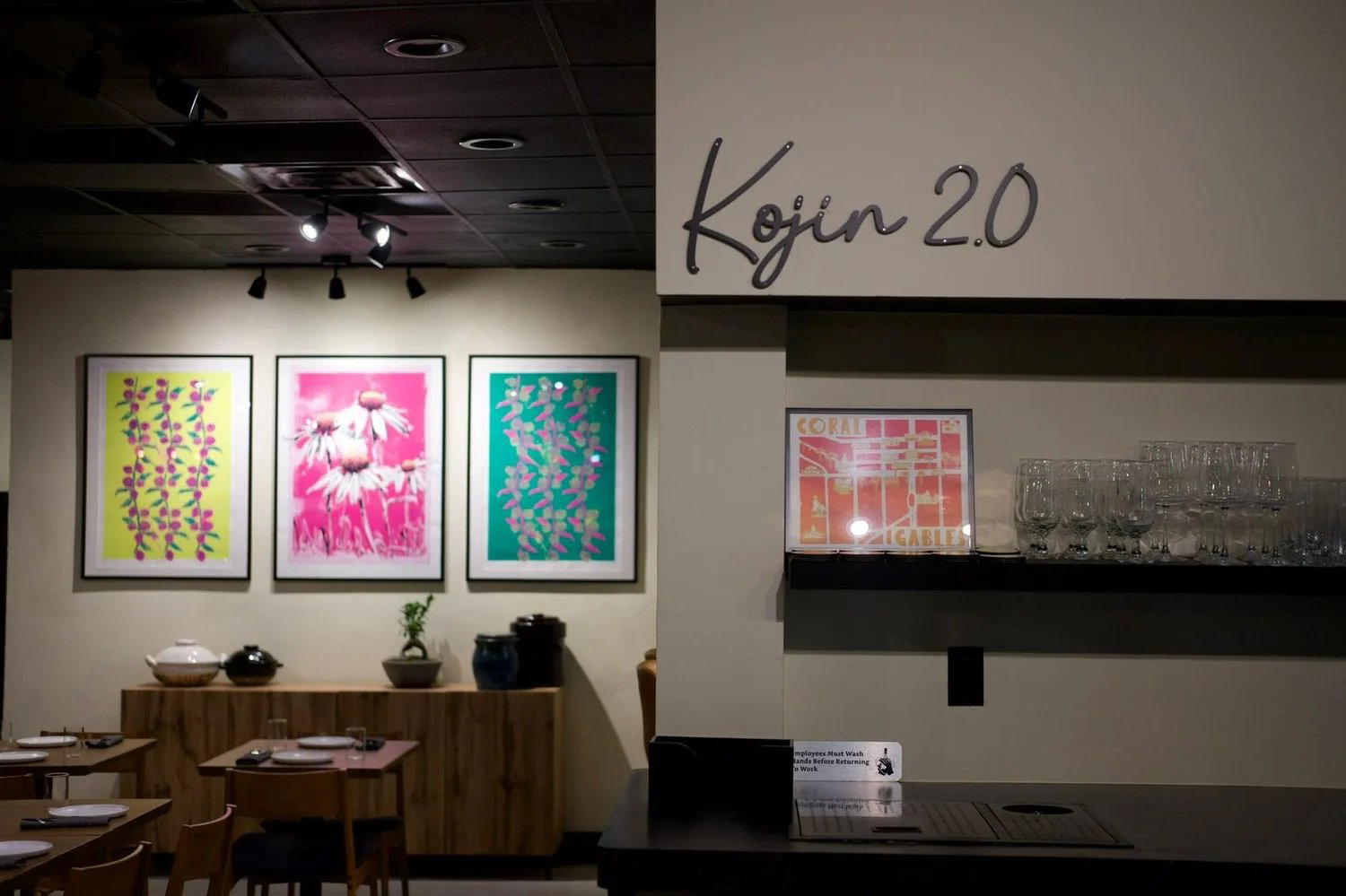
Coral Gables has a particular quality in the early evening: the Mediterranean Revival architecture along Ponce de León Boulevard catches the last hour of South Florida light in a way that makes even a routine block feel composed. At 804 Ponce de León, that ambient weight works in Kojin 2.0's favour. The entrance doesn't announce itself with the bluster common to Miami's more theatrical dining rooms, and that restraint carries through to what happens once you're inside. This is a room that asks you to pay attention to the plate, which is either a declaration of confidence or a gamble — and two consecutive Michelin Plate recognitions (2024 and 2025) suggest it's the former.
What Consecutive Michelin Recognition Actually Signals
In Florida's expanding Michelin universe, a Plate designation isn't the inspectors' consolation prize. It marks a restaurant that met the standard for inclusion — quality cooking worth knowing about, without yet accumulating the consistency or distinction that earns a star. For a contemporary restaurant at the $$$ price tier in a mid-sized dining corridor like Coral Gables, consecutive Plate listings across two guide cycles place Kojin 2.0 in a defined competitive band: above the neighbourhood's casual operators, in direct conversation with the handful of Coral Gables addresses that take their menus seriously, and one demonstrable step below the city's starred tier. Nearby, Shingo operates at a $$$$-rated level with a Michelin star, setting the upper bracket for the immediate neighbourhood. Kojin 2.0 occupies the tier just below, serious enough to earn Michelin acknowledgment two years running, priced to remain accessible within that context.
Menu Architecture as Editorial Statement
Contemporary cuisine, as a category designation, can mean almost anything, which is precisely why menu structure becomes the most useful lens for understanding what a restaurant actually believes. In the contemporary tier across American cities, the structural choice tends to reveal the kitchen's intellectual commitments: tasting menus signal a preference for narrative control, while à la carte formats signal confidence that individual dishes carry enough weight to stand alone. Restaurants that pitch between these formats often use a hybrid approach, offering a tighter set of composed plates alongside ordering flexibility, which allows the kitchen to demonstrate range while giving the guest some agency.
At the $$$ price point in a neighbourhood like Coral Gables, menu architecture also functions as competitive positioning. The $$$ bracket nationally sits in a practical middle ground: ambitious enough to justify Michelin scrutiny, accessible enough to fill seats on weeknights from a local residential base. Restaurants in this tier that hold Michelin attention across multiple cycles tend to maintain menus with enough seasonal movement to re-earn the assessment each year.
For broader context on how menu architecture functions at the highest levels of contemporary cooking, the contrast with nationally-discussed addresses is instructive. Alinea in Chicago treats the menu as pure theatre; Le Bernardin in New York City uses a tightly edited format to concentrate attention on a single protein category. Single Thread Farm in Healdsburg aligns menu movement with agricultural cycles in ways that are legible on the plate. These are reference points for what intentional menu architecture looks like at the top of the American contemporary category, not direct comparisons to Kojin 2.0, but useful calibration for understanding what Michelin's inspectors are attuned to when they return to a room year after year.
Coral Gables' Contemporary Dining Context
Coral Gables sits in a particular position within South Florida dining. It draws a residential and professional demographic that supports mid-to-high price dining without requiring the theatre Miami Beach exports to the world. The result is a dining corridor, particularly along Ponce de León and its cross streets, that tends toward considered cooking over spectacle. Eating House brings an Argentine-Italian approach to that corridor; Beauty & the Butcher anchors the meat-forward end; Daniel's Miami and Havana Harry's serve the Cuban-inflected institutional dining the neighbourhood has always expected. Kojin 2.0 sits within this context as the contemporary fine-dining representative in the Michelin-acknowledged band, distinct from the casual operators while sitting below the starred ceiling.
For a full orientation across the neighbourhood's options, our full Coral Gables restaurants guide maps the range. Those building a broader Coral Gables visit can also consult our Coral Gables hotels guide, our bars guide, our wineries guide, and our experiences guide.
Internationally, the contemporary category Kojin 2.0 occupies connects to a broader global shift toward technically-grounded cooking that draws on multiple culinary traditions without hard national categorisation. Jungsik in Seoul and César in New York City operate within the same loose genre, each anchoring it differently to their city's dining context. Lazy Bear in San Francisco and Emeril's in New Orleans offer further reference points for how contemporary American cooking structures itself at different price tiers and with different regional material. The French Laundry in Napa remains the definitive American benchmark for how a tasting-menu format builds and sustains Michelin recognition over decades.
Planning a Visit
Kojin 2.0 is located at 804 Ponce de León Boulevard in Coral Gables, a walkable address within the main dining corridor. The $$$ price tier places a typical dinner in the range consistent with serious but not stratospheric contemporary dining, expect to spend meaningfully, but not at the level the neighbourhood's starred tier commands. South Florida's dining calendar runs most actively from November through April, when the seasonal resident and visitor population thickens and reservations across the top tier of Coral Gables restaurants tighten. Booking ahead during that window is advisable; the 2024 and 2025 Michelin Plate listings have added visibility that extends beyond local regulars. Contact and booking details are available directly through the restaurant.
Frequently asked questions
What does dinner at Kojin 2.0 typically cost?
Pricing at Kojin 2.0 is listed as $$$.
What kind of recognition has Kojin 2.0 received?
Kojin 2.0 has received recognition including: Michelin Plate (2025); Michelin Plate (2024).
What's the signature dish at Kojin 2.0?
No specific menu items are confirmed in the public record for Kojin 2.0. What is confirmed is two consecutive Michelin Plate recognitions, in 2024 and 2025, which indicate consistent kitchen execution rather than a single standout dish carrying the room. The contemporary cuisine designation suggests a format built around evolving composition rather than a fixed anchor plate.
Is Kojin 2.0 focused on a specific cuisine style?
Kojin 2.
What part of town is Kojin 2.0 in?
Kojin 2.0 is located at 804 Ponce de Leon Blvd, Coral Gables, FL 33134, Coral Gables.
Do they take walk-ins at Kojin 2.0?
0 directly. At the $$$ price tier on Ponce de León Boulevard, back-to-back Michelin Plate recognition in 2024 and 2025 places this restaurant in a segment where reservations are advisable, particularly on weekends. Checking ahead is the practical approach.
What's the signature at Kojin 2.0?
The most documentable signature is sustained Michelin Plate standing across two consecutive cycles, 2024 and 2025, which places Kojin 2.0 among a small set of Coral Gables restaurants that have cleared the inspector threshold more than once. Within South Florida's expanding Michelin geography, that consistency carries more weight than a single-year recognition.
Same-City Peers
| Venue | Cuisine | Price | Awards | Notes |
|---|---|---|---|---|
| Kojin 2.0This venue — the venue you are viewing | Modern American with Japanese Influences | $150–200 | Michelin Plate | Not listed |
| Shingo | Edomae-Style Omakase | $200–300 | 1 Michelin Star | Japanese |
| Eating House | Modern Fusion | $50–100 | Not listed | Argentine-Italian |
| Hillstone | Polished American with Sushi | $50–100 | Not listed | American |
| Tinta y Cafe | Cuban Café & Sandwich Shop | $10–20 | Michelin Bib Gourmand · Eater Coffee Guide | Cuban |
| Zitz Sum | Modern Japanese-Italian Fusion | $100–150 | Michelin Bib Gourmand | Asian |
Recognition history
Dated appearances from independent guides and award organizations, with the underlying list record or original source where available.
Michelin Plate
Michelin
Full recognition history (3 entries)
Michelin Plate
Michelin
Michelin Plate
Michelin
Continue exploring
More in Coral Gables
Restaurants in Coral Gables
All restaurants in Coral Gables →
Bars in Coral Gables
All bars in Coral Gables →
Kojin 2.0
The wine
- Wine program
- Curated wine list
- Extensive wine list
- Sake program
Details
- Intimate
- Modern
- Cozy
- Elegant
- Minimalist
- Special Occasion
- Date Night
- Chefs Counter
- Open Kitchen
- Extensive Wine List
- Sake Program
- Local Sourcing
- Tasting Menu
- A La Carte
- Wine
- Sake
Current opening hours
- Monday
- Closed
- Tuesday
- Closed
- Wednesday
- 5:30–10:30 PM
- Thursday
- 5:30–10:30 PM
- Friday
- 5:30–10:30 PM
- Saturday
- 5:30–10:30 PM
- Sunday
- Closed
Hours can change for holidays and private events. Last verified .
Cozy with a clean minimalist aesthetic, warmly lit, and relaxed yet sophisticated atmosphere fostering guest interaction.