Our verdict
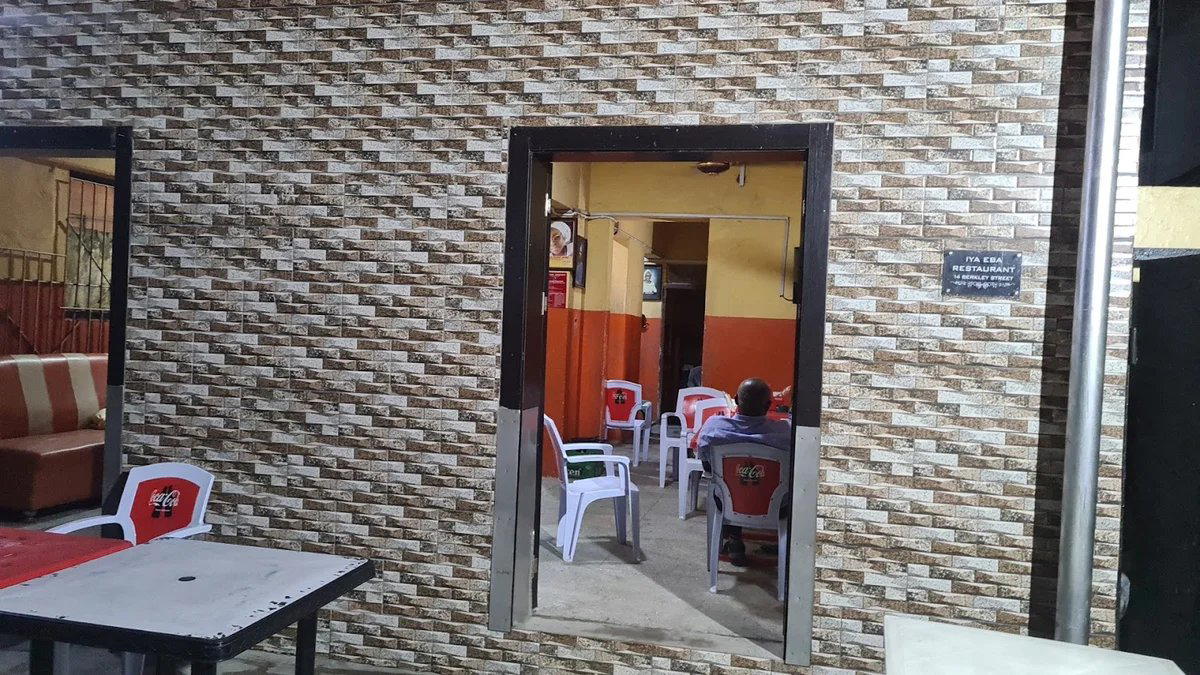
On Lagos Island, Iya-Eba Restaurant & Bar occupies a specific place in the city's conversation about everyday Nigerian food done with care. The name alone signals a menu anchored in eba, the fermented cassava staple that underpins Yoruba domestic cooking, placing this address firmly in the tradition-forward tier of Lagos dining, where sourcing and preparation matter more than spectacle.

Pearl is the En Primeur Club membership app, where members save venues, book tables and use the concierge.
The menu
What to order
- Eba & Egusi
- Amala and Ewedu
- Pounded Yam and Egusi
- Beans & Dodo
Where Lagos Island Eats Without Pretence
Lagos Island has always operated on a different register from the mainland. The density here, commercial, historical, residential, produces a dining culture that is less about trend-chasing and more about the kind of food that has been feeding the city for generations. Berkley Street, where Iya-Eba Restaurant & Bar sits at number 14, runs through a part of Lagos Island that retains this quality: working, purposeful, and grounded in the rhythms of the neighbourhood rather than the expectations of a visiting food editor. The address places the restaurant within easy reach of the island's commercial core, which matters for understanding who eats here and what they expect on the plate.
In a city where the restaurant conversation increasingly gravitates toward the aspirational, a place named for eba, the dense, fermented cassava staple that anchors Yoruba home cooking, is making an implicit argument. It is saying that the food already here, the food that Lagos has always cooked, does not need to be reimagined or repackaged to deserve a dining room. That position is worth examining, particularly as Lagos builds out a more formal restaurant infrastructure and venues like Al Sud and Avenida attract attention for their more contemporary approaches to Nigerian and international cooking.
The Ingredient at the Centre
Eba is not a simple food. The process runs from the cassava root, sourced from farms across southwestern Nigeria, through fermentation, drying, and milling into garri, which is then cooked with boiling water to produce the dense, slightly sour dough that is eaten with soups ranging from egusi to okra to bitterleaf. Each stage of that chain carries decisions: the variety of cassava planted, the fermentation duration, the coarseness of the mill, the ratio of water to garri at the final stage. A restaurant that builds its identity around eba is, in effect, committing to those upstream decisions in a way that a venue focused on hybrid or imported cuisines does not have to.
This is relevant to the broader Lagos food moment. Nigerian cuisine has an ingredient-sourcing story that is rarely told with the same granularity applied to, say, the regional sourcing programs at European fine dining addresses like Dal Pescatore in Runate or Reale in Castel di Sangro. The cassava supply chain in southwestern Nigeria, the palm oil from Edo and Delta states, the smoked crayfish from coastal processors, these are the inputs that define what traditional Yoruba cooking tastes like, and they vary in quality and character in ways that most Lagos restaurant menus do not make legible to the diner. A venue centred on eba puts that conversation on the table, whether or not it makes it explicit.
For context on how tradition-forward dining operates across the Lagos scene, Danfo Bistro approaches a similar brief from a different angle, framing Nigerian staples within a more self-consciously nostalgic format. Further afield, Stella's Place in Ikeja and Mie Mie Taste in Badagry show how this tradition-centred model plays out beyond the island, each shaped by the specific ingredient availability and cooking customs of their districts. For quick street-format eating in the broader Lagos area, Leading Shawarma and Shawarma Heaven in Abeokuta represent the parallel, non-Nigerian track that has grown considerably across the city.
The Bar Format and What It Signals
The restaurant-and-bar format at Iya-Eba places it in a category that Lagos Island does well: the combined eating and drinking address where neither function is purely incidental to the other. This structure reflects how sociable eating actually works in Lagos, meals extend, conversations run long, and the bar is not an afterthought but a continuation of the table. It also gives the venue a flexibility that a purely food-focused address does not have, allowing it to serve the neighbourhood across different hours and occasions without a hard pivot in identity.
The combination is common enough across Nigerian cities, but it carries different implications depending on the price tier and the food philosophy. At the tradition-forward end of the market, the bar component tends toward local spirits and palm wine traditions rather than the imported-wine-and-cocktail programs that define the upper bracket of Lagos Island dining. Where venues like Camilo have leaned into a more international drinking format, the bar at a place named for eba suggests a different set of reference points entirely.
Lagos Island in the Wider Dining Map
Lagos Island dining sits in a different conversation from Victoria Island and Lekki, where much of the city's fine dining investment has concentrated. The island's older, denser character produces venues that tend to serve specific communities rather than casting wide nets for the city's dining-out class. This is not a deficit, it is a different kind of reliability. The trade-off for the diner is that island addresses in this tier rarely have the booking infrastructure, the online presence, or the consistent hours of the Victoria Island bracket. Planning accordingly means visiting in person or through local contacts rather than relying on digital booking systems.
For anyone building a Lagos itinerary that goes beyond the well-documented Victoria Island circuit, our full Lagos restaurants guide maps the city's dining options across neighbourhoods, price tiers, and cuisine types. Globally, the principle of cuisine-specific restaurants holding a neighbourhood's culinary identity applies across many contexts, from Atomix in New York City, which has built a fine dining format around Korean culinary tradition, to HAJIME in Osaka, where Japanese rigour meets French structure. The specific challenge in Lagos is doing that work without the critical infrastructure, the review culture, the awards systems, the trained dining public, that supports those international examples. Venues on Lagos Island are doing it anyway.
Planning Your Visit
Iya-Eba Restaurant & Bar is located at 14 Berkley Street, Lagos Island, placing it in the commercial core of the island and accessible from most Lagos Island addresses without significant travel time. Lagos Island traffic runs predictably difficult during morning and evening peaks, so midday visits tend to move more smoothly. The restaurant-and-bar format suggests a presence across lunch and evening hours, but Lagos Island venues in this tier can operate on schedules that shift with local demand and season rather than fixed published hours. Given the limited advance booking infrastructure typical of tradition-forward Lagos Island addresses, same-day or walk-in visits are the more practical approach for most travellers.
Frequently asked questions
What's the address for Iya-Eba Restaurant & Bar?
Iya-Eba Restaurant & Bar is located at 14 Berkley St, Lagos Island, Lagos 102273, Lagos, Nigeria, Lagos.
Is Iya-Eba Restaurant & Bar a good option for eating and drinking in the same visit on Lagos Island?
The restaurant-and-bar format at 14 Berkley Street places Iya-Eba in a category Lagos Island does well: combined eating and drinking addresses where neither function is treated as an afterthought. On an island where much of Lagos's fine-dining investment has shifted toward Victoria Island and Lekki, Iya-Eba holds a different position, a neighbourhood address focused on Nigerian staples rather than imported dining formats. The bar component makes it a practical stop across both lunch and evening hours.
What dish is Iya-Eba Restaurant & Bar famous for?
The name says it directly: eba is the centrepiece. Made from fermented, dried, and processed cassava, sourced from farms across southwestern Nigeria, eba is a staple of Yoruba and broader Nigerian cooking, and Iya-Eba builds its identity around serving it with the seriousness it deserves on Lagos Island. The pairing of eba with soups such as egusi or okra is the format to expect, not a secondary menu item.
How far ahead should I plan for Iya-Eba Restaurant & Bar?
Iya-Eba sits at 14 Berkley Street in the commercial core of Lagos Island, an area with dense foot traffic from workers, traders, and residents throughout the week. Lunchtime in particular draws quickly from the surrounding offices and markets, so arriving early or off-peak hours is the practical approach. No advance booking data is currently documented for this address, but walk-in timing matters more than calendar lead time.
A Quick Peer Check
Comparable venues nearby, for context on price, style, and recognition.
| Venue | Cuisine | Price | Awards | Notes |
|---|---|---|---|---|
| Iya-Eba Restaurant & BarThis venue (the venue you are viewing) | Traditional Nigerian Yoruba | Not listed | Not listed | Not listed |
| Danfo Bistro | Nigerian Fusion Bistro | $20–30 | Not listed | Ikoyi |
| The Place | Nigerian | $1–10 | Not listed | Ikeja GRA |
| Z Kitchen | Modern Lebanese-Inspired Fusion | $20–30 | Not listed | Victoria Island |
| Ilé Eros | Modern Nigerian / West African dining | $30–50 | Conde Nast Hot List Restaurants | Lekki Phase 1 |
| Best Shawarma | Shawarma | $10–20 | Not listed | Surulere |

Continue exploring
More in Lagos
Restaurants in Lagos
All restaurants in Lagos →
Bars in Lagos
All bars in Lagos →
Details
- Lively
- Cozy
- Casual Hangout
- Family
- Open Kitchen
- Craft Cocktails
- Street Scene
- A La Carte
Current opening hours
- Monday
- 9 AM–10 PM
- Tuesday
- 9 AM–10 PM
- Wednesday
- 9 AM–10 PM
- Thursday
- 9 AM–10 PM
- Friday
- 9 AM–10:30 PM
- Saturday
- 9 AM–10 PM
- Sunday
- Closed
Hours can change for holidays and private events. Hours as of .
Casual and commendable ambiance with an open air kitchen.