Hamburger America



George Motz spent years documenting American burger culture before distilling it into a single address on West Houston Street. Hamburger America, recognized by Opinionated About Dining's 2025 Cheap Eats list, centers on the fried onion burger, an Oklahoma staple built around a crisp-edged patty, caramelized onions, and American cheese on a squishy bun. The retro SoHo room, all vinyl tiles and yellow stools, is the physical argument for why regionalism matters in American food.
Pearl is the En Primeur Club membership app — saves, bookings, and concierge access live there. Same editors, same standards.
- Address
- 155 W Houston St, New York, NY 10012
- Website
- hamburgeramerica.com
- Directions
- Get directions
 Saves & bookings on Pearl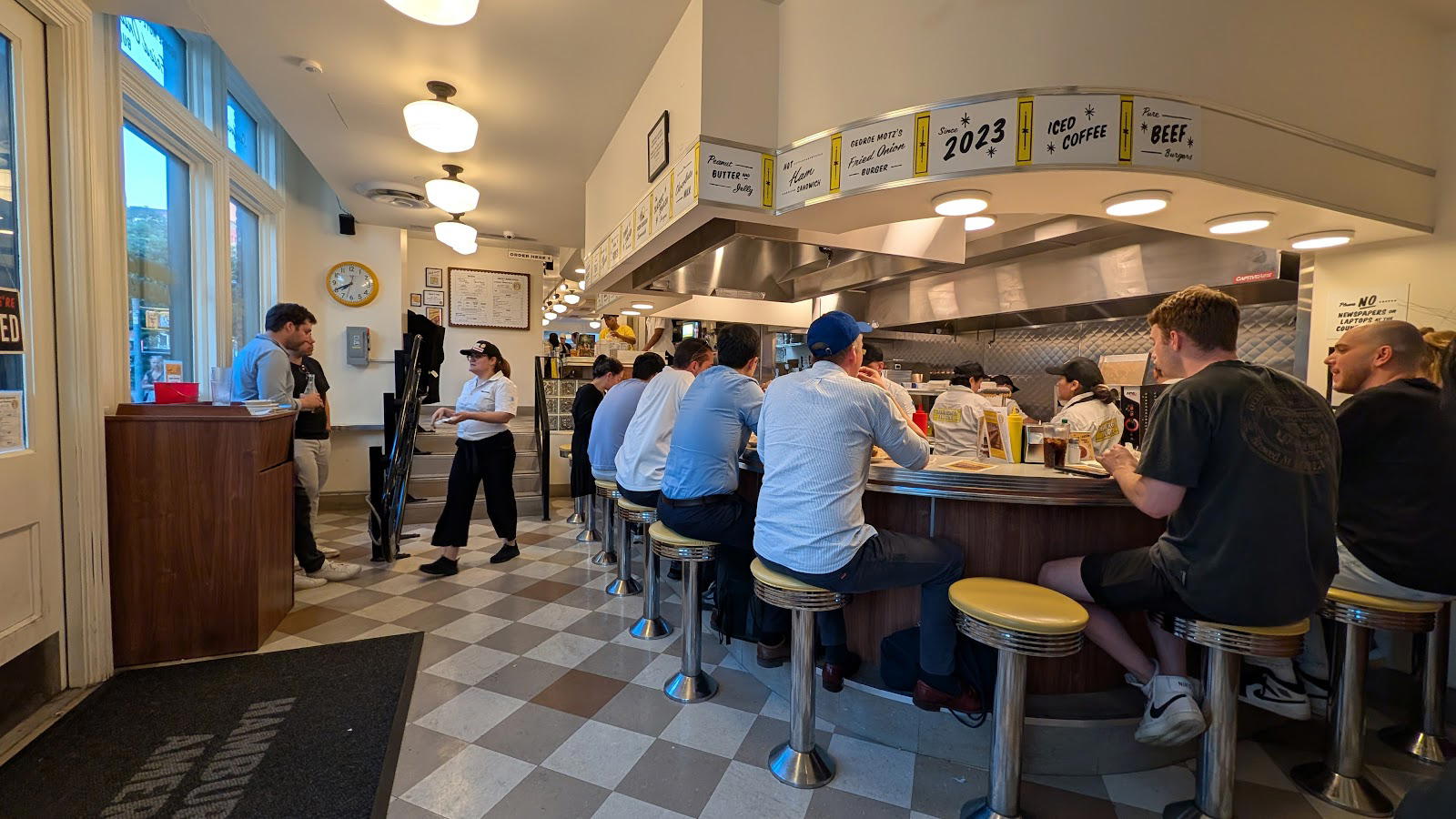
From Student to Specialist: How Burger Scholarship Became a Restaurant
Hamburger America is a New York City restaurant serving classic American smash burgers at 155 W Houston St, New York, NY 10012, with a casual, walk-in-friendly setup and an average price of about $20 per person. There is a particular kind of authority that comes not from culinary school or Michelin kitchens but from fieldwork. George Motz spent years traveling the United States cataloguing regional burger traditions, producing documentary films and books that treated the American hamburger with the same seriousness that wine critics apply to Burgundy vintages. When Hamburger America opened at 155 West Houston Street in SoHo, it was the physical conclusion of that research: a restaurant built on the premise that the burger deserves a practitioner who has studied it systematically, not just cooked it intuitively. That trajectory places Hamburger America in a different competitive conversation than the city's other well-regarded burger spots. Where burger joint trades on decades of compressed, no-frills atmosphere and Shake Shack built a scalable fast-casual format, the restaurant is the product of a specific intellectual project applied to a single address.
The Room as Argument
Regional American burger culture has a visual language, and the dining room at the restaurant speaks it fluently. Vinyl tiles underfoot, yellow stools at the counter, and black-and-white photographs of famous American burger shops lining the walls: the aesthetic reads less as nostalgia performance and more as a curator's archive made physical. In a SoHo dining scene otherwise dominated by format experimentation and open-kitchen theater, the deliberate retro stillness of this room makes a point. It signals that the authority here is historical and documentary, not contemporary and trend-chasing. New York's burger tier has fragmented considerably over the past decade, splitting between fast-casual scale, chef-driven premium formats, and the handful of places that have built identity around a specific regional or historical argument. This room belongs firmly to the third category.
The Fried Onion Burger: An Oklahoma Staple in a Manhattan Context
The fried onion burger is a Depression-era invention from El Reno, Oklahoma, where beef was stretched by pressing raw onions directly into the patty before it hit the griddle. The onions caramelize against the flat-leading, the meat crisps at the edges, and the result is a burger that delivers sweetness, salt, and depth in ratios that the more common smash burger or pub-style thick patty formats rarely achieve. At the restaurant, the signature version includes a squishy bun, a crisp-edged patty with what Opinionated About Dining describes as a beefy depth, a wilting slice of American cheese, and a combination of raw, caramelized, and frizzled onions. That layering of onion textures within a single sandwich is the technical detail that separates this preparation from a casual approximation of the style.
That Motz chose to anchor the menu around this specific regional tradition rather than a more generically crowd-pleasing format tells you something about the approach. The fried onion burger is not the burger that dominates New York menus; it is not the smash burger that 7th Street Burger built its following on, nor the thick-cut format that defines 5 Napkin Burger. It is a regional artifact rendered accurately by someone who went to Oklahoma to understand it before cooking it in Manhattan.
Where Hamburger America Sits in the City's Burger Conversation
New York's burger scene in 2025 covers a wide price and format range, from counter-service spots with sub-fifteen-dollar patties to chef-driven addresses that price against steakhouses. The restaurant occupies a specific position within the accessible, counter-service tier, distinguished not by price or format novelty but by the documentary credibility behind the menu. The Opinionated About Dining 2025 Cheap Eats recognition in North America is a meaningful signal here: OAD's cheap eats designations are drawn from a community of serious eaters and critics, not promotional submissions, which makes them a reasonable proxy for peer validation among the food-serious crowd.
For context on what burger-focused seriousness looks like elsewhere in the United States, Amboy Quality Meats and Delicious Burgers in Los Angeles represents a West Coast counterpart with its own regional-influence argument. In Tokyo, Aldebaran shows what happens when American burger formats are adopted and refined outside their origin context. The restaurant is the source-side of that conversation: the place in the city where the American regional tradition is presented by someone who documented it before cooking it.
The comparison to New York's formal dining tier is instructive for a different reason. Restaurants like Alinea in Chicago or The French Laundry in Napa represent the American fine dining tradition that attracts international attention, while addresses like Lazy Bear in San Francisco and Single Thread Farm in Healdsburg work within a more intimate, terroir-conscious register. The restaurant is not in that conversation in terms of format or price, but it is engaged in the same underlying question: what does it mean to treat an American food tradition with genuine rigor? Motz arrives at an answer through scholarship and regional specificity rather than through tasting-menu structure or fine dining technique.
Planning a Visit to West Houston Street
The restaurant sits at 155 West Houston Street in SoHo, a neighborhood that otherwise skews toward higher price points in its dining options, which makes the restaurant's accessible format and direct counter-service model something of an anomaly for the area. West Houston runs east-west between SoHo and the West Village, with subway access nearby on multiple lines. Open Monday through Thursday from 11 AM to 10 PM, Friday and Saturday from 11 AM to 11 PM, and Sunday from 11 AM to 10 PM. For those who track American restaurant culture across cities, Emeril's in New Orleans and Providence in Los Angeles represent how regional American culinary identity plays out at the fine dining level, while DuMont Burger offers another Brooklyn-rooted entry point into the New York burger conversation.
Reputation First
Comparable venues nearby, for context on price, style, and recognition.
| Venue | Cuisine | Price | Notes |
|---|---|---|---|
| Hamburger AmericaThis venue — the venue you are viewing | Classic American Smash Burgers | $$ | Not listed |
| Fuku | Spicy Fried Chicken Sandwiches | $$ | West Village |
| Momofuku Milk Bar | Modern American Dessert Bakery | $$ | Midtown South-Flatiron-Union Square |
| Ess-a-Bagel | Classic New York Bagels & Deli | $$ | Stuyvesant Town-Peter Cooper Village |
| Golden Diner | Asian-American Diner | $$ | Chinatown-Two Bridges |
| Blue Ribbon Fried Chicken | Fried Chicken | $ | East Village |
Recognition history
Dated appearances from independent guides and award organizations, with the underlying list record or original source where available.
Eater 38 #18
Eater
World Best Burgers World's 101 Best Burgers #88
World Best Burgers
New York Times Best Restaurants in New York City
New York Times
Opinionated About Dining Cheap Eats in North America
Opinionated About Dining
Continue exploring
More in New York City
Restaurants in New York City
Browse all →
Bars in New York City
Browse all →
Hotels in New York City
Browse all →





At a Glance
- Classic
- Cozy
- Well Known
- Casual Hangout
- Solo
- Open Kitchen
Current opening hours
- Monday
- 11 AM–10 PM
- Tuesday
- 11 AM–10 PM
- Wednesday
- 11 AM–10 PM
- Thursday
- 11 AM–10 PM
- Friday
- 11 AM–11 PM
- Saturday
- 11 AM–11 PM
- Sunday
- 11 AM–10 PM
Hours can change for holidays and private events. Last verified .
Retro 1950s diner atmosphere with open kitchen counter seating, well-lit spacious interior, booths, and sidewalk tables.