
Gyoza Tateyama Umeda ten belongs to Osaka’s compact, counter-led dumpling culture rather than the city’s formal dining circuit. Its selection for Tabelog 100 - Dumplings - 2024 gives it a sharper critical signal than its modest format suggests, placing it among Japan’s more closely watched gyoza specialists.
Pearl is the En Primeur Club membership app — saves, bookings, and concierge access live there. Same editors, same standards.
- Address
- 1 Chome-4-19 Oyodominami, Kita Ward, Osaka, 531-0075, Japan
- Phone
- +81 6-6346-5889
- Website
- gyozatateyama.jp
 Saves & bookings on Pearl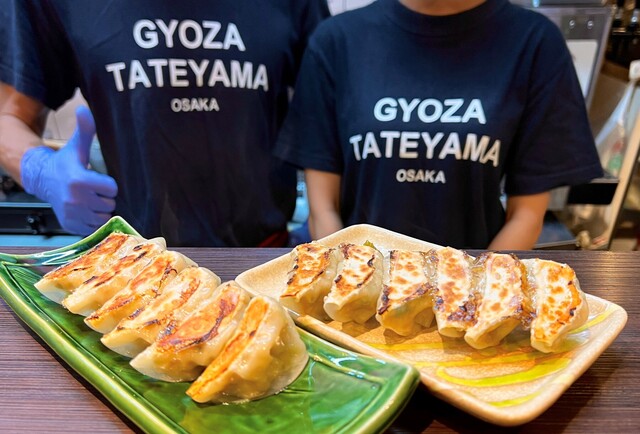
Umeda changes character quickly once the station crowds thin: department-store polish gives way to smaller counters, narrow shopfronts, and the kind of evening eating that Osaka has always understood better than almost anywhere in Japan. Gyoza Tateyama Umeda ten fits that register. The room is built around counter eating, not ceremony, and the appeal is the concentration of a specialist format: dumplings, sake, short dwell time, and a price tier that keeps the experience closer to Osaka’s everyday appetite than to its destination dining economy.
That distinction matters in a city where reputation is often split between two forces. On one side are kappo counters and tasting-menu rooms such as Naniwakappo NOBORU or Kokyu, where price, pacing, and chef-led structure shape the evening. On the other are single-purpose specialists: okonomiyaki, kushikatsu, takoyaki, udon, gyoza. Osaka’s serious food culture is not confined to luxury. It often rewards repetition, speed, and narrow mastery, which is why a small dumpling counter can carry more local relevance than a far more expensive room.
A dumpling counter with a national recognition signal
Tabelog’s Hyakumeiten lists are useful in Japan because they separate genre specialists from general restaurant acclaim. Selection for Tabelog 100 - Dumplings - 2024 puts this address inside a category where the competition is not French technique, omakase theatre, or hotel dining, but the small technical decisions that define gyoza: wrapper, filling, heat control, browning, and how well the plate works with a drink in hand. The listed Tabelog score of 3.65 reinforces the point without overstating it. This is a reputation built within a specific Japanese rating culture, not a Michelin-style luxury signal.
The former-pastry-chef note attached to the shop is relevant only insofar as it suggests a craft angle around dough and handwork. In Osaka, that matters. Gyoza is often treated casually by visitors, ordered between beers and train transfers, but the better specialists operate by millimetres: the thickness of the skin, the moisture in the filling, the timing between pan and counter. The city’s strongest casual restaurants often hide technical discipline beneath an unshowy surface. That is the editorial reason to pay attention here.
There is also a drinking-house logic to the format. The listing places the restaurant in both dumpling and stand-up-bar territory, with sake specifically noted. That pairing is more telling than a long menu description would be. Osaka’s compact counters are built for momentum: a focused order, a pour, a second plate if the room allows it, then onward. This is not a long, leisurely progression in the manner of a formal kaiseki-adjacent dinner. It belongs to the same urban rhythm that makes nearby station districts useful to serious eaters: density, informality, and quick access to narrowly defined specialities.
Where it sits in Osaka's eating hierarchy
Osaka’s international reputation still leans heavily on flour-based comfort food, but that shorthand misses the city’s hierarchy of specialists. A place like Okonomiyaki Kiji represents the griddle tradition; 551 Horai (551蓬莱) represents the mass-market pork-bun institution; gyoza specialists occupy a different lane, closer to the small counter than the civic souvenir. Gyoza Tateyama Umeda ten sits in that latter category, where the decision is less about grand occasion and more about whether the reader wants a precise, local-format meal with credible external recognition.
The comparison with higher-priced Osaka dining is useful because it prevents a common mistake: judging casual Japanese restaurants by the wrong scale. Kokyu and Naniwakappo NOBORU ask for a different kind of evening, one shaped by sequence, pacing, and a broader culinary vocabulary. A dumpling counter asks a narrower question and answers it directly. The Tabelog dumpling recognition is therefore not a decorative badge; it identifies the venue within its correct competitive field. For travellers who build meals around categories rather than prestige alone, that is the signal.
It also helps explain why Umeda remains valuable for food-focused itineraries. The district can feel commercial at first glance, but its station gravity supports small, high-turnover formats that would struggle in quieter neighbourhoods. A visitor can move between bakery, coffee, casual Japanese, and late-evening drinking without treating dinner as a single fixed event.
How to read the room before committing
The decision point is simple. Choose this kind of counter when the night calls for focus rather than range. The format is better suited to friends, solo diners comfortable with counter seating, and travellers who understand that a specialist shop may deliver its value in a short, tightly edited sitting. It is less suited to anyone looking for private-room comfort, a broad menu, or a long celebratory dinner. Osaka has plenty of those; this is the other side of the city’s food intelligence.
For readers mapping a longer Japan or trans-Pacific food itinerary, the useful comparison is not only within Osaka. Casual specificity appears in many forms: coffee at.cafe, baking at 52CHO-ME BAKERY, a civic snack institution at 551 Horai (551蓬莱), Neapolitan ambition at 99 Pizza Napoletana Gourmet, and Italian dining at a canto (Italian). Beyond the city, the same category-first thinking applies to -Grilled beef Sukiyaki- KAMAKURA TANUKIAN 鎌倉 たぬき庵 in Kamakura. 鮪と炭火焼き うお炭 秋葉原店 in Tokyo.know in Kumamoto, (Shoku) Vietnam in Kawasaki, [Curry Senmon Ten] Maruyama Kyoju. in Sapporo, [ki:] in Kyoto, Jōdo Saké Bar in Los Angeles, and Onigiri Time in Pasadena.
The editorial value of Gyoza Tateyama Umeda ten is not that it turns gyoza into luxury. It is that Osaka’s casual food culture has enough depth for a small dumpling counter to earn category recognition and still feel grounded in the city’s nightly eating habits. That combination, specialist credibility without inflated theatre, is exactly where Osaka is strongest.
Cuisine and Awards Snapshot
Comparable venues for cuisine and category context.
| Venue | Cuisine | Price | Notes |
|---|---|---|---|
| Gyoza Tateyama Umeda tenThis venue — the venue you are viewing | Gyoza and Japanese Dumpling Bar | $ | Not listed |
| Udonya Kisuke | Osaka-style udon and tempura | $ | Kita |
| Yotsubashi Cafe | Japanese yoshoku-style cafe specializing in hamburg steak | $ | Nishi |
| Spice Curry Te | Japanese Curry | $ | Chūō |
| Cafe Basara Kaeru dou | Japanese Cafe-Curry | $ | Nishi |
| Angetsu | Traditional Japanese Wagashi (Confectionery) | $ | Chūō |
Recognition history
Dated appearances from independent guides and award organizations, with the underlying list record or original source where available.
Tabelog 100 #60 · No. 60
Tabelog · Tabelog 100 - Dumplings - 2024
Continue exploring
More in Osaka
Restaurants in Osaka
Browse all →




Bars in Osaka
Browse all →




Hotels in Osaka
Browse all →



Wineries in Osaka
Browse all →
At a Glance
- Lively
- Cozy
- Casual Hangout
- After Work
- Group Dining
- Solo
- Late Night
- Standalone
- Beer Program
Current opening hours
- Monday
- 6–11 PM
- Tuesday
- 6–11 PM
- Wednesday
- 6–11 PM
- Thursday
- 6–11 PM
- Friday
- 6–11 PM
- Saturday
- 5–11 PM
- Sunday
- 5–11 PM
Hours can change for holidays and private events. Last verified .
A compact, no-frills gyoza shop and stand bar with simple decor and an essential, local feel, focused on quick plates, drinks, and an energetic, casual atmosphere rather than design flourishes.